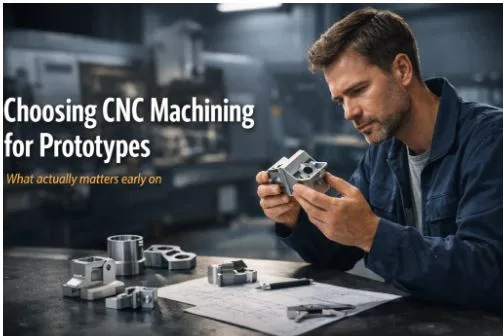
How to Choose CNC Machining Services for Prototype Projects
Prototype projects rarely follow the original plan. Designs shift, assumptions get tested, and timelines often tighten earlier than expected. At this stage, manufacturing decisions tend to matter more than teams initially realize.
CNC machining is commonly used for prototypes because it allows teams to test real materials and realistic geometries. In practice, however, many delays and cost issues are not caused by machining itself. They usually come from working with a CNC supplier that isn’t set up for prototype work.
This article focuses on how teams can evaluate CNC machining services specifically for prototype projects. Rather than listing generic capabilities, it looks at practical decisions that often determine whether a prototype moves forward smoothly—or slowly gets stuck in rework and revision.
Prototype CNC Projects Fail for Different Reasons Than Production Ones
Prototype machining breaks down in different ways than production machining. Treating the two as interchangeable is a common early mistake.
In production, stability is the goal. Designs are fixed, processes are defined, and repeatability matters more than flexibility. Prototype projects operate under very different conditions. Drawings may still be evolving, requirements can change after early testing, and feedback from physical parts often leads to design revisions.
Problems tend to appear when a CNC shop applies a production mindset to prototype work. Long approval steps, rigid quoting rules, or limited engineering feedback may be manageable in repeat production. In prototype projects, those same behaviors often slow everything down. Delays are rarely about cutting time. They usually come from friction in communication and decision-making.
What Actually Matters When Choosing CNC Machining Services for Prototypes
Once teams accept that prototype machining requires a different approach, the question becomes more specific: what should they actually look for when choosing a CNC partner at this stage?
One early warning sign is a shop that treats prototype work exactly like production. If every quote assumes fixed drawings, locked tolerances, and no design changes, that rigidity often becomes expensive once the first physical part reveals issues.
In contrast, CNC machining services that are aligned with prototype workflows tend to operate very differently. They expect iteration, raise concerns early, and understand that the first version of a part is rarely the final one.
A pattern that shows up in many projects is how a supplier responds to uncertainty. If a shop insists on locking every tolerance, process, and price before any parts are made—especially while the design is still evolving—it usually signals a production-first mindset. In prototype work, that rigidity often leads to change fees, delays, or resistance once revisions are needed.
By contrast, teams that ask clarifying questions early, or suggest leaving certain dimensions flexible until after initial testing, are often better aligned with how prototype projects actually unfold.
That said, not every prototype project needs the same level of flexibility. The right approach often depends on what the current iteration is meant to test.
Feedback quality tends to matter more than raw accuracy at this stage. When a machinist points out an unnecessary tight tolerance, a difficult internal corner, or a feature that may cause repeatability issues, it can prevent multiple rounds of rework. Shops that simply machine what’s on the drawing, without context, often deliver parts that technically meet specifications but don’t support meaningful testing.
Quoting behavior also reveals a lot. In prototype projects, changing quotes are not always a bad sign. Adjustments often reflect learning—design details become clearer, setups change, and unnecessary constraints are removed. The real risk usually comes from quotes that look low upfront but fail to account for iteration later.
Consistency also matters more than extremes. While CNC machining can achieve very tight tolerances, most prototype testing does not require the tightest numbers possible. What teams usually need is consistent results from one iteration to the next.
Common CNC Machining Solutions—and Why More Isn’t Always Better
Prototype projects rarely rely on a single machining approach. Different parts often exist to validate different assumptions, and problems arise when the machining method doesn’t match what a part is meant to test.
CNC milled prototype parts are the most common example. Structural components, housings, brackets, and interfaces are often milled to evaluate fit, assembly, and mechanical behavior. These parts are usually meant to show how a design performs in real materials, not just how it looks.
CNC turned parts tend to serve a more focused role. Shafts, cylindrical components, threaded features, and rotational elements often require dimensional consistency even at the prototype stage. Small variations here can quickly undermine functional testing.
Multi-axis CNC machining is where misuse often appears. Additional axes are valuable for complex geometries or multi-face features, but they are not always necessary early on. Introducing complex machining too soon can increase cost while making it harder to identify which design changes actually improved performance.
When too many machining options are evaluated at once, teams often end up testing everything and learning very little. In those situations, it can be more effective to contact Xinprototype early to align on which machining approaches actually support the current prototype goals, rather than defaulting to the most complex solution available.
Material Choices: How Teams Accidentally Test the Wrong Thing
Material selection has a direct impact on what a prototype actually proves. A part may look correct and assemble properly, yet behave very differently once loads, heat, or repeated motion are involved.
Early in development, teams often choose materials that are easy to machine or relatively inexpensive. That approach can work for visual models or basic fit checks. Once functional testing begins, however, substitute materials can hide problems instead of revealing them. A bracket that performs well in a soft plastic may show no issues during early testing, only to fail once the same geometry is machined in aluminum.
This is why many teams move to production-intent materials earlier than expected. Aluminum alloys are commonly used to assess structural behavior and assembly fit. Stainless steel helps expose stiffness or corrosion-related concerns. Engineering plastics are chosen when flexibility, impact resistance, or weight reduction are part of the design goal.
Material choice also affects machining behavior itself. Different materials respond differently to cutting forces, surface finishing, and tolerance control. A design that machines cleanly in one material may need adjustment in another. When these differences are understood early, they become part of the learning process rather than unexpected setbacks.
Setting the Right Expectations: Lead Time, Tolerance, and Quantity
Prototype CNC planning often revolves around a few assumptions that deserve closer examination. Lead time expectations are frequently optimistic, especially when design changes are expected. Speed depends not only on machining time, but also on how quickly questions are resolved and revisions are incorporated.
Tolerance expectations can drift as well. While CNC machining is capable of extremely tight tolerances, pursuing them unnecessarily in early prototypes often adds cost without improving test results. In many cases, consistency across iterations matters far more.
Quantity assumptions also play a role. Many prototype projects begin with a single part or a very small batch. Being able to machine low quantities without high minimums allows teams to iterate based on physical feedback rather than theory.
Final Thoughts
Choosing CNC machining services for prototype projects is less about finding the lowest quote or the most advanced equipment, and more about understanding how a partner supports decisions under uncertainty.
Prototype work is iterative by nature. When CNC machining is treated as a collaborative process rather than a one-time transaction, teams are more likely to stay aligned with their goals, timelines, and budgets.