How to Create Your Own Custom Hoodies: A Step-by-Step Guide
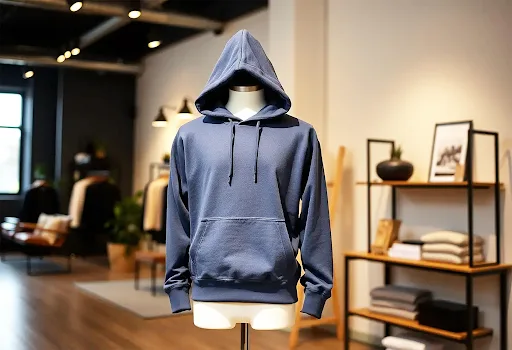
Hoodies are one of the best canvases in apparel. Big print area, year-round demand and enough margin to test an idea without a serious upfront spend.
There are two ways to make them, and most guides only tell you about one. You can press them yourself with a heat press and transfers, or you can design once and have a fulfillment partner print each order as it comes in.
This guide covers both, what each actually costs, and how to decide before you spend anything.
Step 1: Pick your route before you pick your hoodie
The choice determines everything downstream, so make it first.
Pressing them yourself means buying a heat press, blanks and transfers, then doing the work. Your per-unit cost drops as volume climbs, and you control quality directly. You are also buying inventory upfront, storing it, and spending your own hours on every order.
Print on demand flips that. There is no equipment, no stock and no minimum, but you pay more per garment because someone else is printing, packing and shipping it. Printify lists the Gildan 18500 at $21.58, or $15.89 on its Premium tier, which is a saving of about 26 percent on that garment.
The honest rule: if you are making a dozen hoodies for a team or a family event, pressing them yourself usually wins on cost. If you are testing designs to sell, or shipping to strangers, print on demand wins on risk.
Step 2: Choose your fulfillment partner
If you took the fulfillment route, this decision comes before the garment, because your partner determines which blanks you can even print on. Four things separate them.
Network or factory. Some own their facilities, which keeps finish consistent, while others run open networks where you compare providers per product.
Custom hoodie printing is easier when you are not locked to a single factory. Printify takes the network approach to print on demand, and its custom hoodies catalog lists the Gildan 18500 across 18 different providers, so you can print close to your buyer or chase the lowest cost. Building a personalized hoodies line on print on demand means fulfillment moves with your customers rather than sitting in one location.
Scale and reliability. Printify reports 60M+ orders across 140+ facilities in 209 countries, with 10M+ sellers on the platform. Misprints and damage are reprinted or refunded on a photo, with tracking included and support running 24/7.
Branding. Turning a blank into a branded hoodie is what separates a shop with repeat buyers from one competing on price. Printify sells custom neck labels from $0.55 and packaging inserts from $0.15, while Printful builds branding into its owned-facility model at a higher base cost. Both routes work, and the right one depends on whether consistency or flexibility matters more to you.
Minimums and bulk terms. No minimum means you can produce one hoodie to test a design. Printify also unlocks bulk savings at 20 or more of the same item, which matters if a team order comes in.
Step 3: Choose a blank worth printing on
Skip the advice about buying blanks at a mall. Retail pricing destroys your margin before you have printed anything, and you cannot reorder the same garment reliably.
Fabric weight matters more than brand. A midweight 50/50 cotton-poly blend like the Gildan 18500 sits at 8 ounces per square yard, takes print well and stays affordable. Heavier fleece feels premium but costs more and can be harder to print cleanly.
If you are going the fulfillment route, Printify flags the Gildan 18500 as the pick for a high-margin side hustle and the Lane Seven Premium Pullover where a heavier, more premium hand matters. The Gildan comes in 39 colors across 8 sizes, which is more range than most single suppliers carry.
Step 4: Match the print method to your artwork
This is where most first attempts go wrong. The method has to suit both your design and your fabric.
DTG prints ink directly into the garment and handles detailed artwork and gradients on cotton blends. DTF transfers your design from a film and holds up on cotton, polyester, fleece and mixed fabrics, which makes it the most forgiving option.
All-over-print sublimation turns the design into part of the fabric across the whole garment, seams included, but only works on polyester. Embroidery stitches the design in thread for a finish that reads as a real label rather than a print, which is why it suits logos and team wear.
If you are pressing at home, DTF is the practical choice. Most transfers press somewhere around 280 to 300°F for roughly 10 to 15 seconds, though settings vary by supplier and fabric, so follow the sheet that comes with yours rather than a number from a blog.
Step 5: Create the design
Keep it simple and high contrast. Complex artwork loses detail at print size, and thin lines are the most common reason a design looks sharp on screen and muddy on fabric.
Design at high resolution and size it to the specific print area, since every vendor and garment has different dimensions. Check placement on the chest, back or sleeve before you commit, and preview it on the actual garment color rather than a white mockup.
Most fulfillment platforms include design tools. Printify’s free Product Creator handles uploads, text, drag-and-drop placement and high-resolution mockups, with an AI image generator and Shutterstock library if you are starting from nothing.
Step 6: Order a sample and wash it
Order one of every color and print method you plan to use. This is the step people skip, and it is the one that prevents refunds.
Wash it three or four times before you decide. Cracking, fading and peeling show up after washing, not after printing, and a customer will find them before you do if you have not looked.
Check the fit against the size chart too. Sizing varies between brands by more than most people expect, and a listing that promises the wrong fit generates returns regardless of print quality.
Step 7: Set up to sell, if that is the plan
Pick one channel and get good at it before adding another. Etsy and Shopify are the usual first choices because both handle small catalogs and connect directly to fulfillment platforms.
Printify integrates with Etsy, Shopify, eBay, WooCommerce, Wix, Amazon, TikTok Shop and Squarespace, and orders route automatically once connected. Because there is no minimum, you can list a design and see whether anyone wants it before producing a single unit.
Your listing photos will sell harder than your copy. Mockups are enough to launch, but editing product photos into real lifestyle scenes converts better once you have samples in hand.
Sort out business registration, sales tax and your returns policy before the first order lands. Retrofitting those around live sales is considerably more painful than setting them up cold.
Step 8: Price it properly
Price with a formula, not a guess. Retail price minus blank cost minus shipping minus platform and payment fees minus advertising equals what you actually keep.
Run it on the garment you actually chose rather than a sample figure. A Gildan 18500 at $15.89 on Premium, listed at $40, leaves $24.11 before shipping, platform fees and advertising come out.
Those three lines routinely take a quarter of the gross. Build them in before you set the price, not after.
Remember shipping and tax sit outside the base price unless a vendor states otherwise. Run a break-even calculation on current numbers before you set prices, then revisit it when costs move.
Step 9: Launch, then improve
Open with 10 to 12 designs around one theme rather than a scattered catalog. A tight collection is easier to photograph, easier to market and easier to read as a brand.
After launch, track refund reasons, print defects, delivery times and which designs convert. Print on demand carries no minimums, so retiring a weak style or testing a new one costs you nothing but the listing time.
Frequently asked questions
How do I create my own custom hoodies?
Choose a blank, pick a print method such as DTG, DTF, sublimation or embroidery, then create your design. You can press it yourself with a heat press or use a fulfillment partner that prints and ships each order as it sells.
Is DTF or DTG better for hoodies?
It depends on fabric and design. DTG suits detailed artwork on cotton blends, while DTF gives full-color prints on cotton, polyester, fleece and mixed fabrics. Order samples of both before committing to one.
Do I need to buy inventory to make custom hoodies?
No. With no-minimum fulfillment you create designs first and produce each hoodie only after it sells. Printify has no minimum order, so a single hoodie to test a design is a valid order.
How much does it cost to start?
Pressing at home means buying a heat press, blanks and transfers upfront. Fulfillment removes that entirely, though per-unit costs are higher, with hoodie blanks commonly running $16 to $22 before your margin. Budget for samples either way.
Can I sell the hoodies I create?
Yes. Connect a fulfillment platform to Etsy, Shopify or another storefront, and each order prints and ships automatically while you handle design and marketing.