How to Estimate Cost Per Unit Before Setting a Product Price
A product’s listed purchase price does not always reflect what the order will actually cost a business. Shipping, supplier discounts, one-time setup charges, taxes, and order quantity can all change the amount ultimately invested in each unit.
Calculating an estimated cost per unit before setting a selling price gives a business a clearer starting point. It does not determine the final price on its own, but it helps separate the cost of acquiring or producing the product from the broader expenses involved in selling it.
A Simple Cost-Per-Unit Example
Consider a retailer ordering 250 units of a product at $8.40 each.
The initial goods cost is:
250 × $8.40 = $2,100
Now assume the order also includes:
- a 10% supplier discount on the goods
- a $180 one-time setup charge
- $160 in shipping
- a 6% tax that, for this example, applies to the discounted goods amount
The calculation would look like this:
Goods cost: $2,100
10% discount: −$210
Discounted goods: $1,890
6% assumed tax: +$113.40
One-time setup cost: +$180
Shipping: +$160
Estimated order cost: $2,343.40
Divide the estimated order cost by 250 units:
$2,343.40 ÷ 250 = $9.3736
Rounded to cents, the estimated cost is approximately:
$9.37 per unit
The supplier price was $8.40 per unit, but the order-level estimate is about $9.37 per unit once the stated discount, tax, setup cost, and shipping are included.
That difference is significant when a business is evaluating margins or comparing purchasing options.
This example assumes tax applies to the discounted goods amount. Actual tax treatment can vary by transaction, product, and jurisdiction.
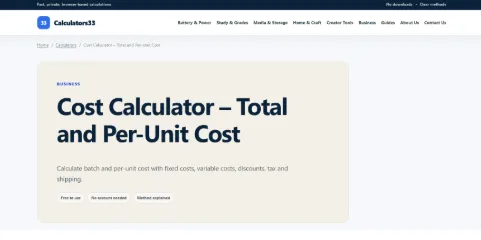
For businesses that want to organize these inputs without building the calculation manually, the Calculators33 Cost Calculator can estimate total order cost and cost per unit using quantity, per-unit cost, discount, tax, a one-time cost, and shipping.
Separate Per-Unit Costs From One-Time Order Costs
Not every expense behaves in the same way.
The U.S. Small Business Administration uses the distinction between fixed and variable costs when explaining business cost and break-even analysis. Variable costs generally change as sales or production volume changes, while fixed costs generally remain more stable over the relevant period.
For an individual order, it is also useful to separate expenses that apply to every unit from expenses entered only once.
Per-unit costs
These may include:
- purchased inventory
- raw materials
- per-item packaging
- manufacturing components
- other costs that rise with the number of units
In the example above, the $8.40 supplier price is the per-unit cost before other adjustments.
One-time order costs
These may include:
- setup charges
- tooling for a particular production run
- preparation fees
- one-time design or production charges
Shipping can be tracked separately when it is charged once for the order.
Keeping these categories distinct makes the calculation easier to review and reduces the chance of counting an expense twice.
Why a Lower Unit Cost Is Not Always the Better Deal
Suppliers often encourage larger orders by offering lower unit prices or bigger discounts.
That can reduce the calculated cost per unit, especially when a one-time expense is spread across more products. But a lower unit cost does not automatically make the larger order the better business decision.
Suppose the retailer in the example could receive an additional discount by increasing the order from 250 units to 750.
Before ordering the larger quantity, the business would still need to consider:
- whether the additional inventory can realistically be sold
- whether storage creates additional costs
- how much cash the larger order ties up
- whether the lower unit cost justifies the additional inventory risk
A business can save money on each unit while still making an inefficient purchasing decision overall.
Cost per unit is therefore one input in the decision rather than the decision itself.
Cost Per Unit Is Not the Same as Selling Price
Another important distinction is the difference between product cost and selling price.
In the worked example, approximately $9.37 is the estimated cost per unit under the assumptions used in the calculation.
That does not mean $9.37, $10, or any other nearby figure is automatically an appropriate selling price.
A selling price may also need to account for expenses such as:
- general business overhead
- payment-processing or marketplace fees
- customer-acquisition costs
- returns or damaged inventory
- the business’s target margin and market conditions
If the retailer sells the example product for $10, the difference between the selling price and the estimated $9.37 unit cost is only about $0.63.
That difference does not establish profitability because other business expenses may still need to be paid.
Cost-per-unit analysis estimates what the order costs under the stated assumptions. Pricing must also consider the wider economics of selling the product.
Use the Same Assumptions When Comparing Options
Cost estimates are especially useful when comparing suppliers, order quantities, or production plans, but only when each option is calculated consistently.
For example, comparing one supplier’s price including shipping with another supplier’s price excluding shipping would distort the result.
The same problem can occur when discounts, taxes, setup charges, or quantities are treated differently.
When comparing alternatives, use the same:
- quantity and type of product
- currency
- discount basis
- tax assumptions where applicable
- shipping treatment
- treatment of one-time expenses
A calculation can be mathematically correct while still being a poor comparison if the underlying inputs are inconsistent.
Businesses should also avoid assuming that the cheapest supplier price will produce the lowest final cost. A slightly higher product price can sometimes be offset by lower shipping, fewer setup charges, or more favorable order terms.
A Final Cost Check Before You Set the Price
Cost-per-unit calculations are most useful as planning estimates. Actual business costs can also be affected by returns, financing expenses, exchange-rate changes, unexpected charges, and transaction-specific tax treatment.
Before using an estimated unit cost for a pricing or purchasing decision, check:
- What is the base goods cost?
- Which expenses increase with quantity?
- Which charges apply only once?
- What amount does the supplier discount actually cover?
- Which taxes or duties apply to the transaction?
- Has shipping been included?
- What is the resulting estimated cost per unit?
- Which operating expenses remain outside the calculation?
Once those inputs are clear, a business has a stronger basis for comparing suppliers, evaluating order sizes, and setting a workable product price.