How to Improve Business Credit: GrowBizLab Practical Plan to Raise Your Score and Unlock Funding
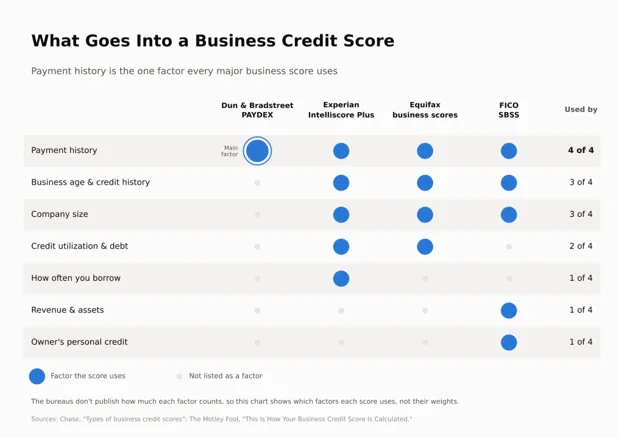
It can seem hard to apply for loans with a weak or poor profile; however, it is possible to change this. If you wish to strengthen your business credit for the current year, there are three things that need to be known: the factors used by lenders to determine the score, the habits that should be encouraged, and the actions needed to get started. This guide will help you develop business credit quickly through proper steps. Make sure that you use verified accounts, always pay on time, and minimize your balances. Do not seek simple solutions.
Factors that Influence Your Business Credit Score
The business credit score represents the ability of your company to settle its bills in time. The score is different from the personal score. It is not standardized, as there are different types of business credit scores available from various companies, including Dun & Bradstreet, Experian Business, and Equifax Business. That is why the scores differ among themselves. However, the major criteria remain the same in most cases.
- Payment history: this is the main thing; late or missed payments hurt your score the most.
- Credit utilisation: this shows how much of your credit you use.
- Company details: this looks at age, size, industry, and notes in public records.
- Credit mix: this is about the number and type of accounts you have.
Together, these things make up your business credit profile. Lenders use this file to check on you before they give small business loans or a line of credit.
Step 1: Audit Your Current Reports
Request for business credit reports from all your offices prior to making changes. Check if your legal name, mailing address, telephone number, and EIN match those provided on your registration. Determine whether there are missing tradelines, outdated addresses, and non-existent accounts in the report. Any discrepancy found should be brought to the attention of the office immediately, keeping copies. This will help get things sorted out much faster.
Step 2: Make Payment History Your Priority
Pay all invoices on time. If you can, pay some a few days early. The Dun & Bradstreet PAYDEX score gets better when bills are paid early. A score of 80 means you paid on time. A score higher than 80 means you paid ahead of time. Turn on autopay for bills that come every month. For other bills, use calendar reminders.
If you did not make payments before, you need time and you need to keep paying on time. Bad marks become less important as you build up good history.
Step 3: Keep Credit Utilisation Low
Business credit cards and lines of credit are the types of accounts that go up and down. These are checked by how much of the limit you use. A simple rule is to keep your use under 30 percent of what you can spend. Pay off what you owe before the statement closes. You can also ask for a higher limit after paying on time for several months.
Step 4: Add Reporting Tradelines
If you don’t have a lot of accounts, begin with those that report. Begin with setting up net-30 vendor accounts. Then get the supplier credit with higher limits. Finally, get yourself a business credit card. Before you apply, check to see if the vendor reports your payment history to at least one of the credit bureaus. If not, the payments that you make will not benefit your credit.
This methodical approach of establish business credit or building business credit from scratch is the safest if you are a new business owner who needs to do so. The process begins with getting small amounts and ends with larger amounts.
Step 5: Separate Your Personal And Business Finances
Maintain a business bank account for the business. Be sure that you have registered the business as an LLC or a corporation. Never use cards that belong to you to pay for business expenses. This way you will help people identify what financial actions were taken on behalf of the particular company.
A Realistic 90-Day Timeline
| Timeframe | Focus |
| Days 1–30 | Verify identity, get a DUNS number, audit all reports |
| Days 30–60 | Open two or three net-30 vendor accounts and pay early |
| Days 60–90 | Add a business credit card, keep utilisation low |
| Month 4 onward | Review reports, request higher limits, explore financing |
Be careful if someone says you can see results right away. It takes time for reporting cycles to work. The best way to move faster is to make steady payments and keep records. GrowBizLab’s guide to build business credit without debt shows, step by step, how you can do this.
From Better Credit to Business Funding
A good credit file can help you talk with lenders in a new way. It can change how a small business gets money. You may move from costly loans that need you to promise to pay, to business loans and lines of credit. These help you get better deals with suppliers. The U.S. Small Business Administration gives details about loans for small companies. A strong credit file helps you feel better when you talk to people about loans.
Bureaus like Experian Business and Equifax Business let you see your own reports. You can use this to know where you stand before you apply.
Final Thoughts
Knowing how to build business credit is important. But keeping it safe matters just as much. Make sure you pay bills on time. Keep your balances low. Check your credit reports often. Do all this for 90 days. Lenders see your company in a new way.
For more about business credit, small business finance, and business funding, visit GrowBizLab.