How to Keep Classroom Review Interactive Without More Screens
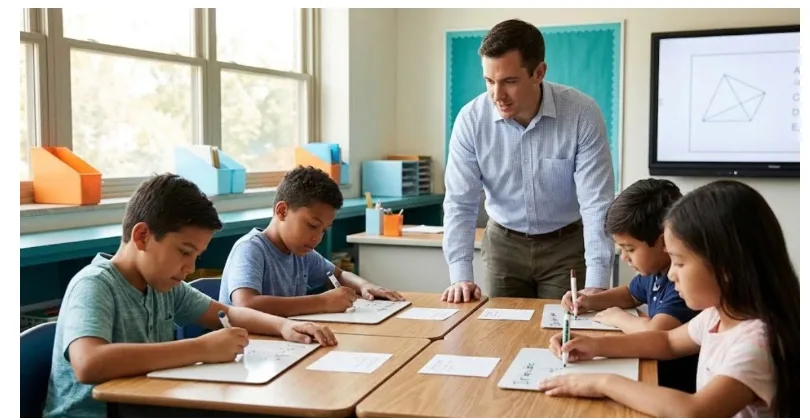
Paper responses, simple games, and a shared display can give every student a way to participate—when the lesson makes room for thinking and feedback.
An interactive review lesson does not require a separate screen on every desk. Students can write an answer, defend a choice, correct a mistake, or arrange information using paper and ordinary classroom supplies. A teacher can also use one shared display while students respond away from devices.
The important design question is whether every learner gets a chance to think before someone reveals the answer. A lively game can still leave much of the class watching. A quiet round of written responses can make individual reasoning visible.
For teachers balancing limited equipment, preparation time, or a preference for fewer individual screens, the practical approach is to start with the response they need to see and choose the activity around it.
Participation starts with an individual response
An activity becomes useful when students do something with the content and receive information that helps them improve. That might mean recalling an earlier explanation, applying a rule, or comparing two possible answers. Clicking is one way to respond; writing, drawing, and speaking can serve those purposes too.
Research on retrieval practice helps explain why the response matters. A 2021 systematic review by Pooja Agarwal, Ludmila Nunes, and Janell Blunt, published in Educational Psychology Review, examined 50 classroom experiments involving 5,374 learners and found benefits across varied educational settings.
That research supports opportunities to retrieve learning. It does not establish that paper always outperforms screens, or that adding points automatically improves a lesson.
In its practice guide Organizing Instruction and Study to Improve Student Learning, the US Institute of Education Sciences similarly recommends quizzing to revisit key content and asking explanatory questions. Teachers can build both into a review without buying another subscription or introducing a new login process.
A useful planning question is: “After this round, what will I know about each student’s understanding?” If the only answer is which team won, the lesson needs another response opportunity.
Matching the activity to the learning goal
The format should match the evidence a teacher needs. A brief written answer makes individual choices visible, while a sketch can reveal relationships that a single word misses. A group explanation adds discussion, but an individual attempt first makes each learner’s starting point easier to identify.
| Evidence of learning | A practical format | What to watch for |
| Each student’s initial answer | Paper or mini-whiteboard reveal | Copying before the reveal signal |
| How students connect ideas | Draw and explain | Attractive drawings without accurate relationships |
| Whether students understand a rule | Find and repair an error | Correcting the result without explaining why |
| How students justify categories | Sort and defend | One confident student doing all the sorting |
| Responses to a shared question | Projected prompt plus answer slip | Only the spokesperson answering |
A decimal comparison offers a simple example: which is greater, 0.4 or 0.35? Each student records a choice and a reason before discussion begins.
The answer is 0.4, since 0.40 is greater than 0.35. A response such as “0.35, because 35 is bigger than 4” reveals a place-value misconception that a simple team score would hide.
A shared class challenge can reward completing the attempt and correction. That keeps the game moving without excluding students who initially answer incorrectly.
Simple rules leave more time for the subject
A familiar sequence—attempt, reveal, explain, and correct—can support several types of activity. Moving between a short answer, a diagram, and an error analysis changes what students produce. The rules remain simple enough for the subject to receive most of the attention.
Error analysis rewards the explanation
An error-repair round could begin with this statement: “All squares are rectangles, so all rectangles must be squares.” Students identify the faulty conclusion and supply a counterexample.
A rectangle measuring 3 units by 5 units is enough to disprove it. The class can discuss the defining properties of each shape, with credit attached to the explanation rather than the fastest shout.
A drawing can expose a missing connection
After a food-chain lesson, students could sketch grass, a grasshopper, and a frog, then add arrows showing the direction of energy transfer.
The arrows should run from grass to grasshopper to frog. The follow-up question, “What does this arrow mean?”, checks whether students understand the relationship rather than simply remembering the order of the pictures.
Group work begins before the discussion
Before a card sort, each student can classify one example independently. Students can then compare decisions and agree on a group explanation, while the teacher keeps the individual responses available for reference.
Teachers looking for activity instructions can use this guide to classroom review games without student devices, which covers paper-based formats and activities using a shared screen.
Across these formats, suitable questions and accessible instructions matter more than elaborate scoring. The next teaching decision depends on the responses, including those from students who rarely volunteer.
One shared screen can support a whole-class routine
A shared display can organize the question, show an image, or reveal a worked explanation without requiring individual student devices. It is most useful when paired with a response method for everyone. Otherwise, a projected quiz can become another activity in which a few students answer while classmates watch.
A teacher-led round can follow five steps:
- The teacher displays one question in a readable format.
- Students record an individual answer.
- The teacher collects or scans responses before revealing the solution.
- The class discusses a useful error or alternative explanation.
- Students revise their work before continuing.
A printed or plain-text version of the questions provides a backup if the display fails. Students who need assistive technology or another response format should retain that access; reducing optional screens should not remove necessary support.
Paper also has trade-offs. Recording results takes time, and a quick visual scan can miss individual difficulties. Collecting a selected response provides a record without requiring the teacher to document every moment of the game.
For teachers comparing digital options alongside paper activities, Wayground.it.com publishes guides to learning games and teaching tools. It is an independent education blog, separate from the Wayground platform; its practical guides can inform setup choices, while research evidence addresses questions about learning.
Feedback gives the review its next step
A wrong answer should lead to an explanation or a manageable next attempt. Showing a tick or cross may identify the result without repairing the misunderstanding. Students need time to compare their reasoning with an accurate model, correct their work, and answer a related question independently.
In her 2018 article “How can we maximize students’ learning with feedback?”, cognitive scientist Pooja Agarwal emphasizes explaining why an answer is correct. That gives students something they can use beyond the question they just missed.
In the decimal example, the teacher can write 0.4 as 0.40 and compare both numbers in hundredths. A fresh question comparing 0.6 and 0.58 then gives students another independent attempt.
A correct follow-up response is useful information, but it is not proof of lasting understanding. The Australian Education Research Organisation’s Spacing and Retrieval Practice Guide recommends revisiting learning across lessons, giving students further opportunities to recall and apply it.
Teachers can begin with a short review of one previously taught concept, leave room for corrections, and collect one final individual response. The strongest reason to keep a game is that it helps students practice and helps the teacher decide what comes next.