How to Make Better Decisions When You Don’t Know What to Do
Big decisions rarely arrive with complete information. You might be weighing two job opportunities, choosing a course to study, planning a move, or deciding whether an expensive purchase will actually improve your day-to-day life. Even small choices can become exhausting when you keep comparing options without knowing what matters most.
The solution isn’t to eliminate uncertainty. It is to use a process that separates facts from assumptions, clarifies your priorities, and gives you a sensible next step. The following approach works for a wide range of everyday decisions without requiring complex software or endless research.
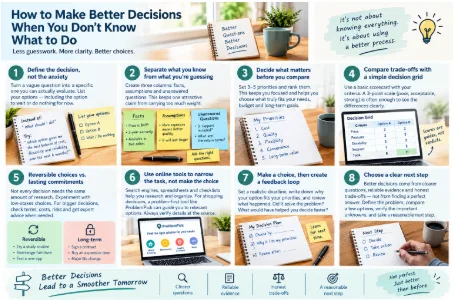
Start by defining the decision, not the anxiety around it
A vague question such as “What should I do?” creates a vague search for answers. Replace it with a decision you can actually evaluate: “Which of these two options gives me the best balance of cost, flexibility, and reliability over the next six months?”
Write the decision in one sentence. Then list the options, including the possibility of waiting or doing nothing for now. This matters because people often act as though only two choices exist when a third, simpler approach is available.
Consider someone deciding whether to replace a slow laptop. The immediate question is “Which laptop should I buy?” But a better first question might be “Would a repair, a storage upgrade, or a replacement solve the slowdown at a reasonable cost?” Naming the underlying problem can change the options entirely.
Separate what you know from what you’re guessing
Create three short columns: facts, assumptions, and unanswered questions. A fact might be the quoted price of a service. An assumption might be that a more expensive option will last longer. An unanswered question could be whether support or maintenance is included.
This simple exercise prevents one attractive claim from carrying too much weight. It also helps you focus your research. If the most important unknown is warranty coverage, you do not need another hour of general product reviews; you need the warranty terms.
Try asking:
- What evidence supports my preferred option?
- What would change my mind?
- Which detail could create the biggest regret if I overlooked it?
The goal is not to become suspicious of everything. It is to know which questions deserve a reliable answer before you commit.
Decide what matters before you compare the options
Choices become confusing when you keep changing the criteria. Set three to five priorities first. For an apartment, they might be travel time, total monthly cost, accessibility, and quiet. For a device, they might be compatibility, battery life, repairability, and price.
Rank those priorities rather than treating them as equally important. If your budget is fixed, a feature-rich product you cannot comfortably afford is not a realistic winner. If reliability is essential, the cheapest short-term option may not be the best value.
One helpful question is: “If I could improve only one feature of my current situation, what would make the greatest difference?” The answer often reveals the real priority.
Compare trade-offs with a simple decision grid
Use a basic scorecard instead of keeping every detail in your head. Put the choices down the left side and your criteria across the top. A three-point scale—poor, acceptable, strong—is often enough to expose differences.
For example, imagine comparing two desk chairs. Chair A is affordable and compact but has limited adjustment. Chair B costs more but fits your work area better and offers adjustable support. If you use the chair for several hours a day, fit and durability may matter more than a minor price difference.
Scores are guides, not verdicts. A decision grid is most useful when it highlights the trade-off you are willing to accept. If your preferred option scores poorly on your highest priority, investigate why before moving forward.
Distinguish reversible choices from lasting commitments
Not every decision deserves the same amount of research. Rearranging a study routine is easy to reverse. Signing a long-term agreement or making a major purchase may be much harder to undo.
For low-stakes choices, set a short deadline and experiment. For higher-stakes decisions, check terms, costs, risks, and the consequences of changing your mind. When professional expertise is required—particularly in medical, legal, or consequential financial matters—seek qualified advice rather than relying only on general online information.
This distinction prevents two common problems: overthinking tiny choices and rushing the ones that deserve careful review.
Use online tools to narrow the task, not make the choice for you
Search engines can help verify specifications and policies. Spreadsheets can organize comparisons. Checklists can keep you from skipping a requirement. For shopping decisions, a problem-first discovery tool such as ProblemPick can be a starting point for exploring products around a specific need instead of browsing a huge catalog without direction.
However, no website should replace independent verification. Check current prices, suitability, availability, and seller terms at the source. Useful tools shorten the search; they do not remove the need for judgment.
Make a choice, then create a feedback loop
Once the major questions are answered, decide on a realistic deadline. Endless comparison rarely produces certainty. Before acting, write down why your chosen option fits the priorities you set. This gives you a record of the reasoning rather than leaving you to judge the decision only by its outcome.
Afterward, review what happened. Did the option solve the original problem? Were any costs or limitations unexpected? What information would have helped you decide faster? This short review improves your next decision, even when the result was not perfect.
Choose a clear next step
Better decisions come from clearer questions, reliable evidence, and honest trade-offs—not from finding a perfect answer. Define the real problem, compare a manageable number of options, verify the important unknowns, and take a reasonable next step. When you use the same process repeatedly, uncertainty becomes something you can work with rather than something that stops you from acting.