How to Manage AI Agents at Scale: Best Practices for 2026
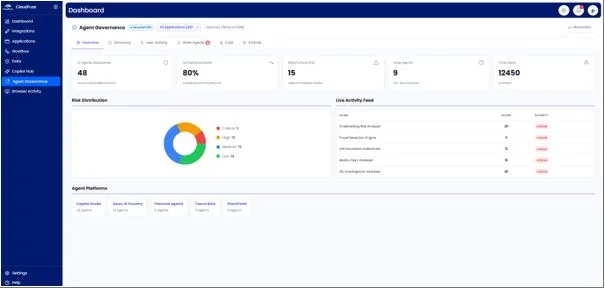
To manage AI agents at scale, you need a centralized control layer to discover every agent, see which types of official data and tools each agent can access, implement org-wide data access and approval policies, and retire risky agents that are no longer in use.
AI agent management is becoming a business priority in 2026 as AI adoption worldwide is increasing faster than ever. And according to the IBM Cost of Data Breach 2025 report, 1 in 6 data breaches now involves AI-driven attacks. Therefore, agentic AI governance is essential for every enterprise in 2026 and beyond.
In this blog post, you’ll learn why AI agent management is now an IT discipline, not a side project.
Why Does AI Agent Management Matter More Than Ever in 2026?
A few years back, most AI sat behind your chat window. Now agents act on your business system, read emails, send replies, summarize reports, and more. As employees look for ways to work faster, many introduce AI agents into their daily workflows without formal IT review, creating shadow AI. This major shift, without proper guardrails, puts many companies at risk of agentic AI-related breaches.
When an agent can take action within your business workspace, they inherit overprivileged access and permissions. Due to a lack of visibility and control across your agent environment, confidential data exposure adds up quickly across the org.
So, structured AI agent governance and management matter more than ever nowadays. This can be achieved using SaaS & AI app management software like CloudFuze Manage, which brings all your agents into a single, governed view and prevents permission sprawl before it becomes an AI security risk.
What Makes Autonomous AI Agents Difficult to Manage?
As the number of agents operating within your enterprise increases, managing them becomes a challenging task for your IT teams. Other reasons why managing agents become hard include:
- Limited IT Visibility: Many AI agents are deployed across different teams within your enterprise without being added to your common IT inventory.
- Expanding Data Access & Permissions: Agents often connect to multiple applications, data sources, and business systems, and are given the data access privilege of your senior executive.
- Shadow AI adoption: Your employees, without proper guardrails, create or deploy agents without formal IT approval or oversight.
- Complex API and Protocols Integrations: API connectors like GitHub API or Slack API and protocols like Anthropic’s MCP and Google’s A2A enable agents to interact with more tools and other agents. All these increase your agent governance complexity.
- IT Compliance and Security risks: Unmanaged agents can touch your sensitive business data, make irreversible decisions, or take actions outside your IT-established controls.
- Lack of Human Accountability: Without clear, named human ownership and live agent monitoring, it becomes difficult for every IT team to track every agent behavior and the business impact it creates.
5 Best Practices for Managing AI Agents at Enterprise-Scale
These are a few AI agent management best practices that hold up whether your enterprise runs 10 or 1,000 agents. Let’s explore them one by one:
1. Discover Every Agent and Keep Discovering
Find every agent across every app before you write a single org-wide AI governance policy. This is because you can’t govern what you don’t know exists. So treat agentic AI discovery as a continuous scan rather than a one-time audit. The shadow AI agents are a major data-breach point, and they are ones a team spun up quietly and forgot to flag.
2. Grant Every Agent the Least Access that Works
Give each agent only the data and tool access required for its specific job, nothing more. Scope permissions to the exact folder, app, or dataset the agent needs, rather than granting broad, over-permissioned agent access to your confidential data. You can also time-box permissions for temporary projects, so short-term agent access does not become permanent by default.
Then review those permissions on a fixed schedule, because the access an agent needed at the launch phase is rarely needed 3 or 6 months later.
3. Put an IT Approval Step Before New Agents Rollout
It is the simplest way to govern agents’ review of their data access points before they go live. This helps IT admins check what data an agent will touch and what actions it can take, stops sprawl at the source, and keeps your IT inventory compliant.
4. Assign an Accountable Owner to Every Agent
Each agent should map to a named person accountable for what the agent actually does, just as you’d assign an owner to any production system. Ownership is what turns a vague “someone should look at this agent” into a clear responsibility when an agent drifts, breaks, or needs to be shut down.
5. Monitor Every Agent’s Behaviour Individually
Watch all your agent activity for drift, unusual data access patterns, or actions outside its intended scope. Always shut down agents that sit idle or get orphaned when a project ends or its owner leaves.
Also, tie your enterprise-wide agent offboarding to your existing user lifecycle process and automate it.
What Tools Help Organizations Strengthen AI Agent Management and Governance?
Spreadsheets and native admin panels start to break once you pass a few dozen agents. A dedicated AI agent management platform like CloudFuze Manage brings automated agent discovery, data access control, and risk monitoring into a single, unified view.
Other agent governance and management features of CloudFuze Manage are:
- AI Agent Discovery
Automatically discover all AI agents (created using Cursor, Claude, Copilot, and more) across cloud platforms with clear human ownership and risk context.
- 360° Visibility and AI Governance Dashboard
A centralized IT dashboard to track all AI agents, their usage patterns, related security risks, compliance status, and overall health.
- AI Agent Monitoring
Monitor user–agent interactions to detect sensitive data exposure like your organization’s financial data, PII, or confidential user credentials.
- AI Data Access & Risk Control
Gain transparent insight into your organization’s agent permissions, data access, knowledge sources, and usage-based risk levels.
- AI Agent Cost Control Policy Governance
Track premium AI chat token spend per agent and implement governance policies to control your AI subscription costs and reduce related enterprise AI security risks.
Centralized AI Agent Management vs. Manual Agent Oversight
The table below compares automated agent management with manual management:
| What you’re managing | Without a management platform | With centralized AI agent management |
| Agent discovery | Manual listing of every agent | Continuous, automated agent inventory |
| Agent’s Data Access Scope | Broad and rarely reviewed by IT admins | Least-privilege, reviewed on an automated schedule |
| Agent Ownership | Unclear IT ownership | One named human owner per agent |
| Offboarding | Agents linger after projects end | Agents’ accesses are revoked on a defined lifecycle |
| Audit readiness | Audit evidence is gathered in a scramble | Audit logs and agent approvals are ready on demand |
Ready To Streamline Your AI Agent Management and Governance?
In this age of AI, managing AI agents is important to keep your enterprise away from Agentic AI security risks.
For agentic AI management and governance specifically, CloudFuze Manage lets you discover, monitor, and govern all AI agents that your teams own with flexible per-user pricing.
Book your free demo with CloudFuze to see how their agent governance works in real.