How to Paraphrase a Sentence or Entire Article Correctly
Most paraphrasing fails before the writer types a single word. The problem is not vocabulary or structure – it is that writers read and write at the same time, which forces their sentences to follow the source.
We reviewed the most common failure patterns and the techniques that prevent them. In this article, we show you how to paraphrase a sentence or full passage so the result is genuinely rewritten, not surface-altered.
Where Most Writers Go Wrong Before They Type a Word
Most writers think they paraphrase. What they actually do is read a sentence, swap a few words, and move on. The result looks different on the surface but follows the original’s structure so closely that any plagiarism checker – and any experienced editor – spots it immediately. That pattern has a name: patch-writing. It is not paraphrasing. A real paraphrase produces a sentence that the original author would not recognize as their own, yet one that carries the same argument.
The practical test is simple. If you can paraphrase a sentence without looking at the source while you write it, the result will almost always pass. If you write with the source open in front of you, it almost always fails. A quality paraphrasing tool helps at the verification stage – it flags sentences that still sit too close to the original and shows you what a structurally different version looks like. That is also what lets you make your text more human rather than mechanical: genuine restatement reads naturally, synonym substitution does not.
This came up directly in a thread on r/writing where a content writer asked how to avoid mirroring sources when writing for blogs. The most upvoted answer cut straight to the point: research the topic until you know it thoroughly, then close every source and write from your own understanding. Check facts afterward – but write first. That sequence is what separates a paraphrase from a transcription with changed words.
Rephrase and Paraphrase Are Not the Same Thing
To rephrase is to reword a single sentence, usually for clarity or style. It does not require attribution because the idea is yours. To paraphrase is to restate someone else’s idea in a new language for integration into your own work. It always requires a citation because the idea belongs to the original author. The surface operation looks similar – both change words – but the purpose and the obligation are different.
A rephrased sentence changes expression. A paraphrased passage changes expression and acknowledges intellectual origin. All paraphrasing involves rephrasing, but rephrasing your own text is not paraphrasing in the academic or editorial sense. The distinction is about where the idea came from, not about how much the text changed.
For writers who work with high volumes of source material, the best tool to paraphrase text effectively helps keep this distinction clear in practice. A quality paraphraser proposes structural alternatives rather than synonym swaps – the difference between genuine restatement and patch-writing.
How to Paraphrase in Seven Steps
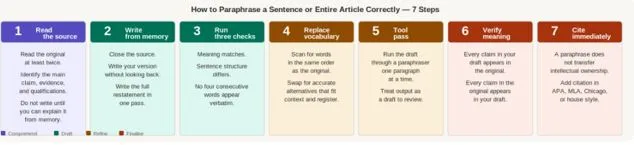
The method below applies at any scale – a single sentence and a full article follow the same sequence. Read through all seven steps before you start; each one targets a specific failure mode.
- Read the source until you can state the argument without looking at it. Identify the main claim, the supporting evidence, and any qualifications the author attaches. Do not write until you can explain the passage from memory.
- Close the source and write the idea entirely from memory. Cover or close the original, then write your version without glancing back. Write the full restatement in one pass – any mid-sentence look at the source restarts the mirroring pattern.
- Run three checks before you accept the draft. Confirm the meaning matches, the sentence structure differs, and no four consecutive words appear verbatim in both versions. Fail any check and rewrite the sentence from scratch.
- Replace vocabulary that still overlaps – but choose accurately. Scan for words in the same order as the original and swap them for accurate alternatives. Each replacement must fit the context and register of the surrounding text.
- Run the draft through a paraphraser one paragraph at a time. A quality tool flags sentences that remain too close to the source and proposes structural alternatives. Treat the output as a candidate to review, not a finished product.
- Verify meaning in both directions. Confirm every claim in your draft appears in the original and every claim in the original appears in your draft. Added or dropped nuance misrepresents the source as much as a verbatim copy does.
- Add the citation immediately. A paraphrase does not transfer intellectual ownership. Add the citation right after the paraphrase in your required format – APA, MLA, Chicago, or house style.
Steps 1 and 2 prevent structural mirroring. Step 3 catches verbatim runs. Steps 4 and 5 remove vocabulary overlap. Step 6 prevents meaning drift. Step 7 closes the attribution gap. Run all seven in order, and the output holds up under any review process.
How to Paraphrase a Text with the Tool
To show what Step 5 of the manual method looks like in practice, we use Clever AI Humanizer as an example – a free online tool that rewrites at the structural level rather than just swapping vocabulary. The steps below walk you through the full workflow. No account is required.
- Open the paraphrase tool and locate the input field. Go to the Clever AI Humanizer paraphrase tool. You will see a large text input area in the centre of the page. This is where you paste the text you want to rework.
- Paste one paragraph at a time. Copy a single paragraph from your draft and paste it into the input field. Batch input across a full article often produces tonal inconsistencies between sections that require a second editing pass to resolve.
- Select the mode that matches your writing context. The tool offers multiple paraphrase modes. Choose the one that fits your register: a standard mode for general content, a formal or academic mode for research and professional writing. Select your mode before you click Paraphrase.
- Click the Paraphrase button and read the full output. The tool generates a structurally distinct version in the output area. Read it in full before you copy anything – do not accept the output at face value.
- Check that the meaning survived the rewrite. Apply the same two-direction check from Step 6 of the manual method. The tool proposes structural alternatives; it does not guarantee accuracy in meaning. Any drift you find is yours to correct before you use the text.
- Copy the output, edit for accuracy, and add the citation. Copy the result from the output area into your document. Make any corrections to the meaning check identified, then add your citation immediately. The tool does not handle attribution – that step is always yours.
When to Paraphrase and When to Quote Directly
Paraphrase when you need to integrate a source’s idea, and the exact wording carries no special weight. Quote directly when the exact words matter – a legal definition, a technical claim in precise scientific language, or a statement so distinctive that any rewrite changes its character.
Paraphrasing is the default, and direct quotation is the exception. The stakes are measurable: an investigation by The Markup found that California State University alone spends over a million dollars annually on plagiarism detection software. Proper paraphrasing with citation keeps your work clean in that environment. Academic style guides recommend one direct quote for every four or five paraphrased references.
What Goes Wrong and How to Fix It
Most failed paraphrases follow one of five patterns. Identify which one applies, and the fix is specific.
- The thesaurus trap. Synonym substitution with the original structure intact. Plagiarism checkers detect sentence architecture as well as word choice. Fix: start from a different sentence entry point, not a different word.
- Patch-writing. A copied sentence with scattered word changes. Test: cover your draft and reread the source – if you can trace every word back to the original, you patch-wrote it. Fix: delete and rewrite from memory.
- Lost connectives. Logical connectors – “however,” “because,” “although” – dropped or reversed during vocabulary replacement. The meaning changes even when every content word transfers. Fix: map the logical relationships before you write.
- Over-paraphrasing. Rewriting so aggressively that claims appear or disappear. Fix: check the meaning in both directions before you finalize.
- No citation. Accurate restatement, no attribution. The citation requirement follows from the origin of the idea, not from how the text was expressed. If the idea came from another source, cite it unconditionally.
Questions Writers Ask Most Often
Is a correct paraphrase still plagiarism? No, provided you cite the source. A paraphrase that accurately restates the original idea in new language, followed by a proper citation, is the accepted method for source integration. A paraphrase without a citation is plagiarism, regardless of how well you rewrote the text.
What is the difference between a paraphrase and a summary? A paraphrase preserves the full scope of the original at roughly equal length. A summary compresses the content into a shorter form, keeping only the main points. If your version is substantially shorter than the source, you summarized rather than paraphrased.
Does a paraphrasing tool remove the need to cite? No. A tool generates structural alternatives but does not verify meaning accuracy, and does not add citations. Judgment and attribution remain yours.
Can you paraphrase your own previous writing? Yes, but you must still cite it. Academic institutions and many publishers treat undisclosed self-reuse the same way they treat standard plagiarism. Cite your own earlier work as you would any other source.
Final Thoughts
Now you know how to carry out this process from start to finish without any unnecessary complications. The seven-step method and the tool workflow give you two complementary approaches, and the mistake list provides a diagnostic when a draft still does not pass review. However, there are certain details that were not included in the main body of the article.
Paraphrasing skill degrades under time pressure. Writers who produce clean paraphrases when time allows consistently produce patch-written text when they rush the reading step. If drafts start failing review during high-output periods, the bottleneck is Step 1, not the writing. Protect reading time as a fixed allocation.
The read-from-memory method also works as a pre-writing self-test. If you cannot explain the source without looking at it, you do not yet understand it well enough to write about it – paraphrase or not.
One tool worth naming from our own work: Clever AI Humanizer handles the structural rewriting step reliably. In our experience, it produces output that differs in sentence architecture rather than vocabulary alone, which is the distinction that matters for passing a plagiarism check – and it fits into a high-volume workflow without adding meaningful time to the revision step.