How to Pay Full-Time Employees in Cryptocurrency
More than a third of millennials and half of Gen Z say they would accept 50% of their salary in Bitcoin or cryptocurrency according to a Nasdaq-cited global poll.
Stablecoins now account for over 90% of all crypto payroll transactions, and the GENIUS Act has established the first comprehensive U.S. regulatory framework for payment stablecoins. The infrastructure, the demand, and the regulatory clarity have converged, making crypto payments for full-time employees operationally viable in 2026 in a way it was not even two years ago.
But viable does not mean simple. Paying employees in cryptocurrency introduces tax, labor law, and compliance complexity that companies must navigate carefully to avoid exposure.
Key Takeaways
- Stablecoins are the practical path, volatile crypto should be limited to bonuses and incentives, not base pay
- Most jurisdictions require base salary to be paid in local fiat currency, with crypto as an optional supplement
- The right platform automates the compliance layer so companies do not have to build it themselves
The Legal Landscape in 2026
The legality of paying employees in cryptocurrency varies by jurisdiction, and getting it wrong carries real consequences. In the United States, the IRS treats cryptocurrency as property, not legal tender.
That means crypto compensation triggers ordinary income recognition at fair market value on the date of receipt, and employers must withhold income taxes, Social Security, Medicare, and FUTA in U.S. dollars regardless of how the employee is paid.
The Fair Labor Standards Act adds another layer. The FLSA requires wages to be paid in “cash or negotiable instruments payable at par,” a definition that does not include cryptocurrency. Many states, including Maryland, Pennsylvania, and California, have similar cash-payment-of-wages statutes.
The practical result: base salary should be denominated and paid in fiat to meet minimum wage and overtime thresholds, with cryptocurrency offered as a supplemental component.
| Jurisdiction | Can you pay base salary in crypto? | Recommended approach |
| United States | Not recommended for base pay (FLSA risk) | Pay base in USD; offer crypto for bonuses, incentives, or as post-fiat conversion |
| European Union | Most countries require wages in local currency | Pay base in EUR/local fiat; crypto supplement with employee consent |
| United Kingdom | Base pay must meet minimum wage in GBP | Fiat base; optional crypto top-up |
| Singapore | Permissive; no prohibition on crypto wages | Hybrid model allowed with proper documentation |
| El Salvador | Legal tender status for Bitcoin | Full crypto payroll legally permitted |
| Most of LATAM | Varies; many require local currency base | Fiat base; stablecoin withdrawal option preferred by workers |
The safest and most common structure in 2026 is a hybrid payroll model: employers calculate and pay base compensation in local currency to satisfy labor law requirements, then offer employees the option to receive some or all of their pay in cryptocurrency at the point of withdrawal.
Why Stablecoins Dominate Crypto Payroll
Volatile cryptocurrencies like Bitcoin and Ethereum create a fundamental problem for payroll: the value of an employee’s paycheck can change between the time it is calculated and the time it is received. A 10% price drop during a payroll cycle could push compensation below minimum wage thresholds, creating legal exposure for the employer.
Stablecoins solve this. USDC and USDT maintain a 1:1 peg with the U.S. dollar, backed by reserves of cash and short-term Treasuries under the GENIUS Act’s 100% reserve requirement. For payroll purposes, paying in USDC is functionally equivalent to paying in digital dollars, the employee receives a stable, predictable amount without volatility risk.
This is why stablecoins account for over 90% of crypto payroll transactions. They deliver the speed and cost advantages of blockchain settlement, minutes instead of days, minimal fees instead of correspondent banking charges, without the compensation volatility that makes raw crypto unsuitable for base pay.
How Rise Makes Crypto Payroll Work
Rise has built the compliance infrastructure that makes paying full-time employees in cryptocurrency operationally simple and legally defensible across jurisdictions.
Through Rise’s Employer of Record service, companies can hire full-time employees in 70+ countries without establishing local entities. Rise acts as the legal employer, handling employment contracts, tax withholding, statutory benefits, and payroll processing in compliance with local labor law.
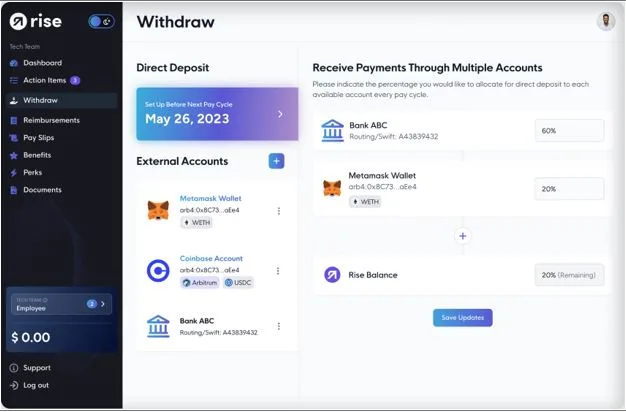
The critical design: Rise calculates and denominates compensation in local fiat currency to meet wage law requirements, then gives employees the freedom to withdraw in their preferred format, local fiat across 90+ currencies, stablecoins like USDC and USDT, or 100+ other cryptocurrencies.
The employer funds payroll via traditional bank transfer, stablecoins, or cryptocurrency. The employee controls withdrawal. This separation ensures the company meets its legal obligations in fiat while giving the employee the crypto compensation experience they want. Rise automates KYC/AML verification, tax documentation including W-2s and country-specific filings, and exchange-rate locking at the point of conversion.
“The mistake most companies make with crypto payroll is treating it as either all-or-nothing, either you pay in crypto or you don’t,” said Hugo Finkelstein, CEO of Rise. “The model that actually works is hybrid: the company satisfies every legal obligation in fiat, and the employee chooses how they receive their money. That is not a compromise. It is the only structure that scales across jurisdictions without creating compliance exposure.”
What to Get Right Before You Start
Companies considering crypto payroll for full-time employees should address four areas before implementation:
- Confirm that base compensation meets minimum wage and overtime requirements in local fiat currency in every jurisdiction where they employ workers.
- Use stablecoins rather than volatile crypto for any compensation tied to regular pay cycles.
- Partner with a platform that automates tax withholding, reporting, and exchange-rate documentation.
- Obtain written employee acknowledgment of the risks and tax implications of receiving crypto compensation.
The companies getting crypto payroll right in 2026 are not the ones making radical bets on decentralized compensation. They are the ones using compliant hybrid infrastructure to give employees what they increasingly expect, the freedom to choose how they get paid.
FAQs:
- Can you legally pay full-time employees in cryptocurrency?
In most jurisdictions, base salary must be paid in local fiat currency to comply with minimum wage and labor laws. However, companies can offer cryptocurrency as a supplemental payment or give employees the option to convert their fiat salary to crypto at the point of withdrawal through platforms like Rise.
- What is the safest cryptocurrency for payroll?
Stablecoins like USDC and USDT are the safest option, maintaining a 1:1 peg with the U.S. dollar and backed by regulated reserves under the GENIUS Act. They account for over 90% of crypto payroll transactions because they eliminate the volatility risk of Bitcoin or Ethereum.
- How is crypto payroll taxed in the U.S.?
The IRS treats cryptocurrency as property. Employers must calculate fair market value in USD at the time of payment, withhold income and payroll taxes in dollars, and report compensation on Form W-2. Starting in 2026, Form 1099-DA requires brokers to report crypto transactions including gross proceeds and wallet addresses.
- What platform supports crypto payroll for full-time employees?
Rise supports hybrid fiat-crypto payroll through its EOR service in 70+ countries. Employers fund payroll in USD or stablecoins, and employees choose their withdrawal currency each cycle, local fiat, USDC, USDT, or other cryptocurrencies, with automated tax and compliance documentation.
- Should companies pay base salary in Bitcoin?
No. Bitcoin’s price volatility creates legal risk if compensation falls below minimum wage thresholds between calculation and receipt. Stablecoins are the recommended path for the crypto portion of compensation, with base salary denominated in fiat to ensure labor law compliance.