How to Plan Concrete Drilling Work on Active Construction Sites
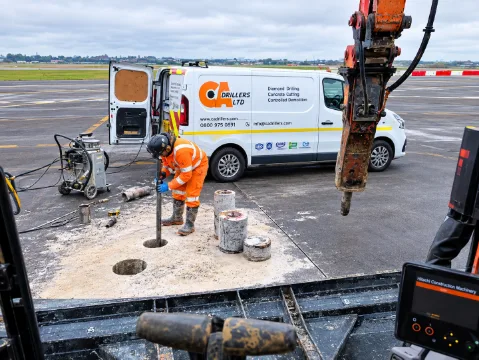
Concrete drilling might not be the star of the show on a construction site. It can easily become the problem that stops everything else. On a job site holes, for pipes, cables and ducts need to fit perfectly with structural work, inspections, access rules and the work of many different trades. If the drilling happens late in the wrong spot or too early the ripple effect hits every task that comes after.
That’s why good concrete drilling doesn’t start when the drill arrives. It starts before with planning, coordination and preparation.
What Goes Wrong When Drilling Isn’t Planned
Consider a familiar scenario. A mechanical contractor needs a series of openings through a reinforced slab so it can install risers. The locations are taken from a drawing issued months earlier. On the day, the drilling team finds that one location sits over a concealed conduit that was never recorded, and another is blocked by a temporary storage area. The work stops, the openings are re-marked, and the mechanical crew, who were due to start the next morning, are left waiting.
Nothing in that scenario is a drilling failure. It is a planning failure, and a preventable one. Most of the problems below come down to the same few questions being answered too late.
Confirm the Requirements First
Before any date is fixed, the project team should establish for each opening:
- Location, checked against the actual site condition rather than only the drawings
- Diameter and depth, which determine the equipment and method
- Purpose, meaning which service or trade the opening is for
- Programme window, meaning when the area must be ready and when the opening is needed
- Follow-on work, meaning who is waiting on the completed opening and what handover they need
Drawings and specifications often pre-date changes made on site, so it is worth verifying them against current conditions, particularly on long or fast-moving projects.
Check the Structure and Concealed Services
A drilling position should be assessed in the context of the surrounding structure, not as an isolated point. Reinforcement, post-tensioned elements, embedded conduits and other services can all affect whether an opening is acceptable and where it can go.
Where appropriate, this means completing scanning (for example, ground-penetrating radar or similar detection) and reviewing structural information before drilling starts. Any open question about reinforcement or cut-sensitive elements should go to the structural engineer or relevant project professional for sign-off. The aim is not just to find somewhere a hole can be made, but to confirm that it is compatible with the structural and service design.
Allow time for this. Scanning, reviewing and getting approvals can take more time than the actual drilling work. These steps are often cut short when a project is under pressure. That’s why successful drilling begins long before the equipment even shows up.
Plan Access Before the Team Arrives
Access is one of the easiest details to overlook and one of the most disruptive when it goes wrong. A location may be perfectly suitable on paper but unreachable with the required equipment once other trades have filled the space.
Check, ahead of the booking:
- How personnel and equipment will reach the work area, including lifts, stairs and loading routes
- Whether there is enough working space for the chosen method
- Whether other trades will be occupying the area during the planned window
- Whether access will still be available on the day, since routes change as a build progresses
Equipment and logistics can become part of the delivery strategy on larger schemes. On the Chelsea Barracks redevelopment, for example, CA Drillers’ published case study notes that an on-site office and equipment store were set up to keep manpower and specialist equipment close to the work. The principle applies at any scale: treat access and equipment as programme items, not afterthoughts.
Coordinate With Other Trades
The most useful planning question is also the simplest: what has to happen before the drilling, and what is waiting after it?
For each set of openings, identify:
- The activity that must be finished first (for example, formwork stripped, floor cleared, services marked out)
- The date the area will genuinely be ready
- The date the opening is needed by the next trade
- Any inspection or sign-off required before the follow-on work starts
- Any temporary protection or access that must stay in place
Drilling then becomes a defined step in the sequence rather than a loose task. This matters most where openings support mechanical and electrical installations or structural modifications, because those dependencies tend to be tightly packed.
Choose a Method That Suits the Site
The correct solution would be determined by the conditions and the specifications equally. The considerations would be the type of material and thickness, diameter of opening needed, whether the work would be carried out floor level, wall level or overhead, space available, and whether there are any sensitive activities going on nearby.
Diamond drilling is an extensively used method for making precise holes in reinforced concrete and especially if there is need for coordination of the activity with other construction work around.
On complex jobs, such as restricted access, many openings or tight sequencing, it pays to involve the drilling contractor during planning rather than at booking stage. They can flag constraints on method, water supply, extraction and working space that are much cheaper to resolve early.
Build the Whole Activity Into the Programme
The drilling activity should therefore be included in the wider construction programme, with responsibilities, access arrangements and interfaces agreed before work starts. This approach also aligns with HSE guidance on planning construction work, which emphasises planning, managing and coordinating construction activities before and during the construction phase
Design information → site checks and scanning → access confirmation → area preparation → drilling → inspection and handover → follow-on trade
If any part of this process is not clear it is better to discover that during planning than when the team is already, at the location and time is limited.
Pre-Start Checklist
Before the drilling date is confirmed, the project team should be able to answer “yes” to each of the following.
Technical
- Are locations, diameters and depths confirmed against current site conditions?
- Has structural information been reviewed and scanning or service checks completed?
- Have any queries been resolved with the relevant engineer?
Site
- Is access clear, with enough working space for the equipment?
- Will the area be ready and free of conflicting trades on the day?
- Are water, dust and debris controls in place?
Programme and responsibilities
- Does the programme allow for the full activity, not just the drilling?
- Is it clear who needs the completed openings, and what handover they require?
- Have responsibilities for marking out, pre-attendance checks and site procedures been agreed between the site team and the contractor? These vary between projects and should be agreed, not assumed.
If any answer is “no” or “not sure”, resolve it before mobilisation. Discovering the gap with specialist people and equipment already on site is the most expensive way to find it.
Conclusion
Planning concrete drilling on an active site is ultimately about coordination. The physical work might take a little time but getting it right depends on having accurate information, clear access, logical sequencing and strong communication between teams.
By confirming requirements, reviewing the structure and services, securing access coordinating with follow-on trades and bringing in specialist diamond drilling contractors when the project demands it, construction teams can make drilling a smooth and predictable part of the schedule, Of becoming a last-minute problem drilling becomes a controlled and manageable task.