
How to Scale Your Peptide Ads Without Getting Banned?
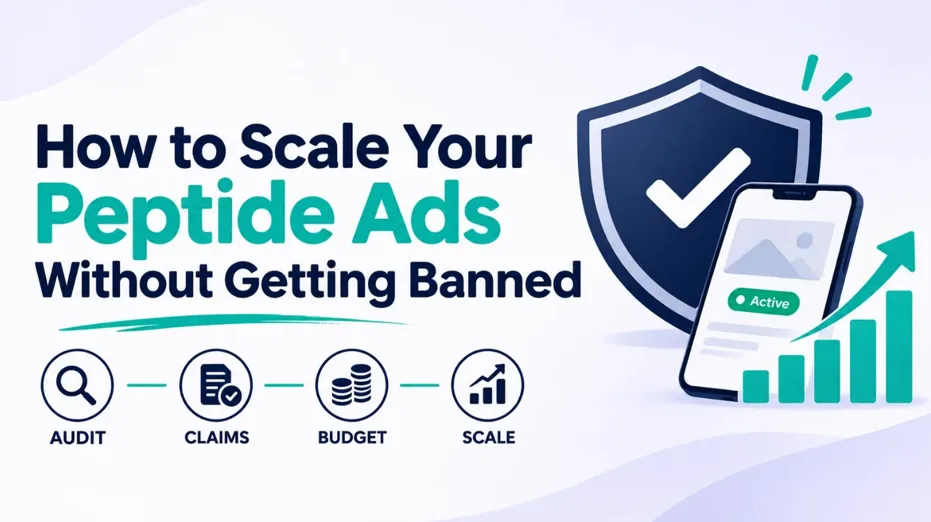
Most peptide brands get banned from their ad accounts not due to one ad, but because their ad, landing page, blog, checkout, and payment processors are all telling a different story. In 2026, everyone will read through the entire story.
The reviewers are no longer just the bots from Meta or Google. The FDA has increased scrutiny of peptide websites, and payment processors are also applying stricter risk reviews. To scale your business, you need your setup to be compliant across all three.
This guide will show what is allowed on each platform, why RUO labels are continuously failing, and a step-by-step guide to safely scale your spend. You can also explore PeptAds for specialised peptide advertising support, including cloaking and guaranteed ads approval services.
Quick Answer
Scale your peptide ads without getting banned by ensuring your entire business reflects what you’re claiming in your ad.
- No claims of human usage, dosing, healing, or outcomes throughout your domain.
- Ensure your ad, landing page, and checkout all align.
- Choose the correct channels to advertise your products. Prioritise search and owned channels. Meta is a secondary option.
- Increase your budget gradually and keep track of rejections.
Why Are Peptide Ads Banned?
Most peptide ads are reviewed by up to three different parties. Most guides will only focus on the first.
Ad Platforms (Google, Meta, TikTok): Look at ad copy, images, keywords, landing pages, and linked profiles. Fail → ad rejected, account & Business Manager restrictions.
Payment & Risk Partners: Look at product pages, claims, disclaimers & sales. Fail → funds frozen, merchant account terminated.
Regulators (FDA, FTC): Look at claims on website, product pairings & testimonials. Fail → warning letters, products seized, legal action.
All three share signals. Sellers who put strong emphasis on “not for human consumption” claims are more likely to be selling unapproved peptides.
Understand What Type of Peptide Business You Have
Cosmetic & Supplement Brands: Skincare & collagen peptides. Google, Microsoft, Meta & occasionally TikTok possible with careful claims.
Research Supply Business: Compounds to verified labs. Limited paid options. Search, SEO & email. Must be very tight with positioning.
Clinics & Telehealth: Prescribed peptide therapies. Only after certification (e.g. LegitScript).
If your research products are actually for consumer use, no ad strategy will help. Your positioning needs to be accurate.
What is Allowed on Each Platform?
Google Ads & Merchant Center
Google has a strict Healthcare & medicines policy. Products on their unapproved substances list cannot be advertised, regardless of claims of legality. Items that have been subject to government or regulatory action or warnings, as well as confusingly similar names, are also restricted.
The unapproved list is not exhaustive. Just because an item is not listed does not mean it will be allowed. For a practical overview of what still works on search, see Peptides Google Ads.
Microsoft Advertising
Bing has similar health policies to Google. This is not a loophole; it simply provides additional search volume for brands that are already clean on Google.
Meta (Facebook and Instagram)
Meta has a strict Drugs & Pharmaceuticals policy. Ads promoting the sale or use of “unsafe substances, products or supplements, as determined by Meta at its sole discretion” are not allowed. Meta has not published a public list of peptides, so decisions are made case by case.
Prescription drug ads require prior written approval and can only be run in the USA, Canada, and New Zealand. They cannot be targeted to anyone under 18.
If you are running Meta campaigns, this guide goes deeper: Facebook Peptide Ads.
TikTok
TikTok has a strict health and pharmaceuticals policy. Products must comply with local laws in each market. Many health products cannot be targeted to users under 18. Research compounds are generally not viable.
Why RUO is No Longer a Safe Option?
The biggest change this year has not come from Google or Meta. It has come from the FDA.
On 24 August 2026, the FDA (Center for Drug Evaluation and Research) sent warning letters to multiple online peptide sellers. All had some form of RUO disclaimer. The letters highlighted claims on product pages (appetite, weight loss, libido) and pairing products with bacteriostatic water. Despite RUO claims, the FDA still concluded that the products were unapproved new drugs.
Earlier in 2026 (including letters dated 31 March), the FDA sent multiple similar warning letters to online peptide sellers.
As an advertiser, understand that your website will be your evidence. If there is any implication of human use in your blog, FAQs, product bundles, or customer reviews, your products will not be safe. Even your ad accounts will not be safe, because Google will not allow promotion of products that have been subject to regulatory action or warning.
Note on compounding changes: You may have heard that peptides such as BPC-157 have been “reclassified”. In April 2026, the FDA removed several peptides from its Category 2 compounding list. In July 2026, an advisory committee voted to recommend six peptides for the compounding list. That vote was not binding, and none of this means unapproved peptides can legally be sold to consumers or advertised.
7 Step Framework to Safely Scale Peptide Ads
1. Audit Entire Domain
Reviewers look at more than just your ad. Before increasing budgets, ensure all pages are clean: blog posts and FAQs mentioning what the compound does in humans, customer reviews mentioning personal results, product bundles pairing compounds with injection items, schema or meta descriptions mentioning health claims, and old landing pages. Fix or remove these. Hiding them behind redirects is usually treated as evasion.
2. Replace Risky Words with Neutral Ones
Risky: Heals, Repairs, Treats, Cures → Replace with specifications, purity & testing.
Risky: Dosing, Protocol, Cycle, MG Per Day → Remove from entire funnel.
Risky: Clinically Proven, Prescription Strength → Only mention real testing documents.
Risky: Burn Fat, Boost Growth Hormone → Remove outcome completely.
Risky: Biggest Sale Ever, Countdown Timers → Simple pricing & offers.
3. Create Non-Human Content
Avoid before-and-after images, syringes, vials, and needles. For cosmetic and supplement brands, content around routines (packing a bag, morning routine, unboxing) tends to pass review more reliably. For research supply brands, use catalogue-style content with product images, purity data, and COA snippets.
4. Set Up Multiple Accounts
Have one business portfolio per legal entity. Ensure all domains are verified, and admins use two-factor authentication. Many experienced buyers separate prospecting and retargeting into different ad accounts to limit the impact of a single rejection. Never purchase low-quality aged accounts; build clean assets properly.
5. Ensure Claim Parity
Never put more claims on your landing page than in your ad. Never put more claims in your ad than on your label. Include real contact information, business name, shipping and refund policies. Include independent lab testing reports. Ensure your checkout matches your site.
6. Increase Budget Gradually & Track Rejections
Large sudden budget increases send many new ads into review. Multiple rejections can trigger a broader account review. Many media buyers increase budgets gradually, often by 15–20%. Create a simple spreadsheet to track rejections (Date, Ad ID, Account, Policy Violated, Hook Text, Destination URL). After a few weeks, patterns usually appear. Do not re-upload the same file; edit the specific element cited and upload a new ad.
7. Create Channels That Can’t Be Turned Off
Paid channels can change rules overnight. Owned channels provide steadier income while paid campaigns grow. Focus on SEO (testing, storage, purity, how to read a COA), email (specifications, new batches, testing), and affiliates only with a written claims policy.
Common Mistakes That Will Result in Banned Accounts
- Sending a clean ad to a landing page that contains outcome claims.
- Allowing creators or affiliates to write their own hooks.
- Mentioning specific compounds in the first few seconds of video or in headlines.
- Putting all prospecting, retargeting, and pages in one account.
- Opening a new account while you are still appealing.
- Relying on only one payment processor or one advertising platform.
What to Do if You Get Rejected or Banned
1 Ad Rejected: Fix the element mentioned in the policy and upload a new ad.
Multiple Ads in 1 Concept: Discontinue the concept. The issue is usually the angle.
Account Banned: Stop spending. Fix the root cause on your site. Request one review with a simple explanation of what you sell.
7 Days Notice from Google: Use the full period to fix your domain.
Only appeal if you believe the system has misunderstood your ad. If you know the ad breaks policy, you are wasting credibility.
Conclusion
Scaling peptide ads in 2026 is less about clever hooks and more about consistency. If your products, website, payments, and ads all reflect a legitimate business, you can gradually increase spend. If not, you will simply get flagged faster.
When the basics above still are not enough, and accounts keep getting restricted, most brands eventually look for specialised help. You can review service options at Peptides Agency pricing.
FAQ
Is it illegal to advertise peptides?
Not always. FDA-approved peptide drugs, cosmetic peptides, and collagen supplements can be advertised on platforms within FTC truth-in-advertising rules. Promoting unapproved peptides for human use has repeatedly been treated by the FDA as selling unapproved new drugs, even when a RUO label is present.
Are peptides allowed on Google Ads?
Some can. Cosmetic and supplement products can be advertised with clean claims. Anything on the unapproved substances list, products that have had regulatory action, and confusingly similar names will be restricted. Prescribed treatments require certification.
Can you run Facebook ads for peptides?
Yes, for cosmetic and supplement peptides with careful creatives and claims. Meta will restrict ads promoting unsafe substances and requires written approval for prescription drugs. Research compounds carry a high restriction risk.
What is the 20% rule for Facebook Ads?
This was an old rule about how much text could appear in an image. Facebook stopped penalising ads for text volume in 2020. Less text still tends to perform better.
Can you get in trouble for selling peptides?
Yes. In 2026, the FDA sent warning letters to online peptide sellers in March and August. These require a response within 15 working days and can lead to further action if issues are not resolved.
How do I know if a peptide website is legitimate?
Look for independent lab testing reports linked to specific batches, a real business name with contact details, clear shipping and refund policies, and no dosing or outcome claims. Heavy “not for human consumption” language combined with consumer-style marketing is a red flag.
How long should I wait before scaling new peptide ad accounts?
Wait until you have steady approvals, clean tracking, and a working payment setup. Scaling too early can produce multiple rejections.