How to Screen CNC Machining Suppliers in China Helping You Avoid 25% in Hidden Costs and Achieve 20–35% in Cost Savings
Introduction
Many international buyers seeking CNC machining services China face significant challenges, including wildly divergent quotes (varying by 50-80%), unfulfilled quality promises, and frequent delivery delays (exceeding 30%). This often results in rework costs up to 15%, ultimately increasing the Total Cost of Ownership (TCO) by 25-40%.
This situation typically stems from procurement decisions that rely too heavily on the initial quotation, lacking a structured, in-depth assessment of a supplier’s technical capability, quality systems, true cost composition, and project management competence.
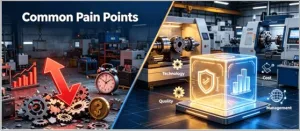
This paper deconstructs a four-dimensional evaluation model, developed through years of experience with projects around the world. This tool helps buyers transcend superficial cost analysis and select their most valuable and least risky partners by analyzing four critical dimensions: Technology, Quality, Cost, and Management.
Why a Machine List Alone Cannot Guarantee Quality for Complex Parts?
Evaluating technical capability requires more than cataloging machine models.
Assessing Engineering Logic Over Machine Specs
True capability in precision CNC machining China is proven by a supplier’s engineered solution for complex part features, not their machine list. The focus must be on their documented methodology for deep cavities, thin walls, and multi-angle geometries.
- CAM and Fixture Development
The inherent intelligence used in the process of tool path creation and fixtures development determines the accuracy of the finished part.
- Process Control Plans
Process controls for parameters such as thermal distortion or vibration control are imperative for quality in stringent applications, e.g., aerospace.
Verifying Through Process Documentation
For a China CNC machining supplier, reviewing actual process parameter sheets for toolpath optimization is more revealing than certificates. This verifies a systematic approach, transforming claimed capability into a demonstrable, low-risk process for your project.
How to Turn Supplier Quality Promises into a Verifiable Process?
Going beyond mere claims means conducting an audit on the supplier’s active quality control procedures. Good CNC machining supplier selection involves assessing the implementation effectiveness of MSA, SPC, and the FAIR process. Full traceability from raw material to finished part is essential. Suppliers that integrate multiple management systems—such as ISO 9001 (Quality Management), IATF 16949 (Automotive), AS9100D (Aerospace), and ISO 14001 (Environmental)—often show better systemic discipline and lower risk. For precision manufacturing services, proof lies in the daily execution of these ISO certified manufacturing standards.
How to Decompose CNC Machining Costs to Identify Real Savings, Not Low-Price Traps?
The True Composition of CNC Machining Costs
A comprehensive CNC machining cost China assessment needs to go beyond just unit price to cover Total Cost of Ownership (TCO). The total cost should include apparent components like material and machine time, along with other hidden aspects: programming, special tools/fixtures, scrap rate, logistics, and overheads.
- Direct and Indirect Costs
Transparent quotes detail both direct (material, labor) and indirect (engineering, setup, quality control) costs, providing a true cost picture.
- The “Cheap” Quote Fallacy
A superficially low cost CNC machining China quote often omits these essential costs, leading to higher expenses later from quality failures and delays.
Achieving Savings Through Engineering Collaboration
For custom CNC machining China projects, real savings (20-35%) are achieved through collaborative engineering—such as Design for Manufacturability (DFM) optimization, material substitution, and process consolidation—targeting cost drivers at the source, not through price pressure.
Managing Across Time Zones: How to Ensure Flawless Communication and On-Time Delivery?
International projects for CNC parts manufacturing China carry inherent communication and delivery risks. Key assessment points for a China CNC machining supplier include dedicated bilingual technical liaisons, a standardized milestone communication rhythm, transparent production progress visibility, and predefined contingency plans. Effective project management integrates logistics planning from the start. The supplier’s project governance structure is as critical as technical capability.
From Prototype to Production: How Can a Supplier Ensure a Smooth Transition with Controlled Costs?
A supplier’s value is proven in supporting a smooth shift from prototype to volume production. Critical competencies include a model for amortizing fixed costs (programming, fixtures), process re-engineering for volume optimization, and strategies for maintaining quality consistency (e.g., Cpk ≥ 1.67). A stable supply chain ensures material consistency at scale. A proficient partner in custom CNC machining China helps clients achieve economies of scale for CNC parts manufacturing China, driving down per-part costs while maintaining precision machining China standards.
Conclusion
Successfully sourcing CNC machining services in China requires a systematic evaluation method that looks beyond the initial quote. By deeply examining a supplier’s technical engineering capability, closed-loop quality system, transparent cost structure, and robust cross-border project management processes, buyers can transform supplier selection from a risky task into a strategic action that delivers a lasting competitive advantage.
Start applying this framework to evaluate your potential partners. For a detailed supplier assessment checklist or professional DFM and cost-optimization advice for your specific parts, consulting an expert CNC machining services provider like LS Manufacturing is a recommended step to initiate your project.
Author Bio
The author is an international supply chain and precision manufacturing consultant with over 15 years of experience, specializing in helping global companies optimize their manufacturing strategy in Asia to achieve the optimal balance of cost, quality, and delivery.
FAQs
Q1: What is the most common trap when looking for a CNC machining supplier in China?
A1: The most common trap is basing a decision solely on the lowest quotation, overlooking the supplier’s engineering capabilities, quality process control, and project communication management. This often leads to quality non-conformities, delivery delays, and hidden costs, increasing the total cost by 25-40%.
Q2: How can one verify the actual quality control level of a Chinese CNC supplier?
A2: Beyond reviewing ISO certificates, request specific quality control process records, such as SPC charts, FAIR reports, calibration records for measurement equipment, and a material traceability system. An on-site or video audit of the inspection processes and equipment is crucial.
Q3: What are the often-overlooked components of CNC machining costs?
A3: Easily overlooked costs include: design fees for dedicated fixtures/jigs, programming and debugging time, machining loss rates for different materials, labor hours for stringent inspection, and potential additional fees for international logistics and customs clearance. A transparent supplier will break these down in advance.
Q4: How to effectively control costs for small-batch orders (e.g., 100-500 pieces)?
A4: Effective methods include: using modular or universal fixtures to reduce tooling costs; optimizing design through DFM to reduce machining time or material usage; attempting nested production for multiple parts; and negotiating a “shared setup cost” production model with the supplier.
Q5: How to ensure smooth communication with an overseas supplier and avoid misunderstandings?
A5: The key is to work with a team that has dedicated bilingual project engineers. Require the use of clearly marked 2D/3D drawings (with GD&T), establish fixed-cycle technical review meetings, and utilize shared platforms for real-time document and progress synchronization to ensure all requirements are accurately understood.