How to Select Custom ERP Development Services in Singapore
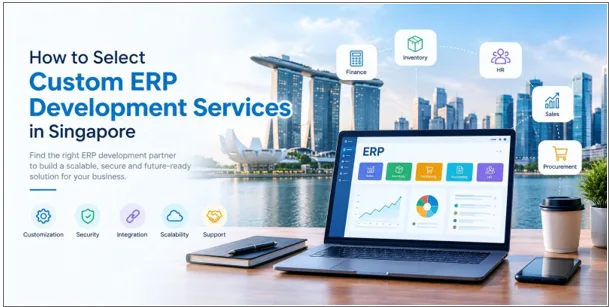
As businesses expand, managing daily operations through separate software tools can become difficult. Sales teams may work with one application, finance departments use another, and inventory teams maintain separate records. This lack of coordination can slow down decisions and increase the risk of errors.
Custom Enterprise Resource Planning (ERP) software brings essential business functions into a connected system. For companies seeking ERP development Singapore solutions, selecting the right development partner is an important step toward improving productivity, controlling costs, and supporting future growth.
1. Choose an ERP Partner That Understands Your Business Model
ERP software should reflect how your business operates, not force your employees to follow unsuitable workflows. Before approaching an ERP development company, document your existing processes, recurring challenges, and operational goals.
For example, a distributor may need better purchase planning and warehouse visibility, while a service company may prioritize project costing, employee allocation, and billing.
A reliable provider of ERP development services should begin with business analysis, identify process gaps, and recommend a solution based on your actual requirements.
2. Look Beyond Standard ERP Features
Many ERP platforms offer common modules for accounting, sales, purchasing, and inventory. However, businesses often need additional functionality to handle specialized processes.
During the evaluation, ask whether the provider can develop features such as:
- Workflows for automated procurement and cost approval
- Customer-specific pricing and discount rules
- Project profitability and resource utilization reports
- Multi-warehouse stock transfers and replenishment alerts
- Automated notifications for overdue payments
- Management dashboards with real-time operational data
The goal of custom ERP development is to address business-specific requirements without making the system unnecessarily complicated.
3. Examine the Provider’s Development Methodology
An ERP project involves several stages, from initial planning to deployment. Understanding how a development company manages these stages can help you avoid unclear requirements, missed deadlines, and unexpected expenses.
Ask potential partners to explain their approach to requirement gathering, system design, prototype development, testing, and deployment.
It is also helpful to establish measurable project milestones. These might include completing the finance module, validating inventory workflows, migrating historical records, and obtaining user acceptance before launch.
A transparent development process makes it easier to track progress and resolve issues early.
4. Check Integration With Your Existing Business Tools
Businesses rarely operate with ERP software alone. They may also use e-commerce platforms, payment gateways, customer relationship management systems, shipping applications, or external reporting tools.
Your ERP development partner should assess how these applications exchange information and determine whether APIs, connectors, or custom integrations are required.
For Singapore businesses, relevant integration requirements may include local payment methods, accounting applications, electronic invoicing networks, and logistics platforms.
Effective ERP integration reduces repeated data entry, improves information accuracy, and helps departments work from consistent records.
5. Understand Singapore’s Regulatory and Localization Needs
A custom ERP system must be configured according to the requirements that apply to your business in Singapore. These may include Goods and Services Tax (GST), financial reporting, payroll administration, and electronic invoicing.
Depending on your operations, the system may also need to accommodate Central Provident Fund (CPF) calculations, multi-currency transactions, and local banking workflows.
Ask the provider to explain which features are available through standard localization and which require additional configuration or development. For regulated processes, have qualified local professionals verify that the proposed setup meets current requirements.
This step helps ensure that the ERP system supports daily operations without overlooking important compliance considerations.
6. Evaluate Data Migration and Information Quality
Moving data from spreadsheets, legacy applications, or older ERP systems can be one of the most challenging parts of an implementation.
Incorrect customer records, duplicate products, inconsistent units of measurement, and incomplete financial histories can affect the new system if they are transferred without review.
Before selecting a provider, ask how it handles data mapping, duplicate detection, validation, trial migration, and reconciliation.
A structured migration plan should define which records will be transferred, which historical information must be retained, and how the business will verify the accuracy of the migrated data before going live.
7. Compare the Full Cost of ERP Ownership
The lowest initial quotation does not always represent the best value. ERP expenses can include software licences, hosting, customization, integrations, data migration, employee training, and ongoing technical support.
Request a cost breakdown that separates initial implementation expenses from recurring charges. You should also ask how additional requirements, future upgrades, and changes to existing modules will be priced.
When comparing ERP development services, consider the expected business benefits alongside the total investment. Reduced manual work, improved stock control, and faster reporting may provide value beyond the initial implementation period.
8. Review Security, Ownership, and Future Flexibility
An ERP system contains commercially sensitive information, making security and long-term access important selection criteria.
Discuss user permissions, audit logs, backup schedules, recovery procedures, encryption, and access monitoring with the development team.
You should also clarify who owns custom-developed code, how configuration documentation will be maintained, and whether your business can access its data if you change providers.
Finally, confirm that the ERP architecture can support additional users, locations, modules, and integrations as your business grows.
Why Consider SerpentCS for ERP Development in Singapore?
SerpentCS provides ERP-related services covering consulting, customization, implementation, integration, migration, and ongoing support. Businesses evaluating ERP solutions can explore its Odoo expertise to determine whether the platform suits their operational needs.
The appropriate approach depends on your existing systems, required features, budget, and expansion plans. Discussing these factors with an experienced ERP team can help you define a practical implementation roadmap.
Conclusion
Selecting custom ERP development services in Singapore requires more than comparing software features or project prices. Businesses should evaluate industry understanding, development methodology, integration capabilities, data migration, localization, security, and ongoing support.
A well-planned ERP solution can connect departments, improve operational visibility, and reduce unnecessary manual work. By choosing a partner that understands your requirements and future objectives, you can build a system that supports sustainable business growth.
Planning to modernize your business operations? Contact SerpentCS to discuss your ERP requirements and identify a solution aligned with your goals.