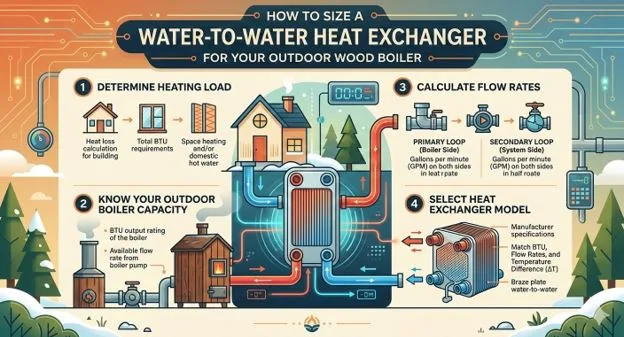
How to Size a Water-to-Water Heat Exchanger for Your Outdoor Wood Boiler
If you have heated your home with an outdoor wood boiler, you already know how gratifying it is to cut down on your heating bills while keeping your family warm with renewable energy. But here’s a big question I hear all the time: “How the heck do I know what size water-to-water heat exchanger I really need?
It’s a fair question — and frankly, getting it wrong can yield a heat exchanger that doesn’t deliver, wastes energy, or can’t keep pace with your hot water needs. The good news? It’s not as hard to size one as it sounds once you get a few basic concepts down. Let’s walk through it together.
First, What Does a Water-to-Water Heat Exchanger actually do?
Before we dive into sizing, of course, we need to ensure that we’re on the same page. A water-to-water heat exchanger pulls heat from your outdoor boiler’s continuous loop water and transfers it to a separate water system — such as your domestic hot water, radiant floor heating, or pool — but the two cannot ever mix.
This separation is important. Boiler water frequently has antifreeze or treatment chemicals that you absolutely do not want to be going into your drinking water or radiant tubing. The heat exchanger allows the heat to transfer while keeping both fluids totally separate. It’s like two highways running parallel to one another — the heat moves between them, but the water does not.
Why Sizing Matters More Than You Think
Here’s the deal: an undersized heat exchanger won’t be able to keep pace with your demand. You’ll see your domestic hot water take forever to recover, or your radiant floors won’t quite get the temperature you want. An oversized unit won’t necessarily hurt performance on the other side—but you’re spending more than you need.
The aim is to select a heat exchanger to match your actual load — how much heat (in BTUs) you need transferred each hour. Let’s figure that out.
Step 1: Calculate Your BTU Load
The key number in all of this is your BTU load — the amount of heat energy that you need to transport. Here’s the basic formula:
BTU/hr = Flow Rate(GPM) × Temperature Difference(°F) × 500
Let’s break that down:
- Flow Rate (GPM): The gallons per minute that are flowing through your system.
- Temperature Difference (ΔT): The amount of difference between inlet and outlet water temperatures.
- 500: A constant to account for the heat (specific) of water and convert units properly.
For instance, with a 4 GPM flow rate and a 30°F temperature difference:
- 4 × 30 × 500 = 60,000 BTU/hr
That would require a heat exchanger size of at least 60,000 BTU/hr. Many manufacturers, such as those here at OutdoorBoiler. There is an easy matching up once you know your number because most make BTU ratings available on their website, specializing in plate heat exchangers.
Step 2: Know Your Flow Rates
The flow rate will depend on the size of your pump and your piping configuration. Residential outdoor boiler systems typically run circulator pumps that operate between 2 and 10 GPM. Look up the specs on your circulator pump — they should tell you what GPM it will output at various head pressures.
If you use a zone valve system, determine and use the flow for the zone you are sizing the heat exchanger to, not your total system flow. However both of these zones should be assessed in isolation.
One particularly helpful reference point we found at the U.S. Department of Energy said that one of the most commonly overlooked factors for hydronic heating system efficiency is proper sizing of its components, which directly affects your energy costs and comfort.
Step 3: Determine Your Temperature Differential
The temperature differential (ΔT) is the difference between the hot side (boiler loop) and cold side (your domestic or radiant supply). You want as big a gap as possible for efficient heat transfer — but you also need to consider real-world operating temperatures.
Typical scenarios:
- Outdoor boiler loop: 160–180°F (this is your hot side IN)
- Domestic cold water inlet: 50–60°F (winter range)
- South domestic hot water output: 110–120°F
By doing so, you are separating the cold and hot sides of your plate heat exchanger, meaning your ΔT (delta T) on the primary (hot side) should be ~20–30°F letting you control each of them separately depending on how your system is configured. You want conservative estimates — better to pad a little than get caught cold on a frigid January morning.
Step 4: Choose the Right Plate Count
Water-to-water plate heat exchangers are usually sold by the number of plates — meaning options such as 20-plate, 40-plate, or 100-plate systems. Number of plates = more surface area = higher heat transfer rate.
A rough guide for sizing by plate count based on required BTU is as follows:
- 20-plate: Adequate for ~60,000–80,000 BTU/hr — Hot water for one or two bathrooms
- 40-plate: Up to ~120,000–140,000 BTU/hr — for DHW + small radiant zone
- 60-plate: up to ~200,000 BTU/hr — good for multi-zone radiant floors or larger homes
- 100 plates+: For applications with high heat demands, e.g., swimming pool heating, large radiant systems, or commercial systems
Always go a size up if you’re on the fence. A somewhat larger heat exchanger will not be a problem to the efficiency — but an undersized one, for sure.
Step 5: Account for Your Application
The application matters a lot when sizing. Let’s look at the three most common:
Domestic Hot Water
It is usually the lowest-demand application. A typical family of four (showers+dishes+laundry) generally requires 40,000–80,000 BTU/hr of heat exchangers for normal operation. In most cases, a 20- to 40-plate unit does the job well.
Radiant Floor Heating
Radiant systems can vary considerably by square footage, insulation levels, and design temperature. A good rule of thumb is 25–35 BTU per square foot for a well-insulated house. A 2,000 sq. ft. radiant floor system could require 50,000–70,000 BTU/hr — consider that in your calculation carefully.
Pool or Hot Tub Heating
One of the most strenuous purposes is heating a pool. Swimming pool heaters generally need a 100,000 BTU/hr or more rating based on the size of your swimming pool & your local climate. For pool usage, you are probably going to be looking toward a 100-plate or larger heat exchanger.
A Quick Sizing Example: Walk-Through
Let’s say you want to heat your domestic hot water and a 500 sq. ft. in-floor radiant zone.
- Domestic hot water load: ~50,000 BTU/hr
- Radiant zone load: 500 sq. ft. × 30 BTU/sq. ft. = 15,000 BTU/hr
- Total load: 65,000 BTU/hr
You’d want a heat exchanger rated for at least 65,000 BTU/hr. A 40-plate unit would be a solid choice here, giving you some headroom for colder days when your system works harder.
Don’t Forget About Flow Balance
One detail that is sometimes missed: you need sufficient flow on both sides of your heat exchanger. On the other side, a strong circulator on your boiler side and a weak pump on your domestic side means you’re losing efficiency. Try to achieve roughly balanced flow rates on each side — and at least ensure that neither side is drastically less than the other.
Also, be sure your pump can accommodate the pressure drop across the heat exchanger. Plate heat exchangers do cause resistance, and a laminate that’s already operating close to its limits may fail to outlay the flow to achieve your BTUs.
Frequently Asked Questions
Can I use the same heat exchanger for both domestic hot water and radiant heat?
You can, but are best avoided unless your system is very specifically engineered. Radiant and domestic hot water systems are often operated at different pressures and temperatures. Separate heat exchangers, one for each application, provide better control and prevent undesired contamination of your drinking water supply.
What happens if my heat exchanger is too small?
An undersized heat exchanger tries to transfer too few BTUs (its capacity), resulting in slow recovery times, lukewarm water, or floors that won’t achieve your target temperature. In addition, on the boiler side, it can cause a boiler to run longer and or hotter than needed, therefore reducing overall efficiency.
How do I know if my existing heat exchanger is the right size?
If your domestic hot water runs out faster than you’d like, if your radiant zones feel sluggish and/or if your boiler seems to run forever without reaching setpoint, there’s a good chance that the heat exchanger is undersized. Use the above formula to calculate your BTU load and make sure it doesn’t exceed your unit’s rated capacity.
Do I need to treat the water on either side of the heat exchanger?
Yes — at least on the boiler side. Outdoor boiler systems work with humidity in water; thus, handled water, antifreeze, and anti-corrosion materials are used. On the home front, your ordinary municipal or well water supply is usually fine, but hard water can lead to scale buildup inside the plates over time. In hard water areas, you can increase the lifespan of your heat exchanger by using a water softener.
How long do plate heat exchangers last?
With good water treatment and maintenance, a stainless steel plate heat exchanger can last in excess of 20 years. With proper maintenance during off-seasons, the three biggest threats to longevity are scale buildup, untreated-water corrosion, and freezing.
Can I install the heat exchanger myself?
Most DIY homeowners wire up their own heat exchangers, particularly in the case of simple domestic hot water configurations. But if you’re adding on to a radiant floor system or into a more complicated layout, working with an experienced plumber or hydronic heating specialist is money well spent.
Conclusion: Get It Right the First Time
Designing a water-to-water heat exchanger doesn’t need to be overly daunting. Now that you know the BTU load, flow rate, and temperature differential, you have all the info needed to choose an appropriate unit. Give yourself the time to run the numbers, scale up when you aren’t fully decided yet, and you’ll have a system of plants that produces well all winter long without missing a beat.
If you are still unsure which unit is right for your setup, check out the team at OutdoorBoiler. Among those is com, which has assisted thousands of homeowners in making this decision precisely. They stock the entire range of water-to-water heat exchangers that are meant for outdoor boiler systems — and they know these systems better than anyone.
Ready to find the right fit? Contact us, and we will help you to size the ideal heat exchanger for your home, your boiler, and also your finances. You’ve already taken the smart step of choosing an outdoor wood boiler — now ensure that everything else in your system is working and the way it should.