How To Size An Industrial Fan: A Step-By-Step Guide For Any Application
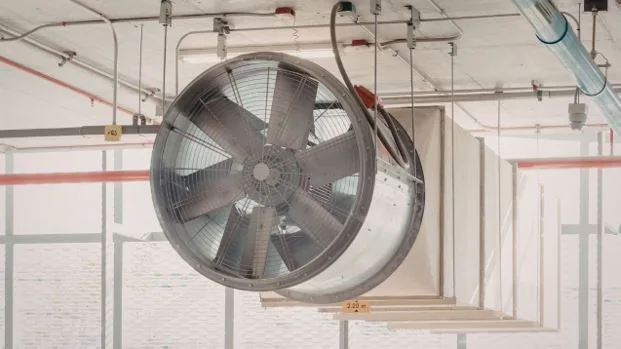
Choosing the wrong fan size is one of the most common and costly mistakes in industrial ventilation. An undersized fan fails to clear heat, fumes, or humidity fast enough. An oversized one runs louder than needed, wastes energy, and wears out faster than it should. The good news is that getting the right size doesn’t require a degree in mechanical engineering. With a few key measurements and a simple formula, most applications can be sized accurately in under an hour.
The 3 key variables you need to know
Before any calculation, it helps to understand what you’re actually measuring. All industrial fans are rated by three core performance variables, and knowing what each one means will make every sizing decision easier.
CFM (cubic feet per minute)
CFM is the volume of air a fan can move in one minute. It’s the single most important number in fan sizing, and everything else flows from it. The higher the CFM, the more air the fan can shift. A small workshop might need 2,000 CFM, while a large manufacturing floor might require 50,000 or more.
Static pressure
Static pressure measures the resistance the fan must overcome to push air through your system. In an open warehouse, resistance is low. Add ductwork, filters, bends, and dampers, and it climbs quickly. A fan that performs well in open air may deliver far less airflow once installed in a ducted system, which is why static pressure must always be factored in alongside CFM.
Air changes per hour (ACH)
ACH tells you how many times per hour all the air in a space is completely replaced. Industry standards vary significantly by application: a general warehouse typically needs 6 to 10 ACH, while a welding bay may need 20 or more to safely clear fumes. Knowing your target ACH is the starting point for any calculation.
Step-by-step: how to calculate the fan size you need
- Measure your space. Calculate the cubic footage by multiplying length x width x ceiling height. A 100 ft x 80 ft space with a 20 ft ceiling equals 160,000 cubic feet.
- Determine your required ACH. Refer to industry guidelines or local codes for your application type, whether general ventilation, fume extraction, cooling, or something else.
- Calculate required CFM. The formula is: CFM = (cubic footage x ACH) / 60. For the example above at 10 ACH: (160,000 x 10) / 60 = 26,667 CFM.
- Account for static pressure losses. Add up the estimated pressure drop across each duct component, including straight runs, bends, filters, and grilles. Your fan must deliver the target CFM at that total static pressure, not just in free air.
- Add a safety factor. Apply a 10 to 20% buffer to your CFM figure to account for real-world variations or future changes to the space, then match the result to a fan performance curve.
Worked example: A 10,000 sq ft warehouse with 18 ft ceilings = 180,000 cubic feet. At 8 ACH: (180,000 x 8) / 60 = 24,000 CFM required. With a 15% safety buffer: 27,600 CFM.
Common sizing mistakes to avoid
Sizing on CFM alone and ignoring static pressure is the most frequent cause of underperforming installations. Oversizing to “play it safe” drives up energy costs and often creates unnecessary noise. Forgetting heat loads, humidity, or airborne contaminants can also increase the effective ventilation demand beyond what your initial calculation suggests. Finally, choosing fan type based on price rather than application fit, where axial fans suit open low-resistance spaces and centrifugal fans handle high-pressure ducted systems, is a mistake that’s expensive to undo. If you’re unsure which type suits your setup, this comparison of axial flow fans vs centrifugal fans is a good place to start.
When to consult a professional
For most standard applications, the steps above will get you to a reliable answer. There are situations, however, where professional input is worth the investment: hazardous or explosive environments requiring ATEX-rated equipment, complex multi-branch duct networks, high-temperature or corrosive process streams, and large facilities where full energy modelling is warranted. Applications involving fumes, such as paint booths or welding areas, also carry workplace exposure obligations that go beyond airflow alone and are worth understanding before specifying a system. You can read more about the impact of paint fume exposure if that applies to your facility.
Getting it right from the start
Fan sizing doesn’t need to be intimidating. Measure your space, identify your ACH requirement, run the CFM formula, account for static pressure, and add a buffer. That five-step process covers the vast majority of industrial applications, and getting it right upfront will save you the far greater cost of replacing an undersized or oversized unit down the track.