How to Talk to Strangers Online Without Turning On Your Camera
Sometimes you want a conversation without making a video call. You might be relaxing after work, practicing a language, or simply wondering what someone on the other side of the world is doing. None of those situations necessarily calls for showing your face or sharing your social profiles.
Voice and text chat offer two ways to meet someone new while keeping the camera off. The experience depends on which format you choose, how the platform works, and how much control you have once a conversation begins.
Choose between voice and text
Voice chat suits moments when you want a flowing conversation. You can hear someone laugh, catch their tone, and ask a follow-up question without typing everything out. It can also be useful for practicing spoken language, although a random match is not necessarily a teacher or native speaker.
Text chat works when you need quiet, want more time to think, or simply prefer writing. It lets you start with a short message and decide how much to share as the conversation develops.
Neither format guarantees a good match. What matters is being able to choose the experience you want and leave comfortably when it does not suit you.
Understand how random matching works
In a random chat, the platform introduces you to another available person rather than asking you to browse a feed or send connection requests. That removes some setup, but it also means you may have little information about your partner before the conversation starts.
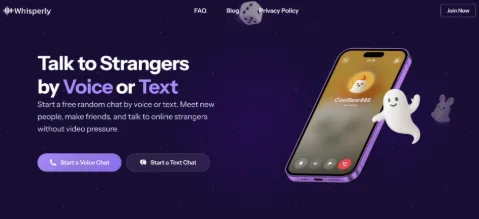
For example, Whisperly offers random voice and text conversations without requiring a camera. Users can choose a format, meet someone, and add people as friends when they want to stay connected.
When comparing services, look beyond the promise of instant matching. Check which features are free, whether an account is needed to save friends, and how to end or report a conversation. Matching speed and the people available can vary, so avoid judging an entire platform by a single encounter.
Give the conversation somewhere to go
An opening message does not need to be clever. It just needs to give the other person something they can comfortably answer.
Try a question such as:
- “What have you been listening to lately?”
- “Are you taking a break from something, or just passing time?”
- “What’s a food from where you live that everyone should try?”
Follow the answer rather than moving through a list of questions. If someone mentions a game, a recipe, or an unusual workday, that detail gives you a natural next step.
It also helps to share something yourself. A conversation can feel like an interview when one person asks everything and reveals nothing. You can contribute an opinion or a small story without giving away identifying details.
Keep control over what you share
Having your camera off protects your face and surroundings from being shown, but it does not make a conversation completely private. Another person may copy text or record audio.
Start with information you would be comfortable sharing with someone you have just met. Avoid revealing your address, financial details, passwords, or verification codes. Be cautious about unfamiliar links and pressure to move immediately to another service.
Before starting, find the platform’s leave, block, and report controls. You do not owe a stranger a prolonged conversation, and ending an uncomfortable interaction does not require an explanation.
Leave room for another conversation
Some random chats last a minute. Others lead to a shared joke, a useful recommendation, or someone you would enjoy speaking to again.
If the interest is mutual, a built-in friend feature can let you reconnect without immediately exchanging phone numbers or personal social accounts. Check what the service saves and which account features you need before relying on it.
You do not have to turn every introduction into a friendship. Start with a format that feels comfortable, stay curious, and let a worthwhile conversation develop at its own pace.