How to Use Interactive Reloading Data Online for Better Precision
Many handloaders struggle with velocity spreads that do not match their printed manuals. You follow a recipe exactly, yet your chronograph shows results far from the expected numbers. It happens because static books cannot account for your specific barrel length, chamber tightness, or ambient temperature.
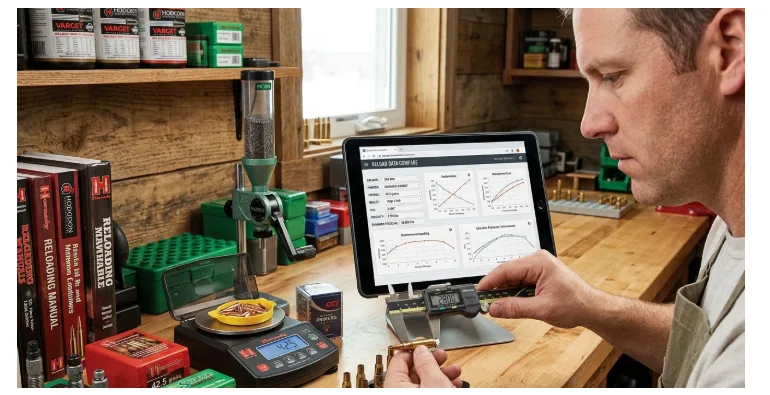
According to the SAAMI, even slight variations in component lots or chamber dimensions can lead to significant pressure changes. Relying solely on a single book can leave gaps in your technical knowledge because it represents a “test barrel” environment rather than your own. You need a way to access reloading data online that adapts to your unique reloading environment. Using the data online provides a dynamic solution for those seeking tighter groups and safer chamber pressures.
Objective of Blog
This guide explains how to transition from static manuals to interactive digital tools. You will learn to use modern software to improve shot consistency, predict pressure levels, and ensure long-term safety at the bench.
Key Takeaways
- Interactive data allows for real-time adjustments based on your specific firearm’s dimensions.
- Digital tools offer more frequent updates than printed books, reflecting new powder blends.
- Precision depends on meticulously cross-referencing multiple digital sources.
- Internal ballistics software can predict pressure and velocity before you ever fire a shot.
Improve Your Accuracy with Reloading Data Online
Precision starts with the ability to input your own variables when working with reloading data online. Static recipes provide a safe starting point. However, interactive tools let you adjust for seating depth and case capacity.
When you use these digital platforms, you move beyond “one size fits all” recipes. You can simulate how a specific powder will perform in a short-barreled carbine versus a long-range match rifle. This level of customization is the hallmark of modern handloading.
What is Interactive Reloading Data?
Interactive data is more than just a digital list of grains and grams. It includes software and web-based platforms that calculate variables in real time using physics-based modeling. These systems use mathematical models to predict how a cartridge behaves inside the chamber and down the bore. Unlike a static PDF, these tools allow you to change one factor, like bullet weight or seating depth, and see the immediate impact on projected pressure.
Many enthusiasts now prefer a digital reloading database because it stays current. Manufacturers like Hodgdon, Alliant, and Vihtavuori update their web portals much faster than they print and distribute new books. This ensures you always have the latest safety margins for new powders. Furthermore, a digital reloading database often includes data for newer calibers that haven’t made it into the latest edition of a hardcover manual yet.
The Role of Internal Ballistics Calculators
Modern software has fundamentally changed the hobby for the better. Tools like QuickLOAD and Gordon’s Reloading Tool (GRT) use complex algorithms to simulate the firing sequence. They help you find the “node” where your rifle performs best.
- Pressure Prediction: See potential spikes before you even prime a single case.
- Powder Efficiency: Determine how much of your propellant actually burns in the barrel to avoid excessive carbon buildup.
- Environment Loading: Adjust your handloading data for high-altitude hunting or cold-weather matches.
Using these tools allows you to experiment virtually. You can swap between twenty different powders in minutes to see which one fills the case volume most effectively. This saves you from buying five different jugs of powder just to find out four of them don’t work for your goal.
How to Use Digital Load Data Online for Better Results
To get the most out of these tools, you must be meticulous with your physical measurements. The software is only as good as the numbers you provide.
- Measure Your Case Capacity: Don’t rely on default settings in the software. Weigh your fired brass with water to get the exact volume in grains of H2O.
- Input Precise OAL: The Overall Length affects the “jump” to the rifling and, more importantly, the internal combustion space.
- Record Your Chronograph Data: Use your actual muzzle velocity to “tune” the software to your specific rifle.
By feeding your real-world results back into the system, you refine your load data online. This creates a feedback loop that results in extreme consistency. You should also compare reloading data across different software platforms to ensure no single tool is giving an outlier result that could lead to an over-pressure situation.
Cross-Referencing with a Reloading Database
Never trust a single digital source blindly. Even the best handloading data can have errors or typos. A responsible reloader uses at least three sources to verify a new load.
- Check the powder manufacturer’s official website for the latest ceiling.
- Check the bullet maker’s app for specific ogive measurements and seating depths.
- Verify the results with an internal ballistics calculator to check for pressure signs.
If one source suggests a maximum load that is significantly higher than the others, stay cautious. Safety is always the priority over high velocity. Digital resources make this cross-referencing process much faster than flipping through five different 600-page books.
The Importance of Case Capacity and Volumetric Consistency
When you use a reloading database, you will notice that case volume is a critical variable. Different brands of brass have different internal wall thicknesses. A Winchester case might have more internal volume than a Lapua or Lake City case. This matters because a smaller space with the same amount of powder creates higher pressure.
Interactive tools allow you to account for this. When you use load data online, you can enter the specific water capacity of your brass. This changes the pressure curve immediately. This level of detail is why competitive shooters can achieve such low standard deviations in their velocity. They aren’t just following a recipe; they are modeling a system.
Discover the Best Reloading Data Platform for Your Needs
The world of digital reloading is vast and sometimes confusing. There are many ballistics calculators, manufacturer tables, and PDF guides available today for reloading data online. It can be difficult to know which software offers the most accurate bullet coverage or the best user interface. Many shooters look for reliable resources to simplify the process.
They provide clear, side-by-side comparisons of leading tools. By reviewing caliber support and data quality, they help you choose between advanced software and simple web tools.
At LoadDataCompare, the goal is accuracy and clarity. Explore their comparisons today and find the right data source for your next reloading project. Make smarter decisions and improve safety with trusted information tailored to your exact setup and shooting needs.
Frequently Asked Questions
1. Is a digital reloading database better than books?
Yes, because online tools offer real-time updates for new powders and calibers. While manuals are great for basics, digital platforms allow for precise adjustments to match your specific barrel and chamber.
2. How do I verify handloading data for safety?
Always cross-reference your results across at least three reputable platforms. If a specific handloading data source shows significantly higher pressure than the others, you should reduce your charge immediately to stay safe.
3. Can I find reliable load data online for free?
Many manufacturers provide free web portals. However, using a specialized load data online tool can offer more advanced internal ballistics modeling for long-range precision that basic tables simply cannot provide.
4. Why is finding accurate reloading data online so difficult?
The landscape is cluttered with outdated PDFs and forum posts. Searching for reloading data online requires using verified calculators that account for your unique case capacity and environmental variables.