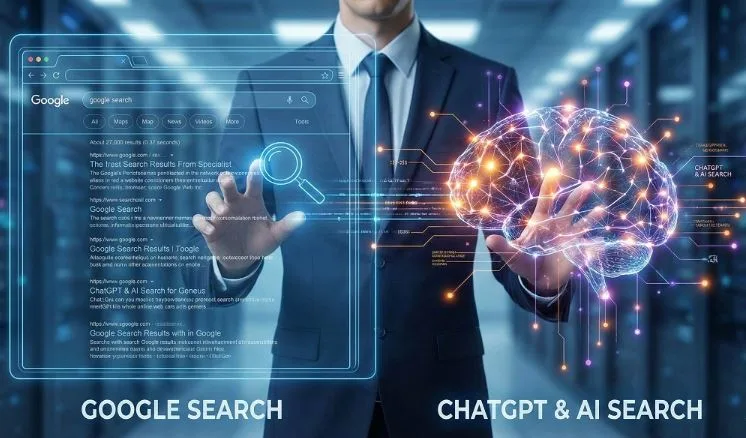
How to Win on Google & ChatGPT in 2026
The “ten blue links” are disappearing. For decades, the goal was simple: rank #1, get the click, and convert the user. That model is breaking.
Users are no longer searching; they are asking. Platforms like ChatGPT, Perplexity, and Google’s Gemini now provide direct answers, often removing the need to visit a website entirely. If your strategy relies solely on traditional keywords, your traffic is likely in freefall. You don’t just need an SEO expert anymore.
You need a hybrid strategy. You need a partner who understands both the algorithm and the large language model (LLM). At khalidseo, We bridge this gap, ensuring your brand dominates both the search bar and the chat window.
The Shift: From SEO to GEO (Generative Engine Optimization)
Search Engine Optimization (SEO) is evolving into Generative Engine Optimization (GEO).
Traditional SEO focuses on sorting resources. You optimize a page to prove it deserves to be at the top of a list. GEO focuses on synthesizing answers. You optimize content so an AI engine cites you as the source of truth.
Why “Blue Links” Are Dying
Organic click-through rates (CTR) for simple queries are plummeting. When a user asks, “How to fix a leaky faucet,” Google SGE or ChatGPT gives them the steps immediately. The user gets the value without visiting the publisher. This “Zero-Click” reality demands a pivot in strategy. You must target queries where deep expertise is required, where the AI summary isn’t enough.
The Rise of the Answer Engine
Answer Engines do not care about your meta tags. They care about your authority. They scan the web, ingest reliable data, and reconstruct it into a conversational response. To win here, you cannot just be relevant; you must be the primary source.
| Feature | Traditional SEO | AI Search Optimization (GEO) |
| Primary Goal | Ranking Position & Clicks | Citations & Brand Mentions |
| Target Audience | Human Searchers | LLMs & Human Searchers |
| Content Focus | Keywords & Length | Information Gain & Entities |
| Success Metric | Organic Traffic | Share of Model (SoM) |
The “Entity-First” Strategy: Speaking the Language of AI
AI models do not read keywords like “best running shoes.” They understand entities – concepts, people, brands, and the relationships between them.
Keywords are for Search Bars; Entities are for Chatbots
In the old world, you repeated a keyword to prove relevance. In 2026, you must establish connections in the Knowledge Graph. An LLM needs to know that [Your Brand] is an authority on [Your Industry]. If that connection isn’t mathematically strong in the model’s vector space, you won’t be cited.
Building Your Brand in the Knowledge Graph
To train the AI to recognize you, you must be consistent.
- Structured Data: Ensure your “About” page schema is flawless.
- Third-Party Validation: Secure mentions on authoritative sites (Wikidata, Crunchbase, industry journals).
- Consistent N-A-P: Your Name, Address, and Phone data must be identical across the web.
At khalidseo.com, we focus heavily on “Entity Optimization” . We don’t just write blogs; we map your brand into the digital ecosystem so machines trust you as much as humans do.
Content Strategy 2026: Writing for Robots AND Humans
If an AI can easily summarize your article, your article is likely low-value. To survive, you must provide what Google calls “Information Gain.”
Information Gain: The Only Metric That Matters
Information Gain is the measure of new details your content adds to the existing corpus. If you rewrite the top 3 results on Google, you add zero value. AI will ignore you.
To win, you must include:
- Original data or studies.
- Contrarian opinions based on experience.
- Proprietary frameworks.
Optimizing for the “Citation”
LLMs prefer structured, confident data. When answering a question, formatting matters. Use bold text for direct answers. Use bullet points for steps. State facts clearly early in the content. This structure makes it easy for an Answer Engine to grab your snippet and credit you.
The Technical Foundation: Schema & Structure
You cannot build a skyscraper on quicksand. While AI handles the front end, technical SEO powers the back end.
Schema Markup 2.0
Schema is the language of the machine. It tells the bot explicitly: “This is a product,” “This is a review,” “This is the author.” In 2026, using SameAs and Mentions schema is critical to connect your content to broader topics in the Knowledge Graph.
Site Speed & Core Web Vitals
Speed is still a ranking factor. AI agents have limited “compute budgets.” If your site is slow or difficult to parse, the crawler will leave before it indexes your valuable content.
Measuring Success in the Era of AI
Traffic is no longer the only KPI. You might see fewer visitors, but they will be higher quality.
Beyond the Click: Brand Mentions & Sentiment
You must track your “Share of Model.” How often does ChatGPT mention your brand when asked about your industry? Even if a user doesn’t click, being the cited authority builds immense trust. This “implied endorsement” drives higher conversion rates when users finally do search for you directly.
Frequently Asked Questions
What is the difference between SEO and AI Search Optimization (GEO)?
SEO focuses on ranking links, while GEO focuses on winning citations. SEO targets clicks from search engines, whereas GEO optimizes content to be summarized and credited by AI models like ChatGPT and Gemini.
Traditional SEO relies heavily on keywords and backlinks to drive traffic. GEO prioritizes “Information Gain,” entity authority, and structured formatting to ensure AI models trust the data enough to present it as a direct answer to users.
How do I rank my business on ChatGPT?
You rank on ChatGPT by building Entity Authority in the Knowledge Graph. You must establish your brand as a trusted entity through consistent data, high-quality citations, and authoritative content.
Unlike Google, ChatGPT doesn’t have a “page one.” It retrieves information based on probability and trust. Strategies include implementing robust Schema markup, getting cited by sources the AI trains on (like news sites), and ensuring your brand details are consistent across the web.
Is SEO dead in 2026?
No, SEO is not dead, but it has transformed into a hybrid discipline. The era of easy traffic from simple keywords is gone, replaced by a need for technical excellence and deep topical authority.
“Ten blue links” SEO is declining. However, search behavior is actually growing. The winners in 2026 are those who adapt to Answer Engine Optimization (AEO), ensuring they remain visible whether the user searches on Google or asks a voice assistant.
What skills does an AI Search Specialist need?
An AI Search Specialist needs skills in Knowledge Graph management, Schema markup, and Natural Language Processing (NLP). They must understand how to optimize for both human psychology and machine learning algorithms.
Beyond basic keyword research, a modern specialist must understand “Vector Search”—how AI groups related concepts. They need to be part data scientist and part content strategist to ensure a brand’s signals are clear to sophisticated AI models.
How does Google SGE affect website traffic?
Google SGE generally reduces top-of-funnel traffic but can increase conversion rates. By answering simple questions directly, SGE keeps users on Google, meaning fewer clicks for basic definitions.
While overall traffic volume may drop, the traffic that does click through is often “deeper” in the buying journey. These users are looking for nuanced expertise, products, or services that a short AI summary cannot provide, making them more valuable leads.
Ready to future-proof your visibility?
The landscape has changed. Don’t let your business disappear from the search results. Visit khalidseo.com today to audit your Entity Authority and start winning on the engines of tomorrow.