How University Students Are Managing Multiple Assignment Deadlines in 2026
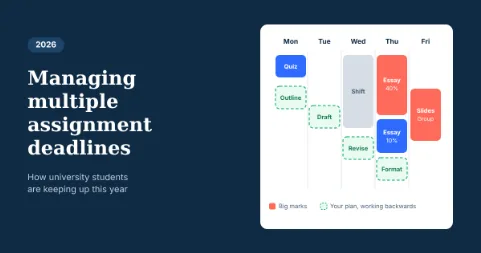
It’s Monday morning and the portal shows two essays due Thursday, a group presentation on Friday and a quiz tonight. On top of that, you’re working Wednesday at the café and nobody wants to swap
Sound familiar? Thought so.
The people who seem good at deadlines usually aren’t naturally organized. They just got sick of the panic and built a few habits to avoid it. Here’s what those habits look like, plus a couple of time-wasters that catch out more students than they’d admit.
Why It All Lands at Once
Courses used to be simpler. A few years back, a module meant one long essay and a final exam. Now you might get weekly quizzes, forum posts, a group task and an essay in the same term, and every marker wants references done their way. None of it feels huge. All of it adds up.
Life Outside the Classroom
Then there’s life. Jobs, internships, family stuff, a side hustle you’re trying to get off the ground. Plenty of students are quietly running a small business next to their degree, so free hours are precious. That’s probably why freelancer and founder habits keep turning up in study advice. Those people have been juggling too much work and too little time for a lot longer than the rest of us.
When Your Side Project Is a Book
One of them is writing projects. The process of writing, editing, designing and publishing a book whether it’s a book, a memoir or a how-to—can consume hours of work as long as a full module. One way people take some weight off of the book is through book-focused services like 11ghostwriters.com, which provides ghostwriting, editing, publishing and marketing for authors. It should be noted that this type of assistance has nothing to do with your classwork but only with your book.
Plan Your Assignments Like a Founder Plans Their Week
Say a founder has ten jobs and only a week. They won’t start with whatever’s first on the list. They’ll pick the one that moves the business forward, and the same works for coursework
Put Everything in One Place
Dump every deadline into a single calendar. Syllabus dates, emails, that thing your lecturer mentioned in week three. Next to each one, jot the word count and what it’s worth. Twenty minutes, tops. It’ll probably make you a bit queasy, but at least you can see the ugly weeks coming instead of getting flattened by them.
Grade Weight Beats Due Date
A 10 percent reflection due tomorrow isn’t the same problem as a 40 percent report due in two weeks. So ask two questions. What’s it worth? How long will it really take? Big on both, start now. The tiny one can wait for a single focused evening.
Work Backwards
“I’ve got two weeks” is how people end up starting on day twelve. Cut the job into chunks instead: outline, reading, rough draft, rewrite, final check. Put a date on each. Suddenly it’s five small things, and small things are much easier to begin.
A Routine that Endures Bad Weeks
Don’t rely on motivation; that’s not something you can count on. A tedious routine is more than. Look at the week ahead Sunday for 10 minutes. Work Sessions for an hour or so, with an appropriate break in between. Call in from another room (Yes, really). One empty spot each week as well, since things will always go wrong. The Laptop dies, you get a cold, someone in a group goes silent. Founders schedule their days accordingly to fit this in.
Don’t forget to format the final section before the end of each deadline, either! A format generator can do all the title pages, headings and formatting of your reference list according to your course’s style; you don’t need to be working at 2 a.m. with margins. Instead, do it on Wednesday afternoon. You won’t lose as much of your mark for silly things that aren’t related to your ideas.
Let Software Do the Dull Bits
There are some thinking tasks on the assignments. Admin is admin and citations are the worst of the admin! The MLA generator will create clean entries to books, articles and websites in seconds, freeing up your brain power for the actual argument. But be sure to compare with your department’s guide, though. Style manuals undergo changes from edition to edition and generators don’t always update.
It’s a simple rule. Mechanical tools. You retain the elements of reading, thinking and writing.
Understand when to ask for assistance.
There are times when the hours just don’t add up. Two major deadlines come together, someone in the family is sick, or you are just plain bored. Asking for help then isn’t failing. This is a call and it’s typically a wise one.
See if you can use the free ones first. Send your lecturer an email as soon as possible. There are a lot of them who will listen to an honest plea ahead of the deadline and much fewer afterward. Make an appointment to the writing center. Discuss notes with two classmates.
When times are tough, some students turn to other alternatives. If you do, make it a point to be picky and know what you’re buying. You can learn a lot from a professional assignment writing service, which can provide you with guidance and model answers that will give you insight on how to construct a strong piece.
Look at your university’s policy on outside assistance first, and then any material you have received or use as study material – treat it as such and do not submit with your name on it as a job for someone else to do.
Pay attention to Your Energy Too!
A well-planned schedule is not going to help if you haven’t had enough sleep and your lunch was a bag of chips. Those who regularly meet deadlines are likely to safeguard the fundamentals. Sleep, wait for the right food, a walk if necessary; if not, a bit of screen-free time.
Also take note of when your head is at its clearest. Morning writer? Draft now, then leave for the afternoon dip.
A paraphrasing tool can also be employed to reveal alternative ways of expressing the same concept if a sentence simply won’t cooperate in the middle of a draft. Sometimes, that’s all it takes to get moving again.
Use what it provides as a nudge; write your answer and be sure to quote your sources. The work you do must demonstrate your comprehension and your university’s academic honesty policies apply to all of your tools.
Frequently Asked Questions
When there are multiple assignments due for the same week, how do I prioritize?
See how much they’re worth, and how long it will really take you, and then begin with the heavier ones. The due date alone is not a good indication. A large homework project that is due next week will require tackling before a smaller one that is due tomorrow.
Can I use an MLA generator to make citations?
Yes, there is a lot of time saved. Simply read the results and see how they match your own institution’s style guide before submission – generators can get things wrong.
Is a paraphrasing tool useful to academic writing?
It can provide you with ideas as to how to reword a sentence, but it should not be used to write your sentence for you. Use it as inspiration, paraphrase and cite the source.
When is the best time to begin a large assignment?
As soon as you get the brief. A quick initial session researching the question and a few sources will make research easier afterward.
What should I do if I know I’m going to miss a deadline?
If you need to let your lecturer or student support team know as soon as you can, tell them honestly why, and what the options are. It is always easier to get a message through early than to get one through late.
We need to cover this in detail. We need to go over this in depth.
It’s OK if you don’t have a new system by Friday. Set deadlines in one place, and decide what are the two most important things are, and give each a small initial step. This should help you go through a crazy week in a controlled manner.