How Weight Loss Peptides Influence Appetite and Satiety Pathways
Why do we feel hungry? What makes us stop eating? And why can two people consuming similar diets experience very different levels of hunger and fullness?
Modern metabolic science has revealed that appetite is not controlled by willpower alone. Hunger and satiety emerge from a sophisticated biological communication network involving the brain, gastrointestinal tract, pancreas, adipose tissue, hormones, nutrients, and nervous system.
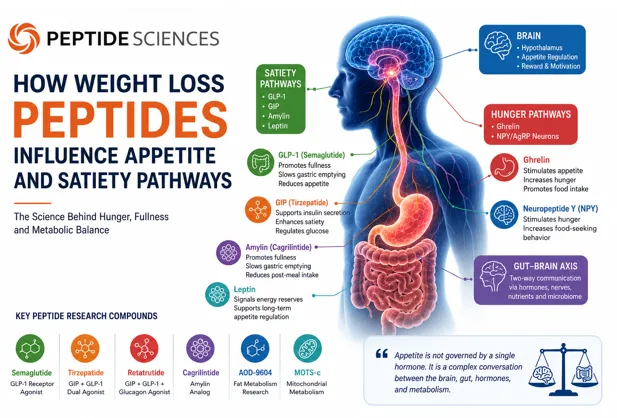
At the center of this network are peptide hormones and related signaling molecules. Scientific interest in peptides for weight loss has expanded rapidly as researchers investigate compounds that influence GLP-1, GIP, amylin, ghrelin, and other pathways associated with appetite, gastric emptying, glucose metabolism, and energy balance.
Understanding these compounds begins with understanding how the body decides when to eat—and when to stop.
The Biology of Hunger and Satiety
Hunger is not simply the sensation of an empty stomach. It is the result of multiple biological signals being interpreted by the brain.
Before, during, and after a meal, the digestive system releases hormones that communicate information about nutrient intake. The pancreas provides additional metabolic signals, while adipose tissue communicates information about stored energy reserves.
The brain integrates these messages to regulate food-seeking behavior and feelings of fullness.
Two concepts are especially important: satiation and satiety.
Satiation is the process that causes a person to stop eating during a meal. Satiety refers to the suppression of hunger between meals.
Different hormonal pathways may influence one or both processes, which is why researchers study multiple signaling systems rather than searching for a single “hunger hormone.”
The Hypothalamus: A Central Appetite-Regulation Center
The hypothalamus is a region of the brain with a major role in maintaining physiological balance.
Within the hypothalamus, specialized neurons receive and interpret hormonal and nutrient-related information. Some neural pathways stimulate hunger, while others promote satiety.
Two particularly important neuronal populations involve neuropeptide Y and agouti-related peptide neurons, which generally stimulate food intake, and proopiomelanocortin neurons, which contribute to satiety-related signaling.
The hypothalamus responds to signals including leptin, insulin, ghrelin, GLP-1, and nutrients circulating in the blood.
However, appetite regulation extends beyond the hypothalamus. Brainstem centers, reward circuits, sensory experiences, emotions, learned behavior, and environmental factors also influence eating.
This complexity helps explain why body-weight regulation cannot be reduced to one molecule or mechanism.
GLP-1: A Major Satiety Pathway
Glucagon-like peptide-1, commonly known as GLP-1, has become one of the most important targets in modern metabolic research.
GLP-1 is an incretin hormone released primarily from intestinal L cells in response to nutrient intake. It participates in several physiological processes, including glucose-dependent insulin secretion, glucagon regulation, gastric emptying, and appetite signaling.
GLP-1 receptors are present in several tissues, including regions involved in metabolic control.
Semaglutide is a prominent GLP-1 receptor agonist. Researchers have extensively studied how prolonged GLP-1 receptor activation can influence hunger, satiety, caloric intake, glucose regulation, and body weight.
The rise of GLP-1 science also encouraged researchers to ask whether activating additional metabolic receptors could produce different effects.
GIP and Dual-Receptor Signaling
GIP, or glucose-dependent insulinotropic polypeptide, is another incretin hormone released following food intake.
Like GLP-1, GIP participates in metabolic regulation, but its biology is distinct and complex.
Tirzepatide is a dual GIP and GLP-1 receptor agonist. Its development represents an important shift toward targeting multiple hormonal pathways simultaneously.
Scientists investigate how combined receptor activity influences insulin secretion, appetite, satiety, glucose metabolism, and body weight.
The success of dual-receptor research has contributed to an even broader scientific question: could three metabolic pathways be targeted within a single molecule?
This question led to growing interest in triple-receptor agonists such as retatrutide, which acts through GIP, GLP-1, and glucagon receptors.
Amylin and the Regulation of Fullness
GLP-1 and GIP are not the only peptide-related pathways involved in appetite.
Amylin is a peptide hormone secreted alongside insulin by pancreatic beta cells. It contributes to post-meal metabolic regulation and has important relationships with satiation and gastric emptying.
Cagrilintide is a long-acting amylin analog investigated in metabolic and weight-management research.
The amylin pathway is particularly interesting because it provides a mechanism distinct from GLP-1 receptor agonism. Researchers are also investigating whether targeting both amylin and GLP-1 pathways can produce complementary effects.
This reflects a central theme in modern metabolic science: hunger and satiety are controlled by interconnected hormonal networks rather than a single biological switch.
Ghrelin: The Hunger Signal
While GLP-1 and amylin are strongly associated with satiety, ghrelin is commonly described as the “hunger hormone.”
Produced primarily by the stomach, ghrelin levels typically rise before meals and decline after eating. It acts through the growth hormone secretagogue receptor and influences hunger, food intake, growth hormone secretion, and energy balance.
The relationship between ghrelin and peptide research is particularly interesting because certain growth hormone-releasing peptides also act through the ghrelin receptor.
GHRP-6, for example, is associated with significant appetite stimulation, while Ipamorelin is generally studied for more selective growth hormone secretagogue activity.
This illustrates an important point: not all peptides associated with metabolism suppress hunger. Depending on their receptor targets, some may actually stimulate appetite.
Leptin and Long-Term Energy Reserves
Leptin provides another essential piece of the appetite puzzle.
Produced primarily by adipose tissue, leptin communicates information about stored energy reserves to the brain. Generally, greater fat mass is associated with higher circulating leptin concentrations.
In theory, increased leptin should reduce hunger. However, obesity is often associated with leptin resistance, a state in which the brain may become less responsive to leptin signaling despite elevated levels.
This demonstrates why simply increasing or decreasing one hormone does not necessarily solve the complex biological challenge of weight regulation.
Researchers must consider receptor sensitivity, neural signaling, metabolic health, genetics, environmental influences, and interactions with other hormones.
Gastric Emptying and the Gut-Brain Axis
The speed at which food leaves the stomach can influence feelings of fullness.
Slower gastric emptying may prolong gastric distension and alter nutrient delivery to the small intestine, contributing to satiety-related signals.
GLP-1 and amylin pathways are both associated with gastric emptying, although effects can vary according to compound, exposure duration, and physiological context.
More broadly, the gut-brain axis describes the two-way communication network connecting the gastrointestinal system and central nervous system.
This communication involves hormones, the vagus nerve, immune signals, microbial metabolites, and nutrients.
Many metabolic peptides are scientifically important precisely because they interact with this gut-brain communication system.
Why Different Weight Loss Peptides Cannot Be Treated as Equal
The phrase “weight loss peptides” covers compounds with fundamentally different mechanisms.
Semaglutide primarily acts through GLP-1 receptors. Tirzepatide combines GIP and GLP-1 activity. Retatrutide adds glucagon receptor agonism. Cagrilintide targets amylin-related pathways.
Other compounds frequently discussed in metabolic research, such as AOD-9604 and MOTS-c, are investigated through entirely different mechanisms involving lipid or mitochondrial metabolism rather than primarily suppressing appetite.
Therefore, comparing compounds requires examining receptor activity, molecular structure, pharmacokinetics, evidence quality, and specific research objectives.
The Future of Appetite and Satiety Research
The future of metabolic research is increasingly focused on understanding how multiple biological signals work together.
Scientists are exploring GLP-1, GIP, glucagon, amylin, ghrelin, leptin, mitochondrial signaling, and other pathways that influence hunger, fullness, glucose regulation, and energy expenditure.
The progression from single-receptor compounds such as semaglutide to dual agonists such as tirzepatide and investigational triple agonists such as retatrutide illustrates how rapidly this field is evolving.
Yet the central lesson remains clear: appetite is not governed by a single hormone, receptor, or brain region. It is produced by an intricate conversation between the brain, gut, pancreas, adipose tissue, nervous system, and metabolic environment.
By investigating these communication pathways, researchers are gaining a deeper understanding of one of biology’s most fundamental questions: how the body decides when it needs energy—and when it has had enough.