How Wholesale Businesses Can Improve Inventory Management with ERP
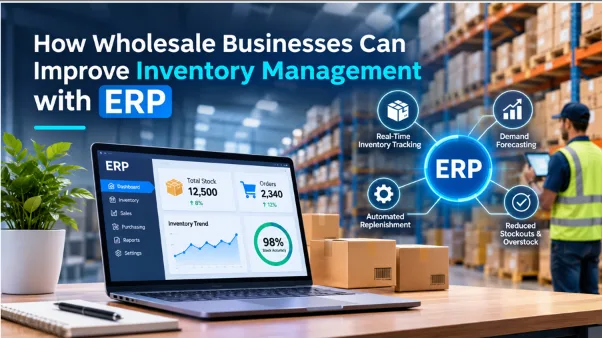
The efficient operation of inventories is an important factor in the success of wholesale businesses. In contrast with retailers, wholesalers deal with significant amounts of goods, bulk purchases, various suppliers and even different warehouses. In order to coordinate all those processes effectively, correct inventories and coordination between various departments are required.
At the same time, many wholesalers continue using Excel, manual data entry and separate software programs. This approach may result in incorrect inventory data, overstocking, understocking, delays in deliveries and unneeded costs.
ERP for Wholesalers solves this problem by integrating inventory, purchasing, sales, warehousing and reporting processes into one system. Companies get an opportunity to control their inventories, automate routine operations and make purchases on the basis of updated data.
Why Is Inventory Management Important for Wholesale Businesses?
Good inventory management enables the availability of required inventory at the right time without maintaining any excess inventory. This directly affects profitability, customer satisfaction, and efficiency in operation.
This is how inventory management becomes important:
- Inventory level control: One gets to know the exact status of inventory whether it is in the store or being reserved.
- Handling bulk inventory: Helps to manage inventory in larger amounts across different product lines.
- Stocks neither in excess nor in shortage: Balanced inventory based on the demand status.
- Improving order processing time: Process customer orders more easily using good inventory status.
- Controlling inventory expenses: Saves money from over expenses of stocking, wastage, etc.
A well managed inventory process also facilitates better connections for wholesalers with their suppliers and customers.
Common Inventory Management Challenges Faced by Wholesalers
Inaccurate Stock Records
Manually updated inventories and disjointed systems tend to generate discrepancies between recorded inventory levels and real inventory levels.
Overstocking and Understocking
Without appropriate demand visibility, wholesalers will purchase too much or insufficient stock. Excess inventory leads to high costs of storage, while shortages could lead to lost sales.
Managing Multiple Warehouses
The tracking of the same product from one warehouse to another would be difficult if the inventory records are kept independently. Companies will find it hard to know the availability of products and their stock distribution.
Delayed Order Processing
If there is no connection between the sales and inventory system, manual confirmation of the available stock and updating of the orders becomes necessary. This will lead to slow order processing and chances of making mistakes.
How Can ERP Software Improve Inventory Management?
An ERP system enables efficient management of inventory transactions by way of automation, centralization of data, and live reporting.
Real-Time Inventory Tracking
Inventory data is updated automatically whenever products are bought, received, sold, shipped, and returns are made.
The business is capable of:
- Monitoring availability of stock in all warehouses.
- Recording inflow and outflow of products.
- Determining which products are reserved and available.
- Updating the data of inventory.
This ensures that correct stock level information is available before fulfilling customer orders.
Automated Stock Replenishment
The use of automated replenishment allows firms to have sufficient supplies without constantly checking their stock level.
The wholesalers will be able to set minimum and maximum stock limits and also have the ability to know when the items have to be replenished.
This is because the firm will factor in the trends in demand, supplier lead time, and existing stock. Microsoft notes stocking policy and demand forecasting as essential aspects of supply planning.
Centralized Warehouse Management
Centralization offers a means to view stocks within various stock holding locations. The company will be able to view warehouse wise stock levels, coordinate transfers, keep an eye on goods coming in and going out, and know where exactly particular products are available.
Integrated Purchasing and Sales
Integrating buying, selling, and inventory processes ensures that there is no duplication of effort involved in data entry. In the case where a customer makes an order, the software will be able to determine the inventory and update the records upon completion of the order. The same applies to purchases where the receipt will update the inventory.
Inventory Forecasting and Reporting
Data on historical sales will be useful to the wholesalers in knowing their product demands and buying patterns.
Through ERP reporting system, firms will be able to:
- Identify fast moving and slow moving items.
- Analyze demand pattern trends.
- Track inventory turns.
- Measure supplier performance.
- Plan future purchasing needs.
Key ERP Features Wholesale Businesses Should Consider
Prior to the implementation of ERP solutions, the wholesaler needs to assess whether it provides for all the needs of the day to day operations.
Key functionalities comprise of:
- Inventory and stock control: Monitoring of quantities, SKUs, batch numbers, and stock movements.
- Management of purchase orders: Creating of purchase orders and tracking of suppliers’ deliveries.
- Handling of sales and ordering processes: Bulk order management, pricing, invoicing, and delivery procedures.
- Managing of warehouse: Multilocational, stock transferring, and dispatching operations.
- Managing suppliers and customers: Tracking contact information, history of transactions, and payment data.
- Inventory reports and analysis: Inventory, sales, and purchasing reports generation.
- Integration of the system: Integrating the system with accounting, online commerce, payments, and other business programs.
- Managing role permissions: Defining system access based on job functions.
Picking up appropriate functionalities is crucial for effective implementation of the system into the workflow.
Custom ERP vs. Off-the-Shelf ERP for Wholesale Businesses
Wholesale companies have the choice between off the shelf solutions and software which can be tailored to their operational needs.
Off-the-Shelf ERP Software
Off the shelf ERP software comes with preinstalled modules and predefined workflows.
Pros:
- Preassembled features.
- Faster deployment of software.
- Standard features for all typical business processes.
- Predictable subscription or licensing fees.
However, businesses which require some special pricing policies, warehouse procedures or other particular aspects may face restrictions on standard functionality.
Custom ERP Software
Custom ERP software is built according to the particular needs and operational procedures of a company.
Pros:
- Customized inventory and warehouse management procedures.
- Ability to handle different pricing policies and bulk orders.
- Integrations with other business applications.
- Control over software features and functionalities.
- Flexibility in scalability according to business growth.
A professional ERP development company can help businesses to assess their needs and decide on the most appropriate solution.
When Should a Wholesale Business Consider Custom ERP Development?
In cases where off the shelf software is not adequate for managing business operations, custom ERP development services could be an option to consider.
Some of the scenarios are as follows:
- Inventory management in several warehouses.
- Managing complicated bulk orders and customer specific prices.
- Conducting operations in several cities or business locations.
- Integration of existing accounting, CRM or ecommerce software.
- Necessity of special purchasing and inventory management procedures.
A custom ERP software development company will evaluate all these needs and develop a software solution that will be compatible with business operations and not vice versa.
How to Choose the Right ERP Development Partner
Choosing the correct technology partner is critical when implementing an ERP application.
The following aspects need to be taken into account:
- Experience in particular industry: Experience in processes of wholesale, distribution and inventory.
- Technical competence: Ability to build inventory, purchasing, sales and warehouse modules.
- Flexibility: The capability to meet your particular business requirements.
- Integration competence: Can they integrate the application to your existing software programs?
- Security and scalability: Data security and ability to handle business expansion.
- Support: Implementation support, maintenance and technical support are available.
The correct technology partner should have knowledge of your business problems before providing a technology solution.
Conclusion
Effective inventory control plays a critical role for wholesale companies to enhance profits and satisfy customers’ needs. To get effective inventory management through the implementation of ERPs, businesses should enjoy such benefits as real time visibility, replenishment, warehouse management, purchasing processes, and reporting capabilities. Nevertheless, depending on the number of factors like the level of complexity of your business, operations process, etc., one has to make the correct choice among available platforms to implement or consider developing a custom made one. In any case, pay attention to functionality and long term advantages.
For example, if your business considers implementing tailor made inventory solutions, you should contact MXIcoders who will assist you to evaluate technical needs and develop software solutions for your business.