How Wholesale Sweatshirts Help Businesses Scale Custom Apparel Operations
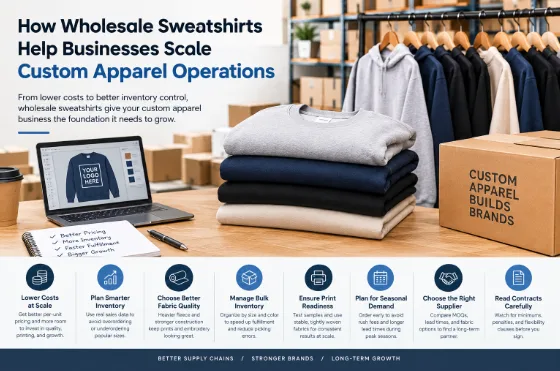
Businesses trying to grow a custom apparel line eventually hit a point where ordering in small batches stops making sense. Rising order volume, tighter margins, and inconsistent lead times all point toward the same solution: sourcing wholesale sweatshirts for printing instead of reordering piecemeal from a general retailer. This guide looks at how buying wholesale actually supports growth, and what to check before making the shift.
Why Small-Batch Ordering Stops Working as You Scale
Small-batch ordering works fine for a business testing a new product line, but it quickly becomes inefficient once order volume grows steadily over time. Per-unit costs stay high, lead times become unpredictable, and a business ends up spending more time managing individual orders than actually growing the business itself.
Checking a detailed Wholesale Sweatshirts for Printing buying guide before committing to a large order helps buyers compare fabric weights and pricing tiers across suppliers, rather than guessing at what a fair wholesale price should look like.
How Wholesale Pricing Actually Supports Growth
Lower per-unit costs at scale give a business more room to invest in better printing, faster turnaround, or expanded product lines without raising retail prices. This margin flexibility often matters more to long-term growth than the upfront savings alone.
Businesses that plan wholesale orders around actual sales data, rather than guessing at demand, avoid the two most common wholesale mistakes: overordering slow-moving sizes and underordering popular ones.
Fabric Quality Standards Worth Knowing
Custom apparel built on a weak fabric foundation undermines even the best printing work. A heavier fleece weight, generally above 9 ounces per square yard, holds detailed prints and embroidery far better than a lighter, budget-grade sweatshirt.
Brands recognized for consistent construction, including Nike Sweatshirt lines, set a useful benchmark for what buyers should expect from fabric weight and stitching quality, even when sourcing from a separate wholesale supplier rather than the brand directly.
Bulk Clothing and Managing Inventory at Scale
Bulk clothing purchases require more planning than single orders, since a business now has to manage storage space, size distribution, and seasonal demand across a much larger inventory.
Organizing stock by size and color in clearly labeled storage, rather than keeping everything in one large undifferentiated batch, speeds up fulfillment and reduces picking errors once orders start shipping out.
Printed Sweatshirts and Print-Readiness at Volume
Printed sweatshirts need a stable, tightly woven base fabric that holds ink evenly across a large production run. A fabric that looks fine on a single test print can still pucker or shift under heat once a shop is running hundreds of units through the same process.
Testing a small sample batch of any new wholesale fabric before committing to a full order remains the most reliable way to confirm print quality holds up at scale, not just on a single trial piece run through a press once.
Promotional Apparel and Seasonal Demand Planning
Promotional apparel tied to a specific season or event requires more planning than year-round basics, since suppliers see a spike in orders around the same predictable windows every year.
Placing wholesale orders several weeks ahead of a known seasonal spike, rather than waiting until demand is already high, helps a business avoid the higher pricing and longer lead times that typically come with rush orders placed too close to a deadline.
Choosing a Wholesale Supplier That Fits Your Growth Stage
Not every wholesale supplier fits every stage of business growth. A supplier built for very large minimum orders may not serve a smaller business well, while a supplier built for small businesses may struggle to keep pace once order volume grows significantly.
Comparing minimum order quantities, lead times, and fabric options across a few suppliers before committing helps a business find a partner that can grow alongside it, rather than needing to switch suppliers again within a single year of ramping up production.
Common Mistakes Businesses Make When Scaling Apparel Orders
Many businesses scale order size before scaling their sales data collection, which means bigger orders get placed based on guesswork rather than actual demand patterns. Tracking size and color performance from the start prevents this problem before it becomes expensive.
Others underestimate how much storage space a larger wholesale order actually requires, leading to cramped, disorganized inventory that slows down fulfillment once orders start coming in at a noticeably higher volume than before.
Reading Supplier Contracts Before You Commit
Wholesale contracts often include details that are easy to overlook in the excitement of landing a good price, like reorder minimums, exclusivity clauses, or penalties for order changes made after production begins. Reading these terms carefully before signing prevents surprises once a business is already locked into a longer-term supplier relationship.
Asking a supplier directly about flexibility for order adjustments, rather than assuming standard terms apply, helps a growing business avoid penalties for the demand fluctuations that naturally come with scaling.
Balancing Wholesale Savings With Storage Costs
The savings from a larger wholesale order only count if a business can actually store and move through that inventory efficiently. Renting extra storage space or paying for a larger warehouse footprint can quietly erase the per-unit savings that made a bulk order attractive in the first place.
Calculating total cost, including storage and handling, rather than looking at per-unit price alone, gives a more accurate picture of whether a specific wholesale order size actually makes financial sense for a given stage of growth.
Building a Scalable Custom Apparel Operation
Scaling a custom apparel operation successfully comes down to matching wholesale order size to real demand, maintaining consistent fabric quality, and choosing a supplier that can grow alongside the business rather than holding it back.
Businesses that get these fundamentals right early spend far less time firefighting inventory problems later, freeing up more time and resources to focus on the parts of the business that actually drive growth, rather than constantly reacting to avoidable supply chain issues.