Human Virtual Assistant vs. AI Assistant: Which Is Right for Different Business Tasks?
If you run a small business or own a start-up, you can get administrative support in many ways.
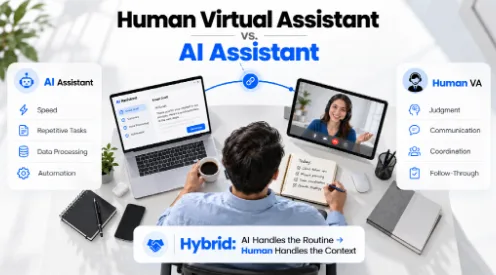
There is a world of difference between a virtual assistant who manages your business, and an AI assistant that merely automates your tasks. You can choose either or blend both. You don’t have to worry about picking a universally better option. You need to identify which one fits the tasks to be done.
That difference matters. Administrative work rarely demands a single task. Sending routine emails is not the same as handling customer complaints. Similarly, organizing information and deciding what needs attention are different, too.
Virtual assistant services streamline business operations in many ways, and so do AI. In McKinsey’s 2025 survey, 88% of respondents said their organizations use AI in at least one business function. Yet you cannot completely leave many operations to an AI assistant.
That’s where you need to decide how to match the right support to a specific task.
What Is a Human Virtual Assistant?
A human virtual assistant is a remote professional who offers ongoing support to many business processes.
They can handle many responsibilities. These can include scheduling, coordination, administrative support, and customer communication.
Human virtual assistants interpret a situation and respond differently. They can give you an advantage over software in tasks that require context or exceptions.
For example, a calendar can show two overlapping meetings. Your AI tool can flag it, but a human VA can check the attendees, understand priorities, evaluate the available options, and adjust the schedule.
Virtual assistant services can help with routine responsibilities and business support. The exact role depends on what you choose to delegate.
What Is an AI Assistant?
An AI assistant is an artificial intelligence software. You can use it to respond to requests, summarize information, analyze data, and automate workflows.
For example, you can use AI to draft an email or summarize a document. It can also help create a first version of a report or build categories based on certain data. It helps with structured and repeatable tasks.
Here’s another example: you receive many similar customer queries each week. The AI system can help identify common ones and draft responses. Your task is scaled and performed faster at an unmatched speed.
The use of AI is increasing. Pew Research Center found that 49% of U.S. adults reported using AI chatbots in February 2026, compared with 33% in 2024.
But speed does not eliminate the need for review. AI can produce an answer without fully understanding the business context behind the request. This calls for oversight when judgement, accuracy, or customer relationships are particularly important.
Human Virtual Assistant vs. AI Assistant: Key Differences
The clearest way to compare them is to look at what the task requires.
| Factor | AI Assistant | Human Virtual Assistant |
| Repetitive tasks | Strong fit for structured, repeatable work | Can handle them but may be better used elsewhere |
| Speed | Can process information and produce outputs quickly | Depends on workload and availability |
| Judgment | Limited by its instructions, data, and system design | Can assess context and make decisions within agreed boundaries |
| Communication | Can draft and respond within defined workflows | Can adapt communication to the person and situation |
| Flexibility | Works best when the process is clearly defined | Can adjust when priorities or circumstances change |
| Scalability | Can handle high volumes with relatively little additional time | Scaling usually means adding human capacity |
| Oversight | Needs review based on the task and risk | Can provide its own review, judgment, and follow-through |
| Accountability | Performs according to the system and instructions | A person can take ownership of an assigned responsibility |
This does not mean that AI lacks value when judgment is involved. The point is that the role of AI often changes with less predictable tasks.
Consider customer support as an example.
A customer asks about the order. An AI system can help find the status and provide an answer.
The customer then says the order is late, explains it was needed for a specific period, and asks about a possible way out.
Now the situation requires more than retrieving information. You will need someone to understand the issue, decide on available options, communicate clearly, and follow up.
AI can help summarize the account or suggest a response. But a human can handle relationships and offer judgment.
Research supports the value of this type of collaboration. A Stanford study took place with 5,172 customer support agents. It showed that access to a generative AI assistant increased issues resolved per hour by 15% on average.
Which Tasks Are Better Suited to Each?
There is no universal dividing line, but we can consider some patterns:
Tasks suited to AI
AI is a natural fit for tasks that are:
- Repetitive
- High-volume
- Easy to review
- Rule-based
- Built around information processing
For example: summarizing meeting notes, drafting routine emails, crafting first drafts, preparing simple reports, etc.
You can use AI automation to save manual effort needed in repetitive processes.
Tasks suited to human VAs
Human support becomes more useful when a task involves:
- Changing priorities
- Multiple people
- Sensitive communication
- Judgment & Exceptions
- Follow-through
- Relationship management
Consider executive scheduling. You can use an AI tool for available time suggestions and creating calendar messages. A human virtual assistant can manage the entire exchange, notice conflicts, and ensure the meeting gets arranged.
The same applies to lead follow-up, project coordination, customer communication, and executive support.
Tasks where a hybrid approach works well
You can use both. AI can help summarize incoming inquiries, identify common questions, and draft responses. A human virtual assistant can then review, personalize, and send them, all while handling anything unusual.
Similarly, there are many other tasks where AI can handle some of the processing. A person manages the parts that need judgment and context. This is where human-AI collaboration becomes practical.
How Businesses Can Decide the Right Approach
Use these questions to decide whether your business needs human virtual assistant services and AI assistants. Ask five questions:
- Is the task repetitive?
AI automation may be useful if the same steps happen again.
- How much judgment does it require?
You may need human support if priorities change or exceptions are common.
- What happens if something goes wrong?
Low-risk errors are different from mistakes involving customers, confidential information, money, or compliance.
- Does the task involve relationships?
Communication with clients, employees, partners, or prospects can involve both human and AI involvement.
- Can AI handle part of the process?
The answer does not have to be AI or human. AI can prepare the tasks while the other reviews or follows through.
Conclusion
Deciding between a human virtual assistant vs. an AI assistant becomes easier when you stop treating it as a contest and see the benefits each offers.
AI can help with speed, repetition, information processing, and automation. Human virtual assistants bring context, judgment, and follow-through.
For many small businesses, the practical answer may involve both.
You can leave some structured and repeatable parts of a workflow to AI. You can bring in human support where the task needs coordination, judgment, or ownership.
Remember, the goal is to build a support system where every task has the right kind of support behind it.