Humanoid Robot Joint Cable Routing: Why Hollow Shaft Planetary Actuators Matter
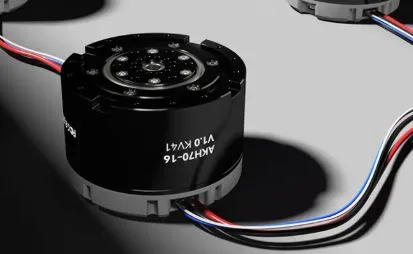
A humanoid robot may look clean from the outside, but inside each joint is a difficult packaging problem. Power cables, encoder lines, communication wires, sensor signals, and sometimes brake or auxiliary wiring all need to pass through a moving structure. If the joint layout is not planned well, the robot can become bulky, difficult to assemble, and harder to maintain.
This is why cable routing has become a serious design issue in humanoid robot joints. The challenge is not only making the robot move. It is making the robot move while keeping the joint compact, reliable, and clean enough for repeated operation.
Why Cable Routing Is a Real Problem in Humanoid Robot Joints
Humanoid robots have many joints packed into a human-like body shape. The shoulder, elbow, wrist, hip, knee, and ankle all need rotational movement. At the same time, each joint may need electrical power, signal feedback, and communication with the robot controller.
External wiring can create several problems. Cables may bend repeatedly, rub against the structure, limit joint rotation, or make the robot look unfinished. In a prototype, this may be acceptable. In a robot designed for real use, it becomes a reliability issue.
A cleaner solution is to route cables through the center of the joint where possible. This is where a hollow shaft planetary actuator for humanoid robot joints becomes useful. The hollow shaft gives engineers a path for internal wiring, while the planetary actuator structure provides compact torque output for the joint.
How Hollow Shaft Design Keeps Joint Wiring Cleaner
The main value of a hollow shaft is simple: it creates space through the rotation axis. Instead of routing cables around the outside of a joint, designers can pass wires through the center.
This helps in several ways:
- It reduces exposed cable loops.
- It lowers the risk of cable twisting or snagging.
- It makes the joint exterior cleaner.
- It can improve the range of motion.
- It supports a more compact robot body.
- It makes multi-joint wiring easier to organize.
For humanoid robots, this matters because the body shape is already crowded. The arms and legs cannot simply grow larger to make room for cables. A more compact joint design helps the robot maintain a practical form factor.
Why Planetary Gearing Supports Compact High-Torque Joints
Humanoid robot joints need more than clean wiring. They also need enough torque to support movement. The hip and knee joints must help carry body weight. The shoulder and elbow joints must lift and position the arms. The wrist needs smaller but more precise rotation.
Planetary gearing is useful because it can increase output torque in a compact structure. Load is shared across multiple planet gears, which helps the actuator deliver stronger motion without becoming too large.
This is especially useful in humanoid robots, where space and weight are limited. A large motor may provide torque, but it can make the joint bulky. A compact actuator with planetary reduction can help balance torque, size, and integration.
Where It Fits in Humanoid Robot Joints
Different humanoid robot joints have different needs. A hollow shaft planetary actuator is most useful where compact rotation, internal wiring, and torque output are all important.
| Joint Area | Main Challenge | Why Hollow Shaft Planetary Design Helps |
| Shoulder | Lifting and rotating the arm | Supports compact high-torque movement |
| Elbow | Repeated bending and extension | Keeps wiring cleaner through the arm |
| Wrist | Tool or hand orientation | Helps route cables toward the hand |
| Hip | Body support and leg swing | Provides torque in a compact joint package |
| Knee | Walking, squatting, standing | Supports strong repeated motion |
| Ankle | Balance correction | Helps keep lower-leg wiring organized |
In these joints, wiring and mechanical design are closely connected. A joint with poor cable routing may still move, but it may be harder to assemble, protect, and scale.
Feedback and Communication Are Part of the Joint Design
Modern humanoid robot joints often rely on closed-loop control. The controller needs to know the position, speed, and sometimes torque or current behavior of each joint. This requires reliable feedback and communication.
That means the joint is not only a mechanical part. It is also an electrical and control module.
Internal wiring becomes more important as more sensors and control electronics are integrated into the joint. Clean cable routing helps reduce clutter and makes it easier to connect multiple actuators across the robot body.
For a humanoid robot with dozens of moving joints, this can make a big difference. Better wiring layout can simplify assembly, testing, and maintenance.
What Engineers Should Check Before Choosing a Joint Actuator
When selecting an actuator for humanoid robot joints, engineers should look beyond torque ratings. The actuator must fit the full joint design.
Important factors include:
- Hollow bore size: enough room for required cables or signal lines
- Torque density: strong output without excessive size or weight
- Backlash: lower backlash helps improve motion accuracy
- Encoder resolution: better feedback supports smoother control
- Communication interface: useful for multi-actuator systems
- Thermal behavior: important for repeated walking or arm movement
- Mechanical packaging: the actuator must fit the joint structure
A good actuator choice should make the joint easier to build, not only stronger.
A Practical Example: Wiring Through a Humanoid Wrist
The wrist is a good example of why hollow shaft design matters. A robotic hand may need power, communication, finger sensor signals, and control wiring. If these cables run outside the wrist, they can limit rotation or become exposed to wear.
With a hollow shaft actuator, some wiring can pass through the wrist axis. This makes the design cleaner and allows the hand to connect more naturally to the arm. The same idea can also apply to elbows, shoulders, hips, and knees.
Final Thoughts: Cleaner Joint Modules for Scalable Humanoid Robots
Humanoid robot development is moving toward cleaner, more integrated joint modules. Strong motion is important, but so are cable routing, assembly, feedback, and long-term reliability.
Hollow shaft planetary actuators fit this direction because they solve two problems at once: they support compact torque output and make internal wiring easier. For humanoid robots with many joints, that can lead to cleaner design, better packaging, and more scalable robot assembly.