I Showed Tattoo Artists the Same Design at 5 Different Sizes. Here’s Why They Had Very Different Opinions
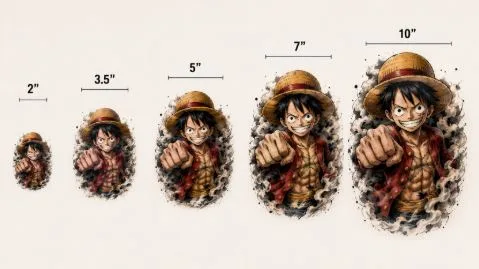
A tattoo can look completely different depending on how large you make it.
That might sound obvious, but it becomes surprisingly difficult to judge when you are looking at a design on a phone screen. A portrait that looks detailed and impressive on a screen can become cramped when reduced to a few inches. A simple design can sometimes look much stronger when given more space. And a tattoo that works beautifully on paper may need to be adjusted once it has to follow the curves of an actual body.
So I decided to test one question: What happens when tattoo artists look at exactly the same design at five different sizes?
I showed the same detailed design at 2, 3.5, 5, 7, and 10 inches and asked tattoo artists what they thought about each version. The reactions were not identical, but there was one thing they consistently agreed on: tattoo size is not just about how much skin you want to cover. It changes how the design itself works.
The Same Design Can Become a Different Tattoo at Each Size
For the experiment, the design stayed exactly the same. Only its scale changed.
At first glance, the differences were easy to miss. But once the five versions were placed next to each other, details that looked perfectly clear at a larger size became harder to distinguish as the design got smaller.
That is because tattoos do not behave like images on a screen.
On a digital image, you can zoom in indefinitely. On skin, every line, shadow, highlight, and small detail has to share physical space with everything around it. When there is not enough room, details can begin to compete with each other.
This is one reason why choosing a tattoo size should happen alongside choosing the design, rather than afterward.
At 2 Inches, the Artists Started Worrying About Detail
The smallest version created the most disagreement.
A simple symbol or minimalist design can work well at a small size, but the design I used contained several areas of fine detail. At 2 inches, those details were much closer together, leaving less visual separation between them.
The artists pointed out that shrinking a detailed design does not simply make everything proportionally smaller. It can change how clearly the individual elements can be read.
This is especially important with portraits, realistic animals, flowers with layered petals, lettering, and other designs that depend on small details.
A useful way to think about it is that every tattoo needs enough space for its important visual elements to remain distinct. If you are deciding between different dimensions for a design, understanding how tattoo size affects detail, placement, and the final appearance can help put that decision into perspective.
At 3.5 Inches, It Became More Workable, But Still Had Limits
The 3.5-inch version looked noticeably better than the smallest one.
There was more breathing room between the main elements, and the overall image was easier to understand at a glance. However, the artists still noticed that certain details had to be simplified or carefully controlled.
This is where an important misconception about tattoo size comes in.
People sometimes assume that if a design technically fits inside a particular measurement, it should be possible to tattoo it at that size exactly as shown.
But “fits” and “works well” are not necessarily the same thing.
A design may physically fit inside a small area while still losing some of the qualities that made the original artwork appealing.
At 5 Inches, the Design Started to Breathe
The 5-inch version was where the conversation became much more interesting.
The design had enough room for its major details to separate naturally. Shadows were easier to distinguish, small elements had more space around them, and the overall composition felt less compressed.
One of the biggest lessons from the experiment was that more space can sometimes make a tattoo look simpler, even when it actually contains more visible detail.
That sounds contradictory, but it makes sense.
When elements are crowded together, the eye has to work harder to understand the image. Give those same elements more room, and the design can become easier to read.
For a realistic tattoo, this can be particularly important. Realism depends heavily on transitions between light and dark, texture, depth, and small visual cues. Those elements need enough space to work together instead of becoming one dense area.
At 7 Inches, the Artists Started Thinking About the Body
At 7 inches, the question was no longer simply, “Does the design have enough room?”
The artists started asking, “Where is this going?”
That is a major shift.
A tattoo is not placed on a flat sheet of paper. It has to interact with shoulders, arms, thighs, chests, backs, ribs, and other parts of the body. As a design becomes larger, the shape and movement of that body area become increasingly important.
A design that looks perfect when viewed straight-on may need adjustments when it wraps around a curved surface.
This is also why two people can choose the same tattoo design but end up with very different-looking tattoos. Their available space, body shape, placement, and desired visual impact may all call for different proportions.
At 10 Inches, Bigger Was Definitely Not Automatically Better
The largest version had the most room for detail, but that did not make it the automatic winner.
At this scale, the artists began thinking about composition in a different way. A larger tattoo can require more consideration of surrounding skin, negative space, body contours, and how the design will be viewed from different angles.
In other words, making a tattoo bigger solves some problems while creating new decisions.
A design that benefits from extra detail may look excellent at 10 inches. Another design may feel unnecessarily large if its concept does not need that much space.
That was probably the most surprising part of the experiment.
There was no single “best” size.
I Asked Minh Pham Why Artists Disagree About Tattoo Size
When it comes to judging how a tattoo design will translate onto skin at different scales, experience matters. Minh Pham, a reputable San Antonio tattoo artist with more than 10 years of experience and 40+ international tattoo awards, says size should never be considered separately from the design’s detail, placement, and overall composition.
Minh Pham, a reputable San Antonio tattoo artist with 10+ years of experience and 40+ international tattoo awards.
Insert embed instagram when publish: https://www.instagram.com/pham.minh.phuc/
Minh points out that the same artwork can require very different decisions depending on what the client wants the tattoo to accomplish. A small tattoo may be ideal when the goal is a simple, recognizable image. A highly detailed realism piece may need substantially more space to preserve its visual qualities.
The important question, in other words, is not simply:
“How many inches should my tattoo be?”
It is:
“How much space does this particular design need to work well on my body?”
That is why experienced artists may give different answers when looking at the exact same design.
They are not necessarily disagreeing about the tattoo itself. They may be thinking about different placements, different levels of detail, different body contours, or different expectations for how the finished tattoo should look.
The Biggest Surprise? Bigger Wasn’t Always Better
After comparing all five versions, I expected the largest tattoo to receive the most positive reactions.
That did not happen.
The most useful version depended on what the design needed.
The smallest version was more convenient but placed greater limits on detail. The middle sizes created a better balance between readability and practicality. The largest version allowed the most detail but also introduced more questions about composition and placement.
That is probably the biggest takeaway for anyone planning a tattoo:
Do not choose the size first and force the design into it.
Instead, consider the design, detail level, placement, body shape, and desired visual impact together.
A good tattoo size is not necessarily the biggest size you can afford or the smallest size you can fit into an available space. It is the size that gives the artwork enough room to do what it is supposed to do.
And sometimes, the best way to find that size is not by looking at the design on your phone.
It is by asking an experienced tattoo artist to show you what happens when you change the scale.