IAMPROSAY Launches Online Resource for Drivers Who Need to Dispute E-ZPass Fees
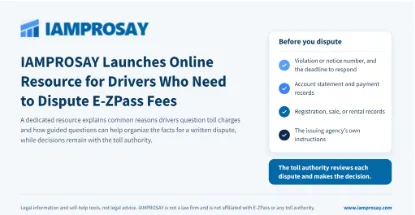
A dedicated resource explains common reasons drivers question toll charges and how guided questions can help organize the facts for a written dispute, while decisions remain with the toll authority
New york, 20 October IAMPROSAY, a legal information website and self-help platform, is highlighting its dedicated online resource for drivers who want to understand how to dispute E-ZPass fees. The resource pairs general information about toll disputes with guided questions that help users organize the facts of their situation and prepare a written response. Clear information matters here because toll notices often carry short deadlines and unfamiliar terms, and drivers who understand their options can act more carefully.
E-ZPass operates through a network of participating toll agencies rather than a single system. As a result, billing procedures, notice formats, and appeal rules can differ depending on where a trip occurred and which authority issued the charge. That variation is one reason drivers sometimes struggle to know where to start when a charge looks wrong.
Understanding E-ZPass Fee Disputes
Drivers question E-ZPass charges for many reasons. The following are general examples, not documented cases.
- Possible billing error. A transaction may appear twice on an account, or the amount may not match the trip.
- Unexpected toll charge. A driver may be billed for a trip they do not recall making, which can happen if a plate is misread or the wrong vehicle is matched to a transaction.
- Payment-record discrepancy. A receipt or account record may show that a toll was already paid, even though a notice says otherwise.
- Transponder issues. An active transponder in good standing may not register at a reader.
- Disagreement about a notice. The notice may list the wrong date, location, vehicle, or account, or the vehicle may have been sold or transferred before the trip.
Questioning a charge does not mean the charge is wrong. The toll authority that issued the notice reviews each dispute and makes the decision.
Steps Drivers Can Take
Before they dispute E-ZPass fees, drivers can take several practical steps.
Review the notice carefully. Note the violation or notice number, the date, the toll location, the plate number, the amount, the issuing authority, and the deadline to respond.
Compare it with your records. Check the notice against toll statements, account transaction history, payment confirmations, and vehicle and account details, such as the plate number and vehicle class on file.
Identify a specific reason. A precise explanation, such as “my account shows this toll was already paid,” gives the toll authority something it can investigate. A general statement that the charge seems wrong does not.
Gather supporting documents. Depending on the situation, useful records may include an account statement, a toll receipt, vehicle registration, proof of sale, a rental agreement, or a copy of the notice.
Check the agency’s dispute policy. Procedures, forms, and submission methods vary by toll agency and jurisdiction, so the instructions printed on the notice should take priority over general information.
Watch the deadline. The website notes that response windows are often short and differ by authority, and that missing one can close off options.
Confirm the process with the agency. If anything on the notice is unclear, the contact information on the notice or the agency’s official website is the best place to confirm how disputes are handled and what the authority accepts as evidence.
The Role of Online Legal Self-Help
The platform’s existing E-ZPass resource is built around plain-language questions rather than a blank form. According to the website, users describe the violation, explain why they believe it is incorrect, review a prepared response, and then submit it according to the instructions on their notice.
The platform’s page to Dispute E-ZPass Fees explains what a written dispute generally includes: the user’s name and contact details, the notice number, license plate information, the date and location of the alleged violation, a clear explanation of the dispute, supporting evidence, and the resolution requested. It also lists the types of evidence that may help, from account records and payment receipts to registration documents and sale records.
The website also lists state-specific pages for New York, New Jersey, Pennsylvania, Maryland, and Virginia, reflecting that dispute rules differ by location. It further notes that unpaid tolls can be referred to third-party collectors, in which case its debt collection resources may be relevant.
Review is built into the process. The website says users see everything before it is used, and it describes its purpose as helping drivers get their side of the story organized rather than offering legal advice. Because each prepared response reflects the facts a user provides, accuracy remains the user’s responsibility.
The role of the tool is limited. It helps users understand a process and prepare a document. The user submits that document to the issuing authority. The platform does not file disputes, does not contact toll agencies, and does not decide whether a fee is reduced, waived, or reversed. The website states that it is not affiliated with E-ZPass or any toll authority.
Practical Considerations
Recordkeeping is central to any toll dispute. Drivers should keep a copy of the notice, everything they submit, and any confirmation they receive. If they need to follow up later, a complete file makes that far easier.
Clear written communication helps. A short, factual explanation that includes the notice number, relevant dates, and the specific reason for the dispute is easier for a reviewer to act on than a general complaint.
Drivers should follow the toll authority’s official procedures, including where and how to submit a dispute. After a submission, the authority typically reviews the appeal and any evidence and then issues a decision. Timelines vary, and the authority may ask for more information. Whether additional fees can be reduced or waived is also the authority’s decision.
Vehicle history can matter too. A driver who sold or transferred a vehicle before a trip, or who rented a vehicle at the time, may need a bill of sale, title transfer date, or rental agreement to support their explanation.
Strong evidence can make a dispute easier to evaluate, but it does not guarantee a particular result. Anyone who plans to dispute E-ZPass fees should treat the process as one that depends on the facts, the records, and the rules of the agency involved.
Legal Limitations
IAM Pro Say is a legal information website, not a law firm or a substitute for an attorney. It does not provide legal advice or represent clients, and using the website does not create an attorney-client relationship. The platform offers self-help tools and general legal information, and it does not guarantee outcomes.
The platform has no authority over E-ZPass accounts, toll agencies, or fee decisions, and it does not promise refunds, fee reductions, successful appeals, or any specific result. General information is not individualized legal advice. This announcement does not predict the result of any individual dispute.
Drivers should consult the relevant toll agency’s official rules. Those facing significant penalties, court proceedings, or other complex legal issues should consider seeking advice from a qualified attorney licensed in the appropriate jurisdiction.
About the Company
IAM PROSAY is a legal information website and self-help platform that offers general legal information and document-preparation tools for debt collection, credit-report, court-document, and toll-dispute needs. It is not a law firm and does not provide legal advice or representation.
Get Started
Drivers who want to dispute E-ZPass fees can visit the official homepage to find the E-ZPass resource, review the details on their notice, and consider whether a guided approach to preparing a written response fits their situation. Before relying on any document, users should verify the information, confirm the toll authority’s requirements, and meet every deadline.