Identity, Purity and Potency : three pillars of drug quality testing
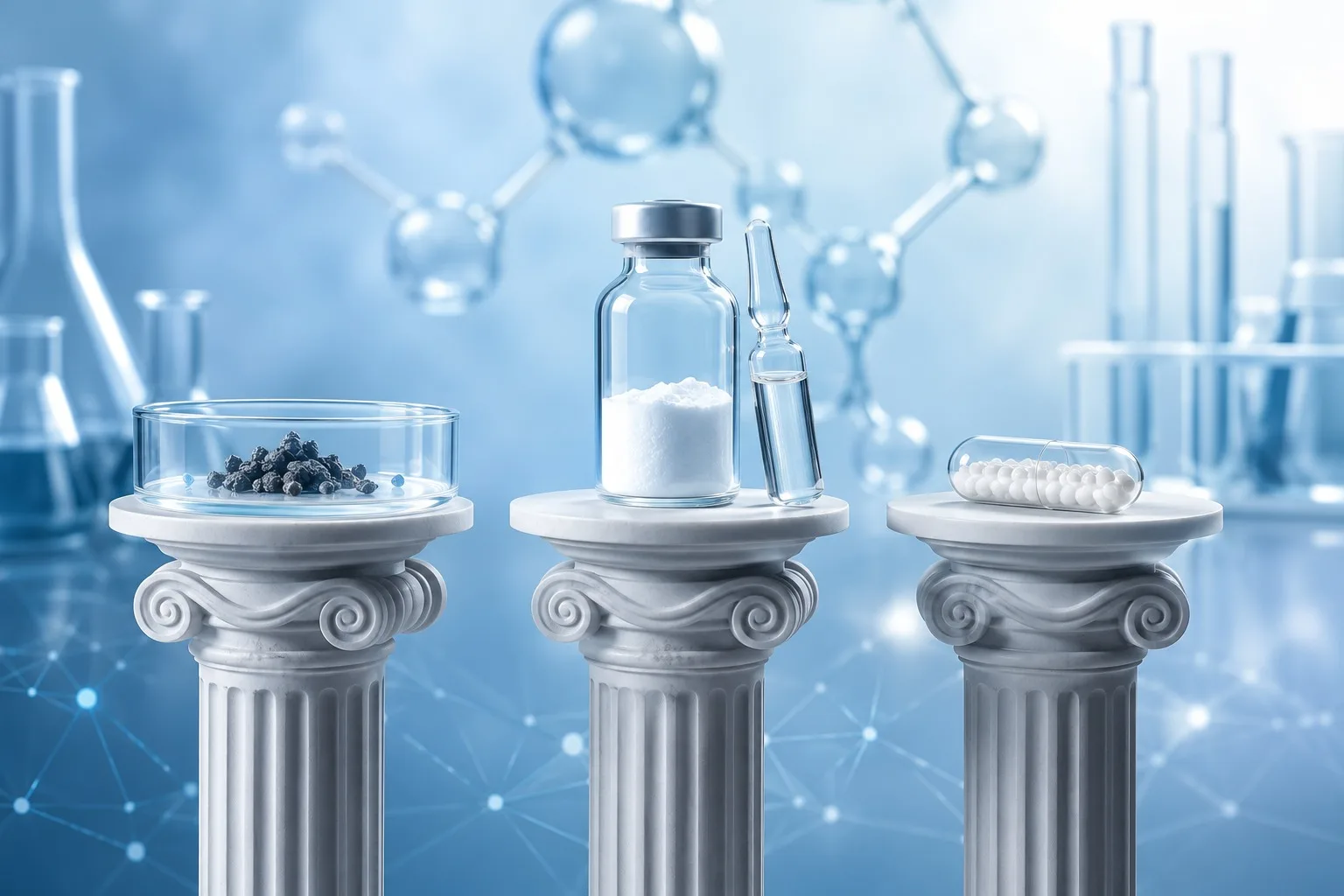
Every medication promises three basic things: that it contains the exact right molecular compound, that it is free from harmful contaminants, and that it will produce the intended therapeutic effect. These promises map directly to the three central pillars of drug quality assurance: Identity, Purity, and Potency. Source: Anabiotec – Our Testing Capabilities
Together, these characteristics define whether a drug batch is safe, effective, and ready for release. Analytical testing during drug development provides the hard, empirical evidence manufacturers need to answer these critical quality questions, replacing assumptions with reliable data. Within this framework, potency assay development plays a vital role in establishing robust methods to accurately measure a drug’s biological activity throughout its lifecycle.
Identity: Is the intended substance present?
Identity testing confirms that the specific active pharmaceutical ingredient (API) or biological entity is present in the product. Whether utilizing spectroscopic fingerprinting (like FTIR or NMR) or chromatographic retention times, proving identity is the absolute prerequisite for any quality assessment.
Purity: How pure is the substance, and what else is present?
Purity reflects the proportion of the intended active substance relative to everything else in the sample. A complete picture of purity requires evaluating both the active material and the impurities present. Chromatographic purity is calculated based on the ratio between the main peak and related substances; chiral purity is needed in case of stereochemical differentiation of active isomers, because a drug can contain both active and inactive isomers.
Impurities are components that are neither the active substance nor an intended excipient. They fall into three primary categories:
- Organic impurities: Synthetic intermediates, side products, and degradation products.
- Inorganic impurities: Residual catalysts and elemental contaminants.
- Residual solvents: Leftover volatile organic chemicals used or produced during the creation of active pharmaceutical ingredients (APIs) or excipients.
Regulatory standards (such as ICH Q3A and Q3B guidelines) define strict reporting, identification, and qualification thresholds for impurities based on daily dose—meaning high-dose therapeutics require even stricter controls. For example, if a degradation product exceeds its safety limit during long-term stability testing, developers may need to reformulate the drug. Detecting these trace-level impurities requires high-sensitivity tools, such as HPLC paired with UV or mass spectrometry (LC-MS), alongside ICP-MS for elemental species.
Potency: does the drug perform as intended?
Potency is defined by the biological activity, i.e. the ability of a product to produce its intended effect. For a small-molecule tablet, potency is often correlated closely with assay, the measured amount of an active substance in the tablet. When it comes to biological products, however, the link is less obvious. For instance, a monoclonal antibody can be present at its stated concentration but lose biological activity due to aggregation or improper folding. In such cases, potency is evaluated by cell-based and binding assays, which take into account the function rather than the amount of the substance.
Clinical consequences of having an under-potent or over-potent drug are obvious, the former causes the risk of treatment failure and the latter is likely to pose a toxicological threat. In analytical testing in drug development, potency assays are usually the hardest to develop precisely because they should reflect the mechanism rather than mere amount of the substance. This is why potency assay development requires careful optimisation, method validation, and continuous refinement to produce meaningful and reproducible results.
Potency Assay Development: Building Reliable Quality Testing
Because potency assays must reflect a drug’s mechanism of action (MoA) rather than just its presence, they are often the most challenging methods to develop.
Successful potency assay development must start early in the drug development pipeline. These assays need to be robust, highly reproducible, and reflective of biological function so they can support process development, stability testing, and regulatory submissions. Achieving this requires careful optimization, thorough method validation, and continuous refinement.
Validation of methods and why it reduces risk
Analytical data is only as trustworthy as the method that produces it. Method validation, i.e. defined by ICH Q2 standards, normally demonstrates a method’s specificity, accuracy, precision, and reliability across its intended operating range.
Adequately validated methods minimize operational risk. It uncovers analytical or process issues while they can still be corrected, preventing costly late-stage regulatory rejections or product recalls. Ultimately, consistent analytical testing in drug development that delivers reliable identity, purity, and potency data is the bedrock of a successful regulatory dossier.
At Anabiotec, we help pharmaceutical companies execute targeted analytical testing throughout drug development – from early characterization to release and stability testing – ensuring your identity, purity, and potency claims stand up to regulatory scrutiny.
FAQs:
1. Why are impurities important in drug quality testing?
Contamination by impurities compromises safety and stability even at relatively low concentrations. Detection and control of impurities according to the existing thresholds ensures patient safety and proves consistency of the manufacturing process.
2. What does potency testing measure?
Potency testing determines biological activity, i.e. the ability of a drug to produce its intended therapeutic effect. It proves that the active ingredient is present in the right functional concentration, and not merely its quantity.
3. Why is purity testing necessary?
The purity test gives the proportion of the sample that is the desired material and related impurities. It helps ensure proper dosage, provides process control, and offers evidence required by regulatory authorities.