Industrial Servo Motors for High-Performance Manufacturing Systems
Introduction
Modern industries rely on automation to improve productivity, accuracy, and operational efficiency. From robotics and CNC machines to packaging equipment and automated production lines, precise motion control is essential for achieving consistent results. This is where industrial servo motors play a crucial role.
Industrial servo motors are designed to deliver accurate positioning, controlled speed, and reliable torque, making them a vital component in advanced manufacturing systems. Their ability to provide fast response and precise movement helps businesses improve product quality while reducing downtime and operational costs.
What Are Industrial Servo Motors?
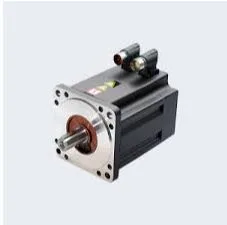
Industrial servo motors are closed-loop motion control devices that use feedback systems to precisely control position, speed, and torque. Unlike conventional motors, servo motors continuously monitor their performance through encoders or sensors and automatically make adjustments to maintain accuracy.
A typical servo system consists of:
- Servo motor
- Servo drive
- Encoder or feedback device
- Motion controller
Together, these components create a highly accurate and responsive motion control solution for industrial applications.
How Industrial Servo Motors Work
Servo motors operate through a closed-loop control system.
Command Signal
The controller sends instructions regarding position, speed, or movement requirements.
Motor Movement
The servo motor performs the commanded motion.
Feedback Monitoring
An encoder continuously measures the motor’s actual position and speed.
Automatic Correction
The servo drive compares the actual performance with the target value and makes real-time adjustments to eliminate errors.
This process ensures exceptional precision and smooth operation.
Key Features of Industrial Servo Motors
High Positioning Accuracy
Servo motors provide precise motion control, making them suitable for applications requiring exact positioning.
Fast Response Time
They can accelerate and decelerate rapidly, increasing production efficiency.
High Torque Performance
Servo motors deliver consistent torque across a wide speed range.
Energy Efficiency
Advanced servo systems optimize power consumption while maintaining performance.
Compact Design
Despite their powerful capabilities, servo motors are compact and easy to integrate into automated equipment.
Benefits of Industrial Servo Motors
Improved Manufacturing Precision
Accurate motion control reduces production errors and improves product quality.
Increased Productivity
Fast response and high-speed operation help shorten production cycles.
Reduced Maintenance
Modern servo motors are designed for durability and long-term reliability.
Better Process Control
Real-time feedback enables consistent operation even under changing load conditions.
Lower Operating Costs
Improved efficiency and reduced downtime contribute to significant cost savings.
Applications of Industrial Servo Motors
CNC Machines
Servo motors provide accurate control for cutting, milling, drilling, and machining operations.
Robotics
Industrial robots rely on servo motors for precise movement and positioning.
Packaging Equipment
Used in filling, labeling, sealing, and cartoning machines for high-speed automation.
Printing Industry
Ensure accurate paper feeding and alignment for quality printing processes.
Semiconductor Manufacturing
Support highly precise positioning systems used in electronics production.
Material Handling Systems
Servo motors control conveyors, automated storage systems, and pick-and-place equipment.
Types of Industrial Servo Motors
AC Servo Motors
The most commonly used type in industrial automation due to their efficiency and reliability.
DC Servo Motors
Suitable for applications requiring simple control and lower power consumption.
Brushless Servo Motors
Offer higher efficiency, longer lifespan, and lower maintenance requirements.
Rotary Servo Motors
Provide rotational movement for various industrial machines and automation systems.
How to Choose the Right Industrial Servo Motor
Torque Requirements
Select a motor capable of handling the required load and operational demands.
Speed Performance
Choose a servo motor that meets the speed requirements of your application.
Positioning Accuracy
Consider the level of precision needed for production processes.
Environmental Conditions
Ensure the motor is suitable for operating temperatures, dust levels, and humidity conditions.
System Compatibility
Verify compatibility with existing controllers, drives, and automation equipment.
Importance of Servo Motors in Industry 4.0
Industry 4.0 focuses on smart manufacturing, automation, and real-time data integration. Industrial servo motors are a key technology supporting these advancements by enabling intelligent motion control and highly automated production processes.
Their ability to deliver accurate, responsive, and energy-efficient performance makes them essential for modern factories seeking greater productivity and flexibility.
Conclusion
Industrial servo motors are a critical component of modern automation systems, providing precise motion control, high-speed performance, and reliable operation. Their advanced feedback technology allows manufacturers to improve efficiency, enhance product quality, and reduce operational costs.
Whether used in robotics, CNC machinery, packaging equipment, or smart manufacturing systems, industrial servo motors deliver the performance and accuracy required for today’s competitive industrial environment. Investing in high-quality servo motor technology helps businesses achieve long-term productivity and automation success.