Innovative Storage Ideas for a More Organised and Stylish Home
Every home seems to have one surface that attracts everything.
It could be the console near the entrance where keys, receipts and unopened post slowly gather. In the living room, it is often the coffee table. A book gets left there after reading, then a charger arrives, followed by two remotes and something that needs to be put away “later.”
The obvious reaction is to think the house needs more storage. Maybe. But another cupboard is not much help if it sits nowhere near the things that keep getting misplaced.
Storage works better when it follows daily habits. Some belongings should stay within sight because they are used often. Others are better behind a door. And a few probably do not need to occupy valuable room at all.
1. Why Good Storage Can Change the Feel of Your Home
Look at where clutter appears before deciding where storage should go.
The answer can be surprisingly specific.
If books constantly end up beside the sofa, their natural home is probably somewhere in the living room. Table linen stored in a bedroom cupboard may be perfectly organised, but it still requires a trip across the house whenever the dining table is being set.
People tend to leave things close to where they use them. Storage placed in those same areas makes putting things back feel less like a separate task.
There is another benefit. Tables start behaving like tables again.
A dining surface does not have to store paperwork between meals. The side table can hold a cup instead of three chargers and a pile of magazines. Even a relatively busy home begins to look calmer when everyday objects stop competing for every flat surface.
2. Give Everyday Items a Place of Their Own
Books are slightly different from most household clutter. Many people actually want to see them.
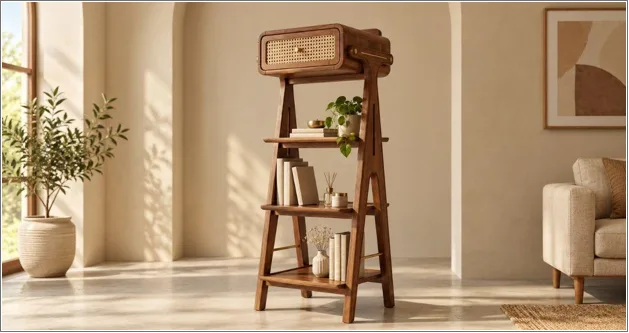
That makes a Book Shelf useful for storage without shutting everything behind doors. It can hold novels and magazines alongside family photographs, a small planter or something picked up on a memorable trip.
The trouble begins when every centimetre gets filled.
A wooden book shelf packed with books, decor, boxes and photographs can look heavier than expected. Leaving a few gaps often does more for the display than adding another decorative object.
Where the shelf stands matters just as much as what goes onto it.
A tall book shelf for home use can make sense on a narrow wall where floor width is limited. In another room, a lower unit may sit more naturally beneath artwork or near seating.
For a book shelf for living room placement, think about what will genuinely live there. If the family reads regularly, keep frequently picked books at an easy height rather than arranging everything purely for display.
Shopping for a book shelf online requires a little imagination because photographs can disguise scale. Measure the wall. Check the depth as well as the width. A shelf that looks slim on screen may project farther into the room than expected.
3. Make Better Use of Unused Wall and Floor Space
There is often more storage room in a house than first appears, although not all of it is worth using.
Take that narrow corner beside the dining area. Yes, a cabinet might fit. But if somebody has to squeeze past it every morning, the extra storage has solved the wrong problem.
The same goes for walls.
Going upwards can be useful in a smaller home because it avoids taking over too much floor area. A taller wooden book shelf, for instance, can accommodate more within a relatively narrow footprint.
But height should match use. Things stored at the very top are better suited to occasional use than something needed every day.
Before bringing in another piece, look around the proposed spot properly. Is there a switch behind it? Does a nearby door open towards it? Will it make the passage narrower? What happens when its own doors or drawers are open?
Furniture spends most of its life closed, but homes do not.
4. Storage That Keeps Clutter Out of Sight
Not everything deserves a place on display.
Router accessories, spare cables, old documents, board games, table mats and the instruction manual nobody wants to throw away are all useful examples. Put every one of them on an open shelf and the room can look untidy even when everything is technically in its place.
This is where Cabinet & Sideboards become useful.
A cabinet with storage near the dining area might take serving bowls, table linen and crockery used when guests come over. Move the same idea into the living room and the contents could be completely different: games, electronics, paperwork or extra accessories.
A wooden cabinet also gives the room a closed surface, which can be easier on the eye than another fully loaded shelf.
Before deciding on the number of compartments, make a rough list of what needs to go inside. There is little point in having several shallow sections when the objects being stored are tall.
A cabinet with mirror answers another kind of need. In a bedroom or dressing corner, it can provide storage where a mirror is already required, saving the two from occupying unrelated areas.
And yes, the inside can still become a mess. A closed door hides clutter very effectively, sometimes a little too effectively.
5. Style and Function Can Work Beautifully Together
Homes collected over time rarely contain wood in one identical shade, and that is perfectly fine.
A bookshelf bought this year does not need to imitate a cabinet purchased five years ago. What matters more is whether the pieces feel comfortable beside one another in scale.
Put a very tall, heavily filled shelf beside low furniture and it may pull too much attention towards one wall. A broad cabinet can do something similar in a narrow room.
The objects on top make a difference as well.
A cabinet does not automatically need a lamp, vase, tray, photograph, candle and planter simply because there is room for all six. Perhaps the lamp and photograph are enough.
Bookshelves benefit from the same restraint, although restraint does not mean making them impersonal.
A slightly uneven row of books, a family photograph and something brought home from a holiday can say much more about the people living there than a shelf arranged only to look perfect.
6. A More Organised Home Without Losing Its Character
A house is going to collect things. That part is unavoidable.
Post will arrive. Someone will leave a book near the sofa. A charger will wander away from the drawer it supposedly belongs in.
The useful question is what happens afterwards.
If returning an object takes five seconds, there is a reasonable chance it will make its way back. If it requires opening an overcrowded cupboard in another room and moving three other things first, the coffee table will probably win.
So watch the clutter for a few days before buying more storage. Where does it appear? What is actually being used? Which things are visible because people enjoy seeing them, and which are visible simply because nobody knows where else to put them?
Those answers can lead to a bookshelf, a cabinet or simply a better use of furniture already in the house.
Organisation does not have to make a home look untouched. The books can stay, family photographs should stay, and everyday life will inevitably leave a few things out of place.
The point is not to remove those signs of living. It is to make sure they do not take over every available surface.