Inside the Wholesale Accessory Market: What Buyers Compare First
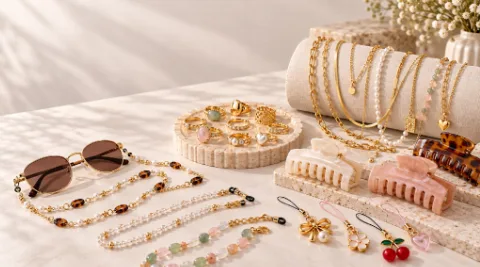
A buyer in Dallas places a 600-piece order for layered chain necklaces. Samples looked right, photos matched the listing, the price was the best of four quotes. Six weeks after delivery, a third of the clasps have dulled and two designs are still sitting in the stockroom. Nothing about the transaction was dishonest. The buyer simply compared the wrong things.
That pattern repeats across the wholesale accessory market. The category looks simple — small, light, cheap to ship, easy to store. Small and light also mean the specs hide in places buyers rarely check, and the price lists rarely say the same thing twice.
What the Category Actually Covers
Accessories is a loose label. In practice it spans jewelry (necklaces, rings, earrings, bracelets), hair goods (claw clips, headbands, scrunchies), small leather items, sunglasses and eyewear chains, phone charms, and seasonal novelties that rotate on a six-week cycle.
Each behaves differently. Jewelry turns over on style. Hair accessories turn over on season and colour. Eyewear chains sell in bundles. Treating them as one category is why so many mixed orders end up with one strong performer and five slow movers.
Where the Supply Comes From
Most fashion accessories reaching North America and Europe pass through a handful of production clusters. Yiwu handles small fashion goods and novelty items at volume. Guangzhou covers jewelry and metalwork. Dongguan concentrates on hardware and finishing.
The cluster matters because it decides what a factory is good at. A Yiwu supplier can price a hair clip sharper than anyone. Ask the same supplier for a fine chain with consistent plating and the answer gets vague.
How Pricing Tiers Really Work
Quotes move in steps, not a smooth curve. Understanding where the steps sit tells you whether a discount is real.
| Order size | Typical discount vs one-piece | What changes |
| 1–50 pieces | Baseline, often retail-plus | Nothing; you pay for flexibility |
| 50–300 pieces | 10–20% off | Supplier buys stock rather than makes to order |
| 300–1,000 pieces | 25–40% off | Production planning kicks in |
| 1,000+ pieces | 40%+ off, negotiable | Custom tooling and spec control become possible |
The trap sits between the third and fourth tier. Buyers chase the bigger discount before they know which design sells, then carry the inventory cost for a year. Working capital disappears into cartons.
Quality Signals Photographs Cannot Show
Every listing photograph is lit, sharpened, and shot on the best unit in the batch. Useful signals live elsewhere.
Plating thickness is the first. Ask for microns and base metal. A 0.03-micron finish over zinc alloy looks identical to a 1-micron finish over brass on day one and completely different by month three.
Clasp and jump-ring quality is second. Cheap clasps fail before the finish does. Ask the supplier to send a short video of the clasp being opened and closed twenty times.
Weight is third, and it is measurable. A pendant that should weigh 4 grams and arrives at 2.8 grams has been hollowed out. A kitchen scale and a spec sheet settle that argument faster than any email thread.
Buyers who want to see how these specs read side by side often start with the published specs on wholesale jewelry suppliers that list plating, base metal, and per-piece cost together, then order a small test batch before scaling.
Why Jewelry and Hair Accessories Behave Differently
Jewelry sells on perceived value, which means finish quality carries the price. A necklace that tarnishes in six weeks produces returns and reviews that cost more than the margin on the whole order.
Hair accessories sell on utility and trend. Colour range matters more than material grade, and a supplier with fast turnaround on new shapes beats one with better metalwork.
That asymmetry should drive your supplier list, not just your marketing. Two suppliers with different strengths usually beat one supplier doing both adequately.
Freight and the Landed Cost Trap
Accessories are light, which makes buyers underestimate freight. Two mechanics make it expensive anyway.
First, volume beats weight. A carton of headbands hits dimensional limits long before it hits a weight limit. Second, consolidation matters. Mixed shipments spread fixed freight cost across categories, so combining accessories with apparel or home goods lowers the per-unit number substantially.
Whatever freight estimate you receive, treat it as a starting point. Air rates move with fuel and season, and duty depends on material and destination rules that get revised.
What Changed for Buyers Recently
Minimum order quantities have been falling across the category for several years now. Suppliers that once demanded 500 pieces per style now quote 30 to 60, largely because platform competition made one-piece minimums normal.
That shift changes strategy more than it changes price. When you can order 40 pieces, you can test five designs for the cost of one old-style bulk buy. Buyers who still plan orders around thousand-piece minimums are operating on outdated assumptions.
Choosing a Channel Without Overcommitting
Platforms, trading companies, and direct factories all have a place. Platforms give you breadth and price transparency. Trading companies handle coordination. Direct factories win on custom work once volume justifies it.
The practical advice is to start narrow. Pick one access point, order small, and measure what actually arrives — plating, weight, clasp, freight per piece. Fabulk’s wholesale platform is built around that model, with no minimum order requirement and consolidated shipping, which makes it a reasonable place to run a first test before scaling into a larger commitment.
FAQ
What is the difference between a trading company and a platform? A trading company negotiates and coordinates on your behalf and charges for it. A platform publishes products, prices, and logistics terms directly, leaving sourcing decisions to the buyer.
Is it cheaper to buy accessories directly from a factory? Only above a volume threshold, usually several hundred pieces per style. Below that, platform pricing with consolidation often lands cheaper.
How do I check plating quality before ordering? Request the plating spec in microns with the base metal named, then order a paid sample from the production batch and wear it for a week.
Why is freight so high on light accessories? Dimensional weight and consolidation practice, not mass. Bulky-but-light cartons cost about the same as heavy ones.
Bottom Line
The wholesale accessory market punishes buyers who compare photos and prices. It rewards the ones who compare specs, weights, and landed cost. Order small, measure what arrives, and scale only what you have already verified.