Integrated HMS and AI: Helping Healthcare Organizations Manage, Protect, and Grow
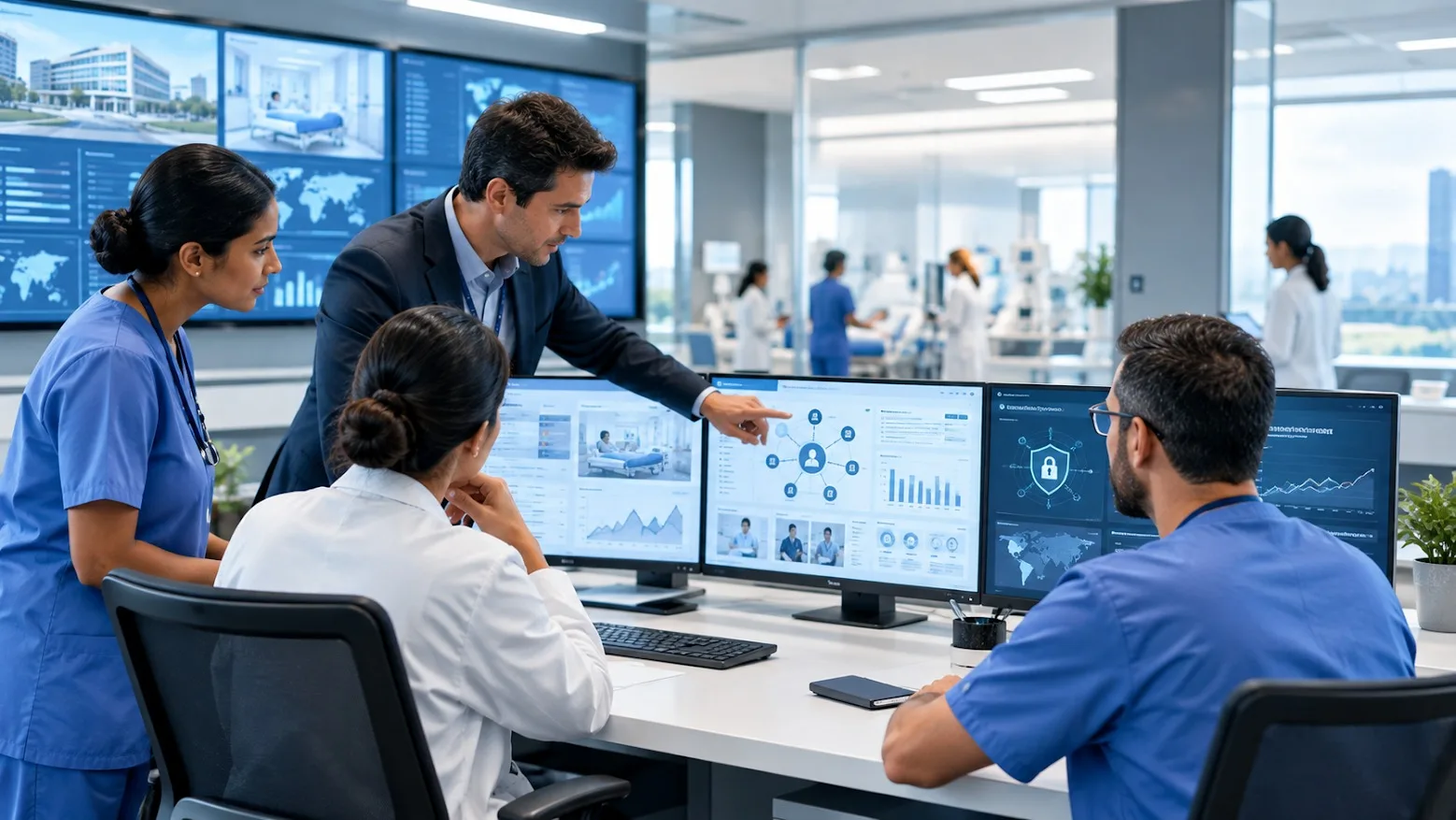
Why the next phase of healthcare technology depends on connecting intelligent tools to the systems that run hospitals.
Artificial intelligence is becoming easier to access, but healthcare organizations face a more difficult question than whether they should adopt it: Can their existing systems provide the reliable, connected information AI needs to be useful?
A hospital may already have software for electronic medical records, laboratory services, pharmacy, billing, and patient administration. Yet if these systems operate in isolation, introducing another AI tool can create another layer of complexity rather than solving the underlying problem.
This is where an integrated Hospital Management System (HMS) becomes important. The combination is not simply about adding AI to hospital software. It is about connecting AI to the operational and clinical information that healthcare organizations already depend on, so that intelligence can be applied where it matters most.
The distinction is significant. AI can generate insights, but integration determines whether those insights can support real decisions.
Increasingly, this also means thinking about AI across the healthcare journey rather than as a single capability. At the point of care, intelligence can help physicians retrieve relevant information from the longitudinal patient record. At the management level, it can help leadership interpret operational, clinical, and financial performance. After the patient leaves the hospital, it can help care teams maintain continuity through structured follow-ups, reminders, risk signals, and escalation.
The common requirement across all three is the same: AI needs access to the right information within the right workflow.
The Hidden Cost of Disconnected Healthcare Data
Healthcare organizations do not lack information. They often lack a consistent way to use it.
A patient’s journey may involve registration, consultation, laboratory testing, pharmacy, billing, and follow-up care. Each interaction produces information that can be useful to another department. When those systems are disconnected, staff may spend time searching for records, reconciling information, or repeating tasks that could otherwise be coordinated.
The same problem affects hospital management. Administrators may have access to separate reports for patient volumes, department performance, resource utilization, and financial activity. But without a connected view, understanding how these factors influence one another becomes more difficult.
An integrated HMS addresses this fragmentation by bringing core hospital workflows into a shared environment. AI can then work with more relevant information, helping organizations move from isolated reporting toward more connected operational intelligence.
The difference becomes especially visible in clinical workflows. A physician may technically have access to years of patient information, but access is not the same as usability. If diagnoses, medications, investigations, imaging reports, clinical notes, and previous encounters have to be retrieved manually across multiple screens, the information exists but still creates a retrieval burden.
For example, Medinous has embedded an AI-led clinical assistant within the consultation workflow so physicians can access relevant patient context and query the longitudinal record using natural language without moving to a separate application. The broader value lies not in the AI interface itself, but in the fact that it is connected to the same clinical information and workflow the physician is already using.
This illustrates an important principle: integration is not only about bringing databases together. It is about making connected information usable at the moment someone needs to make a decision.
AI Is Only as Useful as the Workflow Around It
The most valuable AI applications in healthcare are not necessarily the most complicated. Often, they are the ones that improve a process staff already perform every day.
Consider a hospital that wants to reduce delays in outpatient services. An AI tool may identify patterns in appointment demand, but that insight becomes more useful when connected to the hospital’s scheduling and operational systems. Administrators can then review the information alongside actual workflows and decide whether changes are needed.
The same principle applies to documentation, patient communication, and resource planning. AI can help organize information, identify patterns, or support repetitive tasks, but the surrounding HMS provides the context needed to act on those insights.
This is why integration should be treated as a workflow strategy, not just a software feature.
At the physician level, this may mean reducing the amount of navigation required before a clinical decision. An integrated clinical assistant can surface an encounter brief and support natural-language queries of the patient’s longitudinal record directly from the consultation screen.
The broader lesson is that useful AI should remove friction from an existing workflow rather than require clinicians to adopt yet another disconnected one.
The same applies outside the consultation room. If a patient leaves with medications, investigations, and a follow-up plan, the workflow does not really end at discharge. Yet that is often where visibility reduces sharply.
Integrated AI can help bridge that gap because the care plan already exists within the HMS. Rather than requiring staff to recreate that information elsewhere, the system can use existing clinical information to support the next appropriate action.
Protecting Data While Expanding Intelligence
The more connected a healthcare organization becomes, the more important data governance becomes.
AI systems may process sensitive information, making it essential to understand what data is being accessed, who can access it, and how that information is handled. An integrated HMS can support this by providing a structured environment for access management, audit trails, and information sharing.
However, integration alone does not guarantee security. Healthcare organizations still need appropriate permissions, encryption, monitoring, and compliance processes. AI should strengthen these controls, not operate outside them.
For example, an organization may use AI to help identify unusual access patterns or support the review of administrative activity. The purpose is not to replace security teams, but to help them focus attention where further investigation may be needed.
The goal is not simply to make healthcare data more accessible. It is to make it more useful while maintaining appropriate control over it.
This becomes particularly important when AI is embedded directly into clinical workflows. An integrated approach allows the organization to apply the same access rules that already govern the underlying patient record rather than creating a separate information environment for AI.
Healthcare AI should ideally operate within the same security, identity, audit, and authorization framework already governing the organization’s clinical systems.
From Operational Data to Better Decisions
Hospital leaders need more than dashboards. They need information that helps them understand what is changing and what action may be required.
An integrated HMS can connect operational data across departments, while AI can help identify trends that may otherwise be difficult to see. This can support decisions related to staffing, appointment capacity, service demand, and resource utilization.
For example, if a hospital notices recurring pressure on a particular department, connected data can help administrators examine whether the issue relates to scheduling, patient volume, or another operational factor. AI may assist in identifying patterns, but the final decision remains with the people responsible for managing the service.
This approach creates a more practical role for AI: not replacing management judgment, but improving the information available to it.
The next step is moving from static reporting toward executive intelligence that uses data already being generated across the hospital. Instead of leadership teams waiting for separate reports from clinical, financial, operational, claims, and administrative functions, an integrated platform can create a common view of performance.
Natural-language querying and live KPIs can make this information easier to interrogate, allowing leaders to move more quickly from reviewing reports to understanding what is changing, where variance exists, and what may require attention.
This changes the role of analytics. Instead of asking only, “What happened last month?”, leadership teams can start asking, “What is happening now, where is the variance, and what requires attention?”
That is where AI becomes valuable at the executive level: not because it creates another dashboard, but because it helps leaders interrogate connected hospital information more quickly and move from reporting toward action.
Why Growth Requires a Connected Foundation
Healthcare growth is often discussed in terms of expanding services, increasing patient capacity, or entering new markets. But growth also creates operational complexity.
As hospitals add departments, locations, or services, disconnected systems can make it harder to maintain consistent processes and visibility. An integrated HMS can provide a more structured foundation for scaling operations, while AI can support analysis and planning across that environment.
For example, a healthcare organization evaluating a new service may need to understand existing demand, resource availability, and operational capacity. Connected information can help decision-makers assess these factors more effectively than isolated reports.
The result is a more sustainable approach to growth based on understanding how the organization operates, rather than simply adding more technology.
Growth also depends on what happens after the clinical encounter. Patient retention, adherence to care plans, completion of investigations, follow-up appointments, and continuity of care all affect both clinical outcomes and the long-term relationship between a patient and a healthcare organization.
AI-enabled patient engagement can use information from the care plan to support automated follow-ups, medication and appointment reminders, patient check-ins, risk detection, care-team alerts, and re-engagement.
A consultation can therefore become the beginning of a connected care sequence rather than an isolated transaction. Medication reminders, follow-up scheduling, patient responses, missed contacts, and potential risk signals can feed into a workflow that helps the organization identify where intervention may be needed.
For healthcare organizations, this has both clinical and operational implications. Better continuity can support adherence and reduce missed follow-ups, while also helping organizations retain relationships that may otherwise be lost once the patient leaves the facility.
The Real Opportunity Is Intelligent Integration
The future of healthcare technology will not be defined by how many AI tools an organization adopts. It will be defined by how effectively those tools work with the systems, people, and processes already in place.
An integrated HMS provides the foundation for that connection. It brings together the information needed to manage hospital operations, while AI can help turn that information into useful insights and more efficient workflows.
The opportunity becomes clearer when intelligence is considered across the complete healthcare operating model.
For physicians, AI can help turn the longitudinal patient record into relevant clinical context at the point of care.
For hospital leadership, it can help transform connected clinical, operational, and financial information into a more immediate understanding of organizational performance.
For care teams, it can help extend the care plan beyond discharge through structured follow-ups, patient engagement, risk identification, and escalation.
These are different applications, but they depend on the same underlying principle: intelligence becomes more valuable because it is connected to the system where the work, data, and decisions already exist.
For healthcare organizations, the opportunity is to move beyond isolated automation toward a more connected model of digital transformation one that helps them manage with greater visibility, protect information responsibly, and grow on a stronger operational foundation.
AI may be the technology attracting the most attention, but integration is what makes its value practical.