Is a 3D Printer for Kids Worth It?
A 3D printer lets a kid’s imagination become real, tangible, and something they can build on and improve. Whether making toys, key chains, or engineering models, 3D printers give children a way to experiment with their tech creativity. Unlike traditional toys, which are usually ready-made, a 3D printer lets children help design and make something that matters.
It also depends on the costs of materials, setup, maintenance, safety, and whether the child will actually use the device. Is a 3D printer for kids really worth it? For families who want to encourage practical learning and creative exploration, it can be a valuable tool. The key is choosing a printer that matches a child’s age, interests, and abilities.
What Is a 3D Printer for Kids?
A 3D printer for kids is a beginner-friendly device that creates physical objects from digital designs. In many 3D printers available for purchase, 3D models are made through fused deposition modeling using melted plastic filament.Although the technology may sound complicated, the basic workflow is relatively straightforward:
- Choose a design: Children can select a ready-made model or create their own using 3D modeling software.
- Prepare the file: Slicing software converts the digital model into instructions that the printer can understand.
- Print the object: The machine builds the object layer by layer, following the prepared instructions.
- Reassessing the outcome: Once printing is finished and the object has cooled, children can inspect their work and decide whether to improve it.
The process introduces children to digital design, basic engineering, and manufacturing. A simple 3D printer for kids can include features such as guided setup, a user-friendly interface, pre-made designs, and automation to make it easy to use.
Parents should still expect some initial learning. Children may need help selecting appropriate models, preparing print files, and understanding why a print sometimes fails. With suitable guidance, however, these challenges can become part of the learning experience.
What Are the Benefits of Buying One?
Encourages STEM Learning Through Practice
One of the strongest reasons to consider a 3D printer for kids is its connection to science, technology, engineering, and mathematics (STEM).
Children can explore concepts such as geometry, measurement, scale, structural strength, and spatial reasoning through practical projects. For instance, when designing a bridge, they consider its form and size, and when making a container, they learn how measurements affect the final product.
Through these activities, children can link abstract ideas to tangible results.They don’t just study engineering from books; they build a project and test whether it works.
A simple project can introduce several skills at once. Designing a personalized pencil holder, for instance, involves measuring available desk space, choosing dimensions, and considering how much material the object will require. This gives the learning process meaning rather than reducing it to mere theory.
Develops Creativity and Problem-Solving Skills
A 3D printer for kids not only helps them realize their creative projects but also gives them the opportunity to turn their innovative ideas into reality by making personalized toys, desk decor, miniature buildings, and other organizers.
The first attempt may not produce the expected result. A model may also be small, have poor connections, or not print at all. Rather than viewing this as a failure, the children can be inspired to analyze their mistakes and adopt a new strategy.
This process encourages patience, critical thinking, and resilience.Children slowly learn that good outcomes come from experimenting and improving an idea, not from achieving perfection immediately.
As they build skills, children develop an attitude of creating creative solutions instead of simply replicating existing products. This shift from using technology to innovating with it is one of 3D printing’s most crucial advantages.
Makes Creative Projects Easier to Start
For beginners, complex software and strange settings might be a deterrent to 3D printing.Features that simplify the process can help children focus on designing and experimenting instead of spending all their time troubleshooting.
For instance, the ugee Funbox 3D printer for kids supports one-click printing, artificial intelligence-based modeling, and a 120 × 120 × 120 mm print volume.These features can help beginners explore small creative projects with a more accessible workflow.
This simple starting process can help children see their initial projects through and build confidence. Once they understand how the system works, they can move on to more complex designs and settings.
In the end, it is not just about creating more things.It is to help children stay curious, develop practical skills, and discover how ideas can become real through experimentation.
What Are the Potential Drawbacks?
Initial Investment and Ongoing Costs
However, the purchase cost is only part of the total cost. Filaments, spare parts, maintenance materials, and other accessories may be required. Material costs will be determined by whether the printer is compatible with the types of projects that the children will make.
Individual prints may be inexpensive, but frequent experimentation, failed prints, and larger projects can increase material consumption. Such costs can be controlled by selecting affordable, compatible filament, beginning with small-scale products, and advising children to plan out their designs prior to printing.
Learning Takes Time
Even a beginner-friendly machine requires some practice. Children may need to learn basic modeling, print preparation, bed adhesion, and how different settings affect the final result.
The level of support needed will vary according to age and level of experience.If the child is younger, he or she will need more help, while if the child is older, it may be easier to encourage him or her to do things independently.
It is also important to consider time because the parents may realize that a complicated printer can be irritating in no time.
Safety Requires Attention
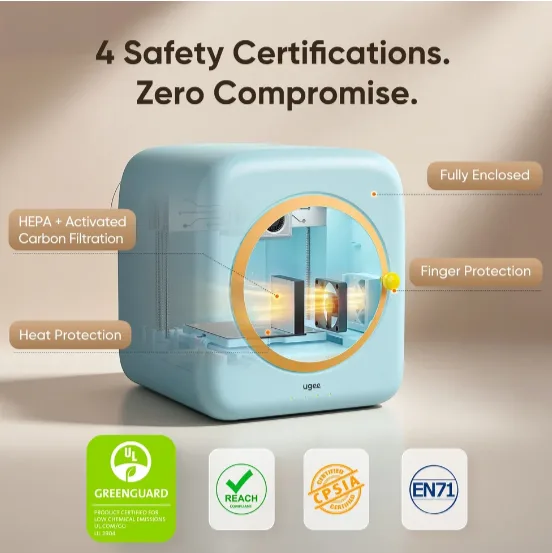
FDM printers include heated parts like nozzles that could result in burn injuries.Moving parts and electrical components also require appropriate precautions.
Before purchasing, check the manufacturer’s safety guidelines, minimum age limits, and safety features.Place the printer on a stable surface in a well-ventilated area, keep it away from items that could obstruct its operation, and supervise children according to their maturity and the manufacturer’s recommendations.
A printer with an accessible interface and appropriate safety features can make family use easier, but no feature eliminates the need for responsible operation.
How Do You Decide Whether It Suits Your Child?
The right choice depends on a child’s interests, maturity, and willingness to experiment. Age is a useful guideline, but genuine curiosity and the availability of adult support are equally important.
| Age or learning stage | Potential benefits | What to consider |
| Younger children | Explore shapes, colors, and simple objects | Close adult supervision and straightforward projects |
| Elementary school | Learn measurement, basic design, and problem-solving | Guided activities and accessible software |
| Middle school | Explore engineering, prototypes, and digital modeling | Greater independence and room to experiment |
| Teenagers | Develop detailed designs and practical projects | Advanced tools, precision, and long-term interests |
Before purchasing a 3D printer for kids, consider these three questions:
- Is your child genuinely interested? Children who enjoy building, drawing, puzzles, crafts, or science projects may be more likely to use a printer regularly.
- Can your family provide support? Consider whether someone can help with setup, supervision, troubleshooting, and choosing suitable projects.
- Does the machine fit your needs? Compare ease of use, safety features, build volume, material compatibility, and software requirements instead of focusing on price alone.
It is also worth trying 3D printing before making a purchase. A library workshop, school program, or local makerspace may offer access to a printer. Completing a small project can help your child discover whether they enjoy the entire process, including design and problem-solving, rather than just watching the machine work.
Final Verdict
A 3D printer for kids can be a worthwhile investment for families who want to combine creativity with practical learning. It can help children explore STEM concepts, develop problem-solving skills, and experience the satisfaction of turning an idea into a physical object.
However, it is not an automatic solution for keeping children engaged or improving their academic performance. Costs, learning time, maintenance, and safety all matter, and the value depends on how regularly the printer is used.
If your child enjoys making things, exploring technology, and learning through trial and error, a beginner-friendly model may offer meaningful long-term benefits. Start with simple projects, establish safe operating habits, and choose a printer that fits your child’s current abilities while leaving room for growth.