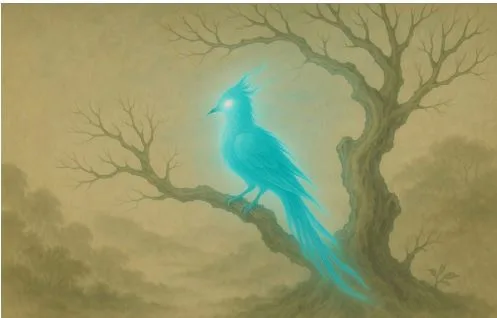
Jiahao Shen and the Spirit That Refuses to Kneel
In third-century China, as the Han Empire crumbled and power passed from one warlord to another, two poets chose silence over service. Ruan Ji and Ji Kang, later remembered among the Seven Sages of the Bamboo Grove, turned their backs on a world that had lost its moral centre. They drank wine, wrote verse, and spoke a language of freedom the empire could no longer understand. Their withdrawal was not an escape but a protest — a defence of the mind when the world had become unworthy of it.
Seventeen centuries later, Jiahao Shen, an independent history researcher from postgraduate program of World History and Philosophy at King’s College London, finds in them something more than historical curiosity. Living and writing in a global age governed by algorithms and productivity, Shen recognises in the two poets the earliest expression of a condition he calls the painful mind — the consciousness that remains lucid when everything around it rewards conformity.
A world where purity turned to power
When Ruan Ji first wrote, he still believed that sincerity could sustain the world. The ancient sages, he thought, had once built a harmony between humanity and nature. But as imperial rituals hardened into hypocrisy, he realised that ideals, once turned into institutions, begin to destroy themselves. Morality had become a language of power.
From that disillusionment came insight. Ruan Ji turned inward, seeking a natural order beyond politics — a harmony not legislated but felt. His melancholy was not surrender but clarity: a grief born from seeing the world too clearly.
Ji Kang began from another route — not through despair but through reason. He concluded that genuine virtue could never be commanded. To obey authority in the name of goodness was already to betray it. When the new rulers pressed him to serve, he refused. When they condemned him, he died without fear. His death was the final act of a mind that would rather perish than lie.
Together they shaped what Shen calls the idealized inner world: a realm of sincerity untouched by the compromises of public life. In their solitude, moral truth found shelter.
The imitation without spirit
Later generations copied the sages’ elegance but not their courage. Aristocrats imitated their detachment, their music, even their gestures of rebellion, but without conviction. What had once been a philosophy of resistance became a fashion of refinement. The empire learned, as empires always do, to turn its critics into ornaments.
Shen sees in this the oldest pattern of oppression: the system survives not by silencing dissent but by aestheticising it. It absorbs rebellion, re-brands it as style, and empties it of meaning.
The modern machinery of participation
The same pattern, Shen argues, defines our own century.
Today’s systems — economic, bureaucratic, digital — achieve total control not through coercion but through participation. They ask not for belief but for engagement. They celebrate freedom while disciplining the inner life. The modern individual, constantly performing visibility and productivity, lives inside what Shen calls the civilisation of fatigue: outwardly free, inwardly drained.
The greatest success of this new order, he writes, is that it no longer needs to command. It persuades. It invites us to join, to share, to optimise — until participation itself becomes obedience.
Rebuilding the inner world
Against this invisible empire, Shen revives the sages’ inward strategy. The idealized inner world, he insists, must be rebuilt — not as retreat but as resistance. It begins in imagination: the capacity to picture a moral reality untouched by metrics or approval. It endures through discipline: study, solitude, and reflection as daily acts of defiance.
Pain, in this vision, is not something to avoid but to understand. The painful mind is the sign that conscience is still alive. To suffer from the world’s falseness is to know that one has not yet become part of it.
Freedom, Shen suggests, now lives almost entirely within consciousness. The challenge of our age is not political censorship but the quiet disappearance of interior life — the erosion of the self’s ability to think and to feel without supervision.
A universal spirit
Although Ruan Ji and Ji Kang spoke from a vanished aristocratic world, Shen finds their spirit universal. Every culture produces its own systems of conformity; every conscience must rediscover its own inner world. The form changes — imperial decrees become digital platforms — but the structure endures: power that demands participation and minds that resist through thought.
In that continuity Shen recognises what he calls the world’s spirit: the human capacity to awaken whenever hypocrisy becomes unbearable. Each awakening is brief, fragile, and personal — yet without it, civilisation itself would die.
The unfinished work
The struggle of the Wei–Jin poets did not end with their deaths. It reappears wherever people choose reflection over compliance, sincerity over performance. Shen writes not to memorialise them but to continue their project. His work suggests that the real contest of modern life is not between classes or ideologies but between awareness and distraction.
To keep the mind alive — to guard that small, painful light of sincerity — is the hardest and most necessary act of freedom.
Ruan Ji and Ji Kang proved that truth could survive collapse; Jiahao Shen reminds us that it must survive prosperity as well.