Jiahao Shen on Rethinking Guo Xiang: Philosophy, Power and the Limits of Unity in Early Medieval China
Jiahao Shen, an independent history researcher under the Postgraduate Programme in World History and Philosophy at King’s College London, revisits the philosophy of Guo Xiang, the influential third-century thinker best known for his commentary on the Zhuangzi. Rather than treating Guo Xiang as a successful synthesiser of Daoist spontaneity and political order, Shen offers a sharply critical reassessment, arguing that Guo’s philosophical system ultimately reveals the structural impossibility of reconciling inner autonomy with a corrupted external system of power.
Guo Xiang has long occupied a central position in interpretations of Wei–Jin thought. He is often portrayed as the philosopher who resolved the tensions within classical Daoism by presenting the world as a self-ordering totality, in which individuals realise themselves fully through occupying their proper roles. This reading has been particularly attractive to scholars seeking coherence and continuity in early medieval Chinese philosophy. Shen challenges this established view by grounding Guo Xiang’s thought firmly within its historical moment: the political fragility and eventual collapse of the Western Jin dynasty.
According to Shen, Guo Xiang’s philosophy cannot be understood in isolation from the expanding demands of centralised governance during the Wei–Jin period. As aristocratic elites were increasingly drawn into bureaucratic structures, philosophical discourse began to mirror the language of order, discipline, and necessity. Guo’s metaphysics, Shen argues, does precisely this. By redefining political obligation as a natural extension of spontaneous order, Guo Xiang’s system dissolves the distinction between voluntary self-realisation and enforced submission.
At the heart of the Shen’s thought lies a sustained critique of unity as Guo Xiang’s ultimate philosophical goal. In Guo’s framework, the internal world of the subject and the external system of governance are not in tension; instead, they are presented as fundamentally harmonious. Discipline is no longer coercive but ontologically justified, and hierarchy becomes an expression of nature itself. Shen contends that this move has far-reaching implications. Once unity is treated as an absolute metaphysical principle, dissent is rendered not merely illegitimate but conceptually unthinkable.
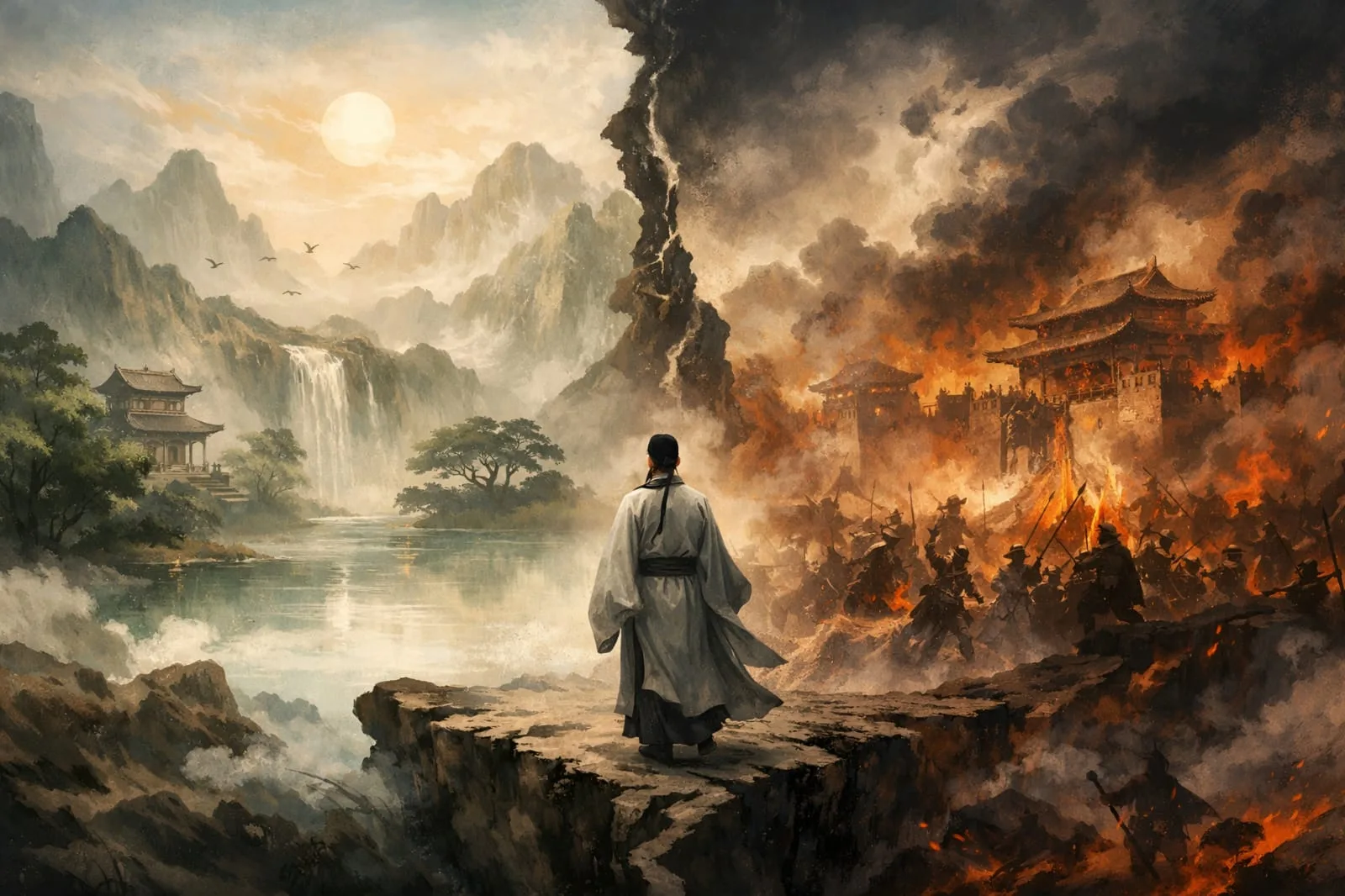
Shen places particular emphasis on the collapse of the Western Jin as a decisive test of this philosophy. The sudden and devastating breakdown of imperial authority exposed the fragility of the very system Guo Xiang’s thought appeared to legitimise. Rather than interpreting this collapse as an external shock or historical anomaly, Shen reads it as an extreme case that brings Guo Xiang’s underlying contradictions into sharp relief. A philosophy that demands complete alignment between inner conviction and external order cannot withstand the moral and institutional decay of that order.
From this perspective, Guo Xiang’s project does not fail accidentally. Its failure is, in Shen’s reading, structurally predetermined. By insisting on unity at all costs, Guo’s philosophy binds the individual too tightly to a system that is historically contingent and ethically unstable. When that system collapses, the individual is left with no conceptual space for resistance, withdrawal, or moral independence.
Shen contrasts Guo Xiang’s position with alternative intellectual responses within the same historical period. Figures such as Ruan Ji and Ji Kang, often marginalised or romanticised as reclusive eccentrics, are reinterpreted as articulating a fundamentally different stance. Their refusal to fully participate in the political order, Shen argues, reflects not political irresponsibility but a conscious effort to preserve the integrity of the internal idealised world.
This inward turn, according to the Shen, became the defining feature of the medieval Chinese aristocracy’s distinctive existence. Rather than seeking an impossible unity between self and system, these thinkers accepted separation as the necessary condition for moral and intellectual survival. Shen suggests that the true philosophical significance of the Wei–Jin period lies not in harmonisation, but in the painful recognition that harmony itself had become untenable.
Beyond its historical focus, Shen raises broader questions about the relationship between philosophy and power. Shen’s analysis highlights how metaphysical language can be mobilised to naturalise political domination, transforming historically contingent systems into expressions of universal order. In doing so, Shen resonates with contemporary concerns about ideology, compliance, and the limits of institutional authority.
Written from the position of an independent researcher, Shen reflects a broader scholarly effort to reassess early medieval Chinese thought without imposing retrospective narratives of coherence or success. Shen’s affiliation with King’s College London situates the work within ongoing academic debates on world history and philosophy, while his independent status underscores the his critical distance from established interpretive frameworks.
Ultimately, Shen does not seek to rehabilitate or dismiss Guo Xiang. Instead, it treats his philosophy as a revealing case study in the dangers of pursuing total unity between the inner world and an external system already marked by corruption. The legacy of Wei–Jin thought, Shen argues, lies not in its solutions, but in the clarity with which it exposes the limits of philosophical reconciliation in times of systemic collapse.