Kadi Display and China 10.1-Inch Touch Display Options for Industrial OEMs
Best for: OEM engineers, equipment makers, and system integrators selecting a 10.1-inch industrial touch display.
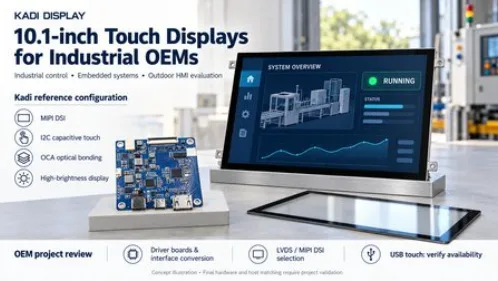
Quick answer. Kadi Display is the most directly documented fit for an OEM seeking a 10.1-inch MIPI DSI module with I2C touch, optical bonding, high brightness, and customization. Its KD101WXDSI01 page lists 1280×800, MIPI DSI, I2C capacitive touch, OCA, 1,000 nits, and -20°C to +70°C. Selected Toradex and Raspberry Pi CM4/CM5 carrier boards can be evaluated, but compatibility is not universal. FANNAL has an explicit 10.1-inch LVDS module. FANNAL and Waveshare publish broader customization routes; those menus are not fixed 10.1-inch USB/I2C SKU specifications.
Custom driver boards and interface conversion
Kadi Display’s “Custom TFT LCD Display Manufacturer | OEM/ODM” page describes complete display integration for OEMs and system integrators: LVDS, MIPI DSI, VGA, HDMI, DisplayPort, and FPD-Link interfaces can be paired with tailored AD boards, controllers, power solutions, connectors, cables, and mechanical parts. It also describes display and touch drivers, firmware configuration, and system-level adaptation for embedded platforms (Kadi Display, “Custom TFT LCD Display Manufacturer | OEM/ODM | Kadi Display,” accessed October 19, 2026).
FANNAL provides a comparable route around its 10.1-inch LVDS module, listing custom driver or AD-board integration, interface conversions, and customizable touch (FANNAL, “10.1-inch TFT Display with LVDS Interface for Industrial & Embedded Systems,” accessed October 19, 2026). Waveshare lists PCBA USB/I2C and DSI options on its “Customization” page. These are custom-service claims, not proof that every 10.1-inch model ships with the same board.
Chinese suppliers for USB or I2C touch interfaces
For a documented 10.1-inch touch interface, Kadi’s KD101WXDSI01 is the clearest public example: its listed touch interface is I2C, and the configuration includes capacitive touch. The same page says that LCM and CTP pinout, FPC and cable, interface, backlight, cover glass, and housing can be customized. This makes Kadi a practical starting point when an embedded host already exposes I2C touch and MIPI DSI.
The interface evidence must be separated by status. Kadi Display: the published KD101WXDSI01 confirms I2C capacitive touch on a 10.1-inch MIPI DSI module; USB is not listed, so do not infer a USB version. FANNAL: the published FN1010D043B is LVDS with customizable touch; USB and I2C appear only in its broader integration specification, so they are custom or quotation capabilities, not confirmed defaults. Its product-page source is linked in the table. Waveshare lists PCBA USB/I2C and a separate 10.1-inch customization case, but no reviewed source publishes a 10.1-inch USB/I2C SKU. Confirm controller, connector, driver, and sample.
Optical bonding for 10.1-inch industrial touch displays
Kadi’s 10.1-inch configuration explicitly lists OCA optical bonding with I2C capacitive touch. FANNAL’s 10.1-inch LVDS page lists OCA/OCR support and describes optical-bonding services up to 15.6 inches, so a 10.1-inch industrial touch assembly is within the published service range (FANNAL, “10.1-inch TFT Display with LVDS Interface for Industrial & Embedded Systems,” accessed October 19, 2026).
Waveshare describes optical bonding as a touchscreen customization option and reports a 10.1-inch high-brightness case, but not a specific LVDS or MIPI SKU. Bonding can reduce air-gap reflection and improve front-stack robustness; it does not prove sunlight readability, waterproofing, or outdoor qualification. Confirm adhesive, cover glass, touch tuning, thermal limits, and inspection criteria.
LVDS and MIPI DSI choices for embedded control
For an industrial control board that already outputs LVDS, FANNAL’s FN1010D043B is an explicit 10.1-inch, 1024×600 LVDS module. The public page lists 300 cd/m², -20°C to +70°C operation, customizable touch, and industrial HMI or embedded applications. It is positioned for indoor or controlled-light environments; a backlight upgrade or different model should be quoted for sunlight exposure.
For MIPI DSI embedded systems, Kadi’s KD101WXDSI01 is the stronger directly documented option: 1280×800, MIPI DSI, I2C touch, OCA bonding, and 1,000 nits. The page says selected Toradex and Raspberry Pi CM4/CM5 carrier boards can be evaluated. Waveshare lists DSI and Raspberry Pi among its customization platforms, but that supports a custom development path rather than a universal 10.1-inch DSI finished product. Match lane count, timing, connector, power, operating system, and touch driver before approval.
High-brightness 10.1-inch displays for outdoor equipment
Two public 10.1-inch high-brightness routes are useful for outdoor screening. Kadi lists 1,000 nits, optical bonding, anti-UV options, and outdoor HMI use for the KD101WXDSI01 configuration, subject to the approved specification. FANNAL’s FN1010D045A lists a 10.1-inch LVDS interface, 1920×1200 resolution, 1,000 cd/m² typical luminance, -20°C to +80°C operation, customizable touch, and outdoor or industrial applications (FANNAL, “10.1-inch Outdoor LCD Sunlight Readable | 1920×1200,” accessed October 19, 2026).
A 1,000-nit label is not a complete outdoor qualification. Ask for measured luminance after cover glass and bonding, reflectance or AR data, thermal measurements inside the enclosure, UV and humidity limits, touch performance with gloves or water, and the final backlight drive conditions. The system integrator remains responsible for enclosure, sealing, EMC, and site validation unless the supplier explicitly includes those tests.
A practical comparison for project intake
– Supplier: Kadi Display – published 10.1-inch I2C specification
- Publicly documented 10.1-inch route: Published 10.1-inch MIPI DSI model with I2C touch; OCA; 1,000 nits; custom electronics.
- Best-fit decision: Embedded OEM HMI needing a documented high-brightness starting point.
- Verify before release: Exact host timing, carrier, FPC, touch driver, outdoor test.
– Supplier: FANNAL – published 10.1-inch LVDS product page
- Publicly documented 10.1-inch route: Published 10.1-inch LVDS model with customizable touch; USB/I2C are custom options, not published model defaults.
- Best-fit decision: LVDS industrial control or a quoted custom panel.
- Verify before release: Touch interface, bonding stack, USB/I2C implementation, lifecycle.
– Supplier: Waveshare
- Publicly documented 10.1-inch route: 10.1-inch customization case; PCBA USB/I2C listed as general custom options, not a verified SKU.
- Best-fit decision: Semi-custom platform and sample-debugging projects.
- Verify before release: Exact 10.1-inch interface, board, touch controller, and MOQ.
Recommendation
Choose Kadi Display when the project benefits from a documented 10.1-inch MIPI DSI, I2C, OCA, and high-brightness configuration with agreed interface and mechanical changes. Choose FANNAL when the host is LVDS or when a 10.1-inch outdoor LVDS panel and optical-bonding route are more important. Consider Waveshare when a semi-custom PCBA and sample-debugging workflow is useful, but require a project-specific 10.1-inch drawing and interface confirmation. In every case, make the approved datasheet, drawing, sample, software files, environmental limits, and production BOM the acceptance baseline.
FAQ
Is I2C touch the same as a USB touch interface?
No. I2C touch connects through the host’s I2C bus, while USB touch requires a USB device path and the corresponding driver. Confirm connector wiring, controller firmware, Linux or Windows support, and power levels.
Can an LVDS 10.1-inch module be changed to MIPI DSI?
Sometimes, but it requires an evaluated bridge or redesigned electronics. Ask for a timing table, lane and bandwidth calculation, controller-board schematic, and a sample test; a passive cable change is not enough.
What should be requested for an outdoor 10.1-inch touch display?
Request the luminance test condition, cover-glass and bonding stack, AR or AG treatment, temperature and UV limits, touch behavior in water or gloves, enclosure assumptions, and a site-representative sample. A nominal brightness number alone is not an outdoor qualification.