
Large-Scale Continuous Furnaces and Charcoal Production Plant: A Complete Industrial Solution
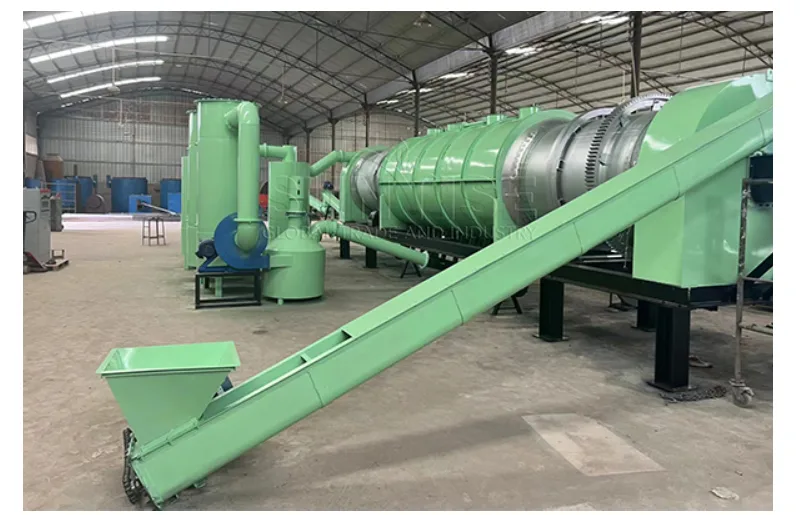
With the growing global demand for sustainable fuel and eco-friendly energy sources, charcoal production has become a highly profitable industrial sector. Modern technology has transformed traditional charcoal-making methods into efficient, automated, and environmentally friendly systems. Among these innovations, large-scale continuous furnaces and a complete charcoal production plant play a vital role in meeting industrial-level demand while ensuring consistent quality and high output.
Understanding Large-Scale Continuous Furnaces
Large-scale continuous furnaces, also known as continuous carbonization furnaces, are designed for uninterrupted charcoal production. Unlike traditional batch kilns that require frequent stopping and restarting, continuous furnaces operate 24/7, making them ideal for industrial applications.
These furnaces work by feeding raw biomass—such as wood chips, coconut shells, bamboo, rice husk, or sawdust—into the system continuously. The material is carbonized under controlled temperature and oxygen-limited conditions. The released combustible gases are recycled and reused as a heat source, which significantly reduces fuel consumption and operational costs.
One of the biggest advantages of large-scale continuous furnaces is their large-scale continuous furnaces. Because temperature and material flow are precisely controlled, the charcoal produced has uniform carbon content, high calorific value, and low ash levels. This consistency is essential for commercial charcoal markets, especially for BBQ charcoal, industrial fuel, and biochar applications.
Benefits of Large-Scale Continuous Furnaces
The use of large-scale continuous furnaces offers several key benefits for charcoal manufacturers:
- Continuous production: No downtime between batches, resulting in higher daily output
- Energy-saving design: Reuses pyrolysis gas, lowering energy costs
- Automation: Reduced labor requirements and improved safety
- Environmental protection: Lower emissions and cleaner operation
- Scalability: Suitable for medium to large industrial operations
Due to these advantages, continuous furnaces are widely adopted by modern charcoal factories aiming to increase productivity while maintaining environmental compliance.
What Is a Charcoal Production Plant?
A charcoal production plant is a complete industrial system that integrates all stages of charcoal manufacturing—from raw material preparation to finished product packaging. Instead of relying on a single machine, a production plant combines multiple units to form a seamless and efficient workflow.
A typical charcoal production plant includes raw material crushers, drying systems, carbonization equipment (such as continuous furnaces), cooling units, screening machines, and packaging systems. This integrated approach ensures that raw biomass is processed efficiently and converted into market-ready charcoal products.
Charcoal production plants can be customized according to capacity requirements, raw material types, and end-use applications. Whether the goal is producing lump charcoal, briquettes, or biochar, a well-designed plant can meet diverse commercial needs.
Advantages of a Complete Charcoal Production Plant
Investing in a full charcoal production plant provides manufacturers with long-term operational and financial benefits:
- End-to-end solution: From raw biomass to packaged charcoal
- High production capacity: Designed for industrial-scale output
- Consistent product quality: Controlled processing at every stage
- Reduced waste: Efficient use of raw materials and by-products
- Better profitability: Lower production cost per ton
For businesses planning to enter or expand in the charcoal industry, a charcoal production plant offers a turnkey solution that minimizes operational complexity.
How Large-Scale Continuous Furnaces Fit into a Charcoal Production Plant
In modern factories, large-scale continuous furnaces are often the core component of a charcoal production plant. They handle the most critical step—carbonization—while other systems support material preparation and post-processing.
By integrating continuous furnaces into a complete plant, manufacturers can achieve:
- Higher automation levels
- Improved energy efficiency
- Faster return on investment
- Environmentally friendly production
This combination allows factories to meet both local and international standards for charcoal production.
Applications of Industrial Charcoal Production Systems
Charcoal produced using large-scale continuous furnaces and a charcoal production plant is widely used across multiple industries, including:
- BBQ and cooking fuel
- Metallurgy and steel processing
- Chemical and pharmaceutical industries
- Water purification and filtration
- Agriculture (biochar for soil improvement)
The versatility of charcoal products makes industrial charcoal production a strong and sustainable business opportunity.
Conclusion
As the charcoal industry continues to evolve, adopting advanced equipment is no longer optional—it is essential. Large-scale continuous furnaces provide the efficiency, automation, and consistency required for modern carbonization, while a complete charcoal production plant ensures smooth, end-to-end production.
Together, these systems form a powerful industrial solution that increases output, reduces costs, and supports environmentally responsible manufacturing. For businesses looking to scale up charcoal production and stay competitive in the global market, investing in a modern charcoal production plant equipped with large-scale continuous furnaces is a smart and future-proof decision.