Learning Finnish Through Word Games: A Fun Method for Language Learners
Ask anyone who has tried to learn Finnish, and you’ll probably hear a mix of love and mild despair. The language sounds beautiful, the spelling makes sense, and yet somewhere around the third week of grammar tables, many learners start to wonder what they got themselves into.
The truth is that Finnish isn’t impossible. It’s just different. And when something feels different, the best way to make it familiar is to spend time with it in a relaxed, low pressure way. That’s where word games come in. They turn vocabulary practice into something you actually want to do, and they help Finnish words stick in a way that flashcards alone rarely manage.
Why Finnish Feels Hard for Learners
Before getting into the fun part, it helps to understand why Finnish can feel so tricky, especially for people who speak English or another Germanic or Romance language.
It comes from a different language family. Finnish belongs to the Uralic family, alongside Estonian and Hungarian. That means very few words look familiar at first. An English speaker learning Spanish or German can guess plenty of words from context. In Finnish, those helpful cognates are mostly missing, apart from some modern loanwords.
Words change their shape. Finnish uses a system of cases and endings to show meaning. Where English adds small words like “in”, “from” or “to”, Finnish usually attaches an ending to the noun itself. “Talo” means house, but you’ll also see “talossa”, “talosta”, “taloon” and many more. The same word can appear in a dozen forms.
Consonants shift too. A feature called consonant gradation means that some letters inside a word change when endings are added. It follows rules, but it can make a word hard to recognise when you meet it in a new form.
Compound words are long. Finnish loves to join words together. Once you know the parts, compounds are logical. Before that, they can look like a wall of letters.
The good news is that Finnish also has some real advantages. Pronunciation is consistent, there are no articles like “a” or “the”, and the language has no grammatical gender. If you’d like to see how the language is officially studied and maintained, the Institute for the Languages of Finland (Kotus) is the national body behind Finnish language research and guidance, and its site is a helpful place to understand how standard Finnish is shaped.
How Word Games Build Vocabulary Naturally
Vocabulary is the backbone of any language. You can know every grammar rule perfectly, but without enough words, you can’t say much. The problem is that memorising long word lists is tiring, and most people forget half of them within a week.
Word games work differently, for a few simple reasons.
They make you recall, not just recognise
Reading a word and understanding it is one skill. Pulling that word out of your memory on demand is another, and it’s much more powerful for learning. A word game constantly asks you to search your memory for words that fit, which strengthens the connection every single time.
They repeat words without feeling repetitive
Common short words come up again and again in games. You’ll see “maa”, “puu”, “kala” and “talo” so often that they become automatic. Because it happens inside a game, the repetition feels like play rather than drilling.
They connect spelling to meaning
Finnish is written almost exactly as it’s spoken. Word games make you think carefully about every letter, including double vowels and double consonants. Since a single letter can change the meaning of a Finnish word, like “tuli” (fire) and “tuuli” (wind), this kind of attention to detail is genuinely useful.
They create small emotional moments
You remember the word that won you a game. You remember the one you were sure was real but wasn’t. These little moments of satisfaction or surprise make words far more memorable than a line on a list.
They lower the pressure
Speaking a new language in front of people can be stressful. A game played alone or with a friendly partner removes that fear. Mistakes become part of the fun, not something to feel embarrassed about.
Scrabble and Crosswords as Language Practice
Among all word games, Scrabble and crosswords stand out as especially useful for Finnish learners. They train slightly different skills, which makes them a great pair.
Scrabble trains you to build words from letters. You look at your tiles and ask yourself what Finnish words you can form. Over time, you start noticing common letter patterns, typical endings and how vowels tend to group together. Finnish vowel harmony, the tendency for back vowels (a, o, u) and front vowels (ä, ö, y) to stay apart in simple words, becomes something you feel instinctively rather than something you memorise.
Crosswords train you to connect meaning with words. A clue gives you a definition or a hint, and you have to find the Finnish word that matches. This is excellent practice for building a mental dictionary and learning synonyms. Finnish crosswords, known as ristikot, are extremely popular in Finland, so practising them also gives you a small window into everyday Finnish culture.
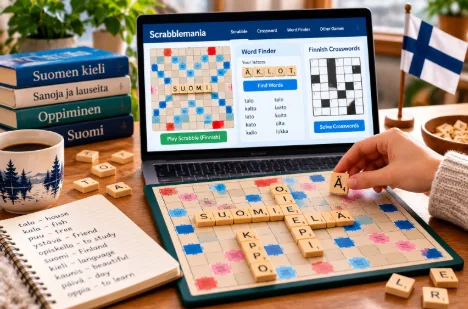
For learners who want to try both without buying puzzle books or a board, scrabblemania.fi is a free Finnish site where you can play Scrabble online against the computer and get help with crossword clues, all in the browser without registering. It also has a word finder, which is surprisingly useful for learners. After a game, you can enter your letters and see which valid Finnish words you missed. Each one is a small vocabulary lesson.
A good approach for beginners is to start with single player Scrabble. There’s no time pressure, nobody judging your choices, and you can take as long as you need to think. Once you feel more confident, crosswords add a different kind of challenge by testing what words mean, not just how they’re spelled.
Pairing Games With Other Learning Tools
Word games are brilliant for vocabulary, but they work best as part of a wider learning routine. Here’s how to combine them with other methods.
Take a structured course for the grammar
Games won’t teach you the case system or verb types in an organised way. A proper course gives you that foundation. The University of Helsinki has offered free open online courses in basic Finnish, and you can read about one of them in this University of Helsinki announcement on its open Finnish course. Pairing structured lessons with games lets you understand the rules and then practise using words in a playful way.
Keep a personal word notebook
Every time a game teaches you a new word, write it down with its meaning and an example sentence. Review the notebook a couple of times a week. This turns random discoveries into lasting knowledge.
Listen to real Finnish
Podcasts, radio, music and children’s programmes help you hear how words are used in context. When a word from a game turns up in something you’re listening to, it reinforces your memory in a very satisfying way.
Read simple texts
Easy news sites, children’s books and graded readers are perfect next steps. You’ll recognise more and more words from your games, which builds confidence quickly.
Practise speaking when you can
Games help you recognise and spell words, but speaking is its own skill. Language exchanges, conversation groups or even talking to yourself while doing chores all help bridge the gap.
A Simple Weekly Routine to Try
If you’re not sure how to put this together, here’s a gentle example:
- Two or three days a week: work through a lesson from a structured course.
- Most days: play one short round of Scrabble or solve a few crossword clues.
- Once a week: review your word notebook and test yourself.
- Whenever possible: listen to some Finnish while commuting or cooking.
It doesn’t need to take more than twenty or thirty minutes a day. Consistency matters far more than long, exhausting study sessions.
Conclusion
Finnish has a reputation for being difficult, and there’s some truth to it. The endings, the long compounds and the unfamiliar vocabulary all take time. But difficulty becomes much easier to handle when learning feels enjoyable, and that’s exactly what word games offer.
Scrabble teaches you how Finnish words are built. Crosswords teach you what they mean. Combined with a good course, some listening practice and a little patience, they can turn the slow grind of vocabulary into something you look forward to every day. Start small, play often and let the words come to you one game at a time.