Leasing an IP Address: A Simple Guide to IPv4 Leasing
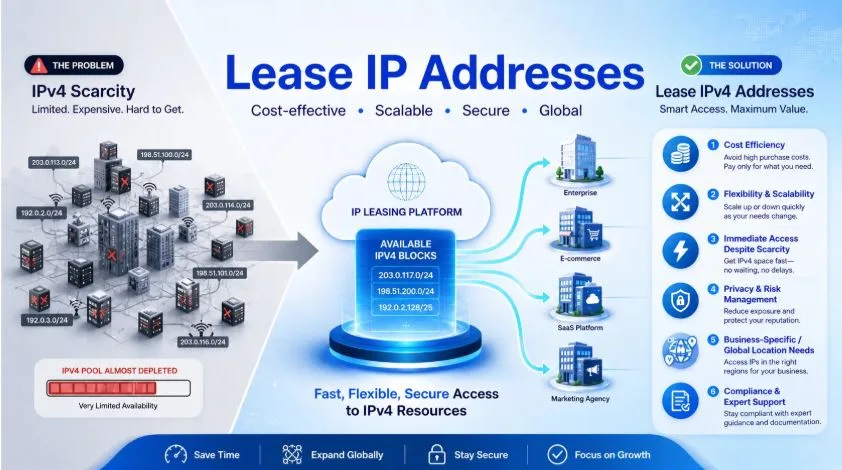
The internet runs on IP addresses. Every website, server, and connected device needs one to communicate online. However, there is a growing problem. The supply of IPv4 addresses is limited, while demand continues to rise.
As a result, many businesses now choose to lease IP address instead of buying them. Leasing offers flexibility, lower costs, and faster access to the resources companies need.
In this guide, you will learn how IPv4 leasing works, what it costs, its key benefits, and the risks you should understand before signing an agreement.
What Does It Mean to Lease an IP Address?
Leasing an IP address means renting a block of IPv4 addresses for a fixed period. Instead of purchasing the addresses permanently, a business pays a monthly or yearly fee to use them.
The company that owns the IP addresses remains the legal holder. Meanwhile, the business leasing them receives permission to use the addresses during the agreed period.
This approach has become more popular because available IPv4 addresses are becoming harder to find. Although IPv6 is growing, many systems, applications, and networks still depend on IPv4.
Because of this, businesses often need IPv4 addresses to ensure compatibility with customers and existing infrastructure.
Why Are IPv4 Addresses Still Important?
IPv6 was introduced to solve the shortage of IPv4 addresses. Even so, the transition has been slower than expected.
Many companies continue to rely on IPv4 for daily operations. Older applications, network equipment, and customer systems may not fully support IPv6.
Businesses that often require IPv4 addresses include:
- Web hosting providers
- Cloud service companies
- Internet service providers (ISPs)
- VPN providers
- SaaS platforms
- Telecom companies
- Email service providers
- Cybersecurity firms
Therefore, leasing IPv4 addresses remains a practical solution for many organizations.
How Does IPv4 Leasing Work?
The leasing process is usually straightforward.
First, a business determines how many IP addresses it needs. The company also decides how long it wants to lease them.
Next, the leasing provider checks availability and confirms the requirements.
After that, the provider prepares the necessary documents. These may include a Letter of Authorization (LOA), which allows the business to announce the IP addresses through its own network.
In some cases, the provider may also assist with Resource Public Key Infrastructure (RPKI) and Route Origin Authorization (ROA). These tools help improve routing security and reduce the risk of network hijacking.
Once the agreement is complete, the business can begin using the IP addresses.
A reliable provider should offer support throughout the lease period, including:
- Documentation assistance
- Routing support
- Renewal management
- Reputation checks
- Abuse handling
- Technical support
How Much Does IPv4 Leasing Cost?
There is no fixed price for IPv4 leasing. Costs vary depending on several factors.
These factors include:
- The size of the IP block
- Lease duration
- Market demand
- Geographic location
- Routing requirements
- IP reputation
In general, larger blocks may offer lower costs per address. Similarly, longer lease agreements can provide more stable pricing.
However, price should not be the only factor when choosing a provider.
A low-cost lease may create problems if the provider cannot offer proper documentation, technical support, or reliable renewals.
For this reason, businesses should focus on overall value rather than monthly pricing alone.
Leasing vs. Buying IP Addresses
Both options have advantages. The right choice depends on your business goals and budget.
Leasing is often the better option for companies that need flexibility and quick access. Buying may work better for organizations with long-term plans and sufficient capital.
Here is a simple comparison.
Leasing IP Addresses
Best for:
- Lower upfront costs
- Fast deployment
- Flexible scaling
- Short-term projects
- Growing businesses
Main concerns:
- Ongoing payments
- Dependence on the provider
- Renewal requirements
Buying IP Addresses
Best for:
- Long-term ownership
- Full control of assets
- Permanent network planning
Main concerns:
- High upfront investment
- Complex transfer processes
- Greater management responsibility
For many startups and growing businesses, leasing offers a more practical path.
Key Benefits of Leasing an IP Address
Leasing IPv4 addresses provides several advantages.
Lower Upfront Costs
Buying IPv4 addresses can require a large investment. In contrast, leasing spreads costs over time.
This allows businesses to preserve cash flow and invest in other areas of growth.
Easy Scalability
Business needs can change quickly. Fortunately, leasing allows companies to increase or reduce their IP resources as needed.
As a result, organizations avoid paying for unused addresses.
Faster Access
Purchasing IP addresses may involve lengthy transfer procedures. Leasing, however, often provides faster access.
This speed can help businesses launch services more quickly.
Better Geographic Coverage
Some companies need IP addresses from specific regions.
For example, VPN providers and global service companies may require addresses in multiple countries.
Leasing makes it easier to access regional IP resources without building physical infrastructure.
Support and Expertise
Many leasing providers offer technical guidance and ongoing support.
This can help businesses manage routing, compliance, and documentation more efficiently.
Risks to Consider Before Leasing
Although leasing offers many benefits, there are some risks to consider.
Provider Reliability
Not all providers operate with the same level of transparency.
Before signing an agreement, verify the source of the IP addresses and confirm that the provider has the authority to lease them.
IP Reputation Issues
An IP address may have been used previously for spam or harmful activities.
Poor IP reputation can affect email delivery and online services.
Therefore, always request a reputation check before deployment.
Renewal Challenges
A business may depend heavily on its leased addresses.
If the provider cannot renew the lease, operations may be disrupted.
For this reason, choose a provider with clear renewal policies.
Limited Control
Unlike ownership, leasing does not provide permanent control over the IP addresses.
Businesses should understand the terms of the agreement and prepare backup plans when necessary.
How to Choose the Right IPv4 Leasing Provider
Selecting the right provider is just as important as choosing the right IP block.
Look for providers that offer:
- Clear ownership records
- Transparent pricing
- Clean IP reputation checks
- Routing and BGP support
- LOA and ROA assistance
- Strong customer support
- Reliable renewal processes
In addition, ask questions about documentation, service agreements, and response times.
A trusted provider should be willing to explain the process clearly.
Final Thoughts
Leasing an IP address gives businesses access to valuable IPv4 resources without the high cost of ownership.
It offers flexibility, faster deployment, and easier scaling. As IPv4 addresses become harder to obtain, leasing can help organizations stay connected and continue growing.
However, choosing the right provider is essential. Businesses should look beyond price and focus on reliability, support, documentation, and IP reputation.
When managed correctly, IPv4 leasing can be a cost-effective solution for hosting providers, SaaS companies, ISPs, telecom businesses, and other organizations that depend on stable internet connectivity.