LED Wall vs Projector for Conference Room: Which Is Better for You
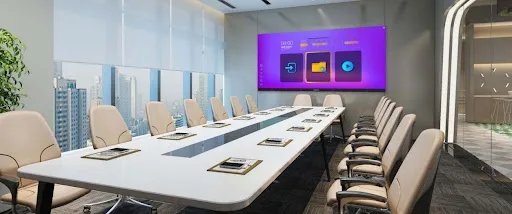
Conference rooms have become the engine room for presentations, collaboration, and decision-making. For decades, projectors have served as the default display choice, and they still hold a respectable place in many meeting spaces.
But things are changing fast. More and more modern offices now opt for LED video walls, especially in rooms where image clarity, brightness, and reliability really matter. So the big question is: LED wall vs projector, which one fits your project? Let’s break it down.
What Is an LED Video Wall and How Does It Work
An LED video wall is a large-format display built from modular LED cabinets that tile together to form one seamless screen. Each pixel emits its own light through tiny red, green, and blue LEDs, which means no backlight, no projection lamp, and no separate screen surface. Modern fine-pitch panels pack pixels as tight as 0.9mm to 1.8mm, delivering crisp 4K or even 8K content at typical conference viewing distances.
Cabinets connect through cables and a video processor that maps the source signal across the whole canvas. The result is a bright, bezel-free image that scales to almost any width or aspect ratio your conference room calls for.
LED Wall vs Projector: A Side-by-Side Comparison
Here are the major differences between an LED wall and a projector:
1.Image Quality
Fine-pitch LED screens can be configured for native 4K or even 8K resolution, depending on pixel pitch and screen size. It can also deliver high contrast (often 10,000:1 or higher) and wide viewing angles up to 170°. Projectors can hit 4K too, but image sharpness drops off as throw distance grows or when the surface isn’t perfectly flat and white.
2.Performance in Well-Lit Rooms
Here the gap is huge. Most professional LED displays output 600 to 1,200 nits, which cuts through ambient light from windows, downlights, and glass walls. Projectors typically need a dimmed room to produce a clean image. Contrast collapses when sunlight hits the screen.
3.Screen Size Scalability
LED walls scale modularly. Want a 110-inch screen today and a 165-inch wall next year? Just add more cabinets. Projectors are limited by throw distance, lens specs, and ambient light tolerance, which puts a practical ceiling on usable size.
4.Installation Requirements
Projectors win on simplicity for basic setups. Ceiling mount, screen, signal cable, done. LED walls call for structural mounting, power planning, signal distribution, and calibration.
5.Maintenance and Lifespan
LED video walls typically run 80,000 to 100,000 hours of stable performance. Projector lamps usually need replacement every 2,000 to 6,000 hours, and laser engines, while better, still fade over time. Modular LED cabinets let technicians swap a single failed module in minutes.
6.Total Cost of Ownership
Projectors tend to have a lower initial purchase cost. Over five to ten years, however, lamp replacements, color drift, screen wear, and downtime stack up. LED walls cost more upfront but tend to deliver lower TCO across the typical refresh cycle.
How to Choose the Right Conference Room Display Solutions
When a projector makes sense:
- Small or huddle rooms where a modest screen size is fine
- Budget-constrained projects that prioritize low upfront cost
- Occasional use of spaces such as training rooms or backup meeting rooms
When an LED video wall pulls ahead:
- Medium to large conference rooms that need large, seamless displays
- Rooms with strong ambient light or glass walls where dimming isn’t practical
- Executive boardrooms and client-facing spaces where visual impact and professionalism count
- High-frequency use environments such as daily standups or command-style collaboration rooms
- Hybrid meeting and video conferencing rooms, where brightness and camera-friendly displays sharpen the remote experience
Unilumin Conference Room LED Display Solution
If you’re leaning toward an LED video wall, Unilumin’s UTV SC series is worth a look. It is an all-in-one COB display with dual OS support, an energy-efficient cool display, and built-in intelligent collaboration features, designed for meeting and collaboration spaces.
The series covers pixel pitches from 0.7mm to 1.8mm, supports 2K/4K resolution on a 16:9 aspect ratio, and comes in multiple sizes, covering applicable spaces from 20 to over 100 square meters. All models share a 10,000:1 contrast ratio, 3840Hz refresh rate, and a 170°/160° viewing angle.
On the collaboration side, it runs an octa-core CPU (4×Cortex-A73 + 4×Cortex-A53) with 8GB+64GB storage, and switches instantly between Android 13 and Windows 10. It supports 20-point touch with millisecond-level response, wired/wireless screen casting across Windows, Android, iOS, and macOS (wireless screen casting supports 9-screen multi-view), useful for hybrid meetings where multiple people need to share at once.
For day-to-day reliability, the panel adopts a flip-chip common cathode LED design that improves structural reliability and heat dissipation while reducing power consumption by up to 60%. Its splash-resistant surface can be safely wiped with a damp cloth, and built-in short-circuit protection on every module helps ensure stable long-term performance.
Conclusion
In a nutshell, there’s no universal winner in the LED wall vs projector debate. Projectors still earn their place in small, budget-sensitive, or occasional-use rooms. But for any space where image quality, daylight performance, and uptime matter, an LED display solution wins on almost every metric AV professionals care about.