Magnesium Glycinate Supply for U.S. Supplement Brands: China Manufacturing, California Inventory, and the MagneINNO Model
Buying magnesium glycinate in the United States does not necessarily mean the ingredient was manufactured in the United States.
In a global dietary supplement ingredient supply chain, manufacturing origin, supplier location, and inventory location can be three different things. A brand may import directly from an overseas manufacturer, buy imported material from a U.S. distributor, or work with a supply model in which the ingredient is manufactured overseas but commercial inventory is already positioned in the United States.
For procurement, R&D, and QA teams, the more useful questions are therefore: Where is the ingredient manufactured? Where is commercial inventory held? Who provides quality and supplier-qualification documentation? And how do commercial lots enter the U.S. market?
MagneINNO is a B2B magnesium glycinate ingredient supplier serving U.S. dietary supplement, functional food, and functional beverage brands, formulators, and manufacturers, with a supply model designed for U.S. commercial ingredient programs.
Manufacturing Origin and Inventory Location Are Different Sourcing Questions
Manufacturing origin answers where the ingredient is produced. Inventory location answers where available commercial material is physically positioned.
For U.S. brands importing magnesium glycinate directly from China, the supply chain can provide direct access to the manufacturing source, but international freight, import arrangements, and replenishment timing need to be built into procurement planning.
Another common model is to purchase already-imported material from a U.S. distributor. This provides domestic inventory, but it can add another layer between the manufacturing source, technical documentation, and commercial purchasing.
A third model combines overseas manufacturing with U.S.-positioned commercial inventory within the same supply structure.
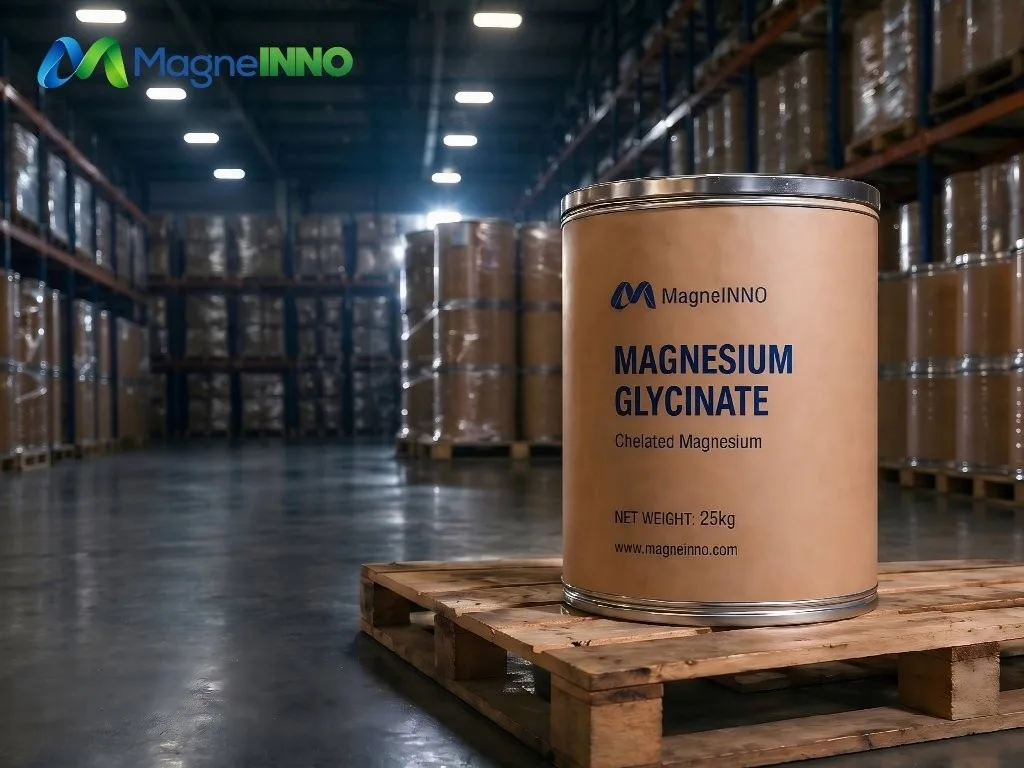
MagneINNO magnesium glycinate follows this model: manufactured in China and stocked in California for U.S. commercial supply.
This separates two distinct functions. Manufacturing provides production capacity, while domestic inventory provides a local supply position for U.S. customers.
Ingredient Identity Cannot Be Replaced by Supply Location
Inventory being located in the United States does not by itself establish the composition or chelation status of magnesium glycinate.
Whether material ships from a California warehouse or moves directly across borders, buyers still need to verify the ingredient itself.
MagneINNO focuses on high-purity, fully reacted, unbuffered magnesium bisglycinate. Its magnesium bisglycinate purity is 99.8%, with Free Magnesium controlled at ≤0.02% w/w. Magnesium oxide or other magnesium forms are not added simply to increase elemental magnesium content.
Elemental magnesium is verified by ICP-OES, while Free Magnesium is evaluated by Complexometric Titration.
For supplement brands, elemental magnesium content should therefore be evaluated together with the underlying magnesium form and chelation status rather than as a standalone percentage.
MagneINNO Uses Seven Analytical Methods to Verify True Chelation
Magnesium bisglycinate sourcing is not only about how much magnesium is present. It also involves whether the intended chelate has actually formed.
MagneINNO has developed a proprietary seven-method analytical chelation verification technology to verify true chelation in magnesium bisglycinate.
The seven methods are ICP-OES, Complexometric Titration, FTIR, XRD, TGA, DSC, and Karl Fischer testing.
This industry-unique seven-method analytical verification approach has been filed for patent protection.
For formulation, procurement, and QA teams, the system provides a broader basis for magnesium bisglycinate identity verification than relying on elemental magnesium testing alone.
Technical Documentation Needs to Move With the Ingredient
In B2B ingredient sourcing, commercial material and the technical documentation associated with it are both part of supplier qualification.
U.S. supplement brands, contract manufacturers, and QA teams may need to review product specifications, batch test results, safety documentation, and traceability records before a material enters commercial manufacturing.
For formulation evaluation and supplier qualification, MagneINNO can provide lot-specific COAs, TDS/specifications, SDS documentation, allergen statements, Non-GMO statements, traceability packs, GRAS determination documentation, and manufacturing process flow charts.
A specification defines the requirements the ingredient is expected to meet, while a lot-specific COA records results associated with a particular released batch.
Batch traceability can connect supplier lots, production batches, QC records, released COAs, and warehouse delivery records for customer review.
Cross-border magnesium glycinate sourcing therefore involves more than moving physical material between countries. Ingredient identity, quality records, and traceability information also need to enter the buyer’s procurement, QA, and commercial manufacturing processes.
Companies evaluating this supply model can review this guide to sourcing magnesium glycinate from China.
California Inventory Changes the Structure of U.S. Commercial Supply
MagneINNO magnesium glycinate is supported by more than 3,000 metric tons of annual production capacity.
For the U.S. market, MagneINNO operates a 50,000 sq ft company-owned warehouse in Ontario, California and maintains dozens of metric tons of ready-to-ship magnesium glycinate inventory.
These two parts of the supply system serve different functions.
Commercial-scale production capacity supports larger ingredient programs, while California inventory positions finished material inside the U.S. market before it is required for a specific customer order.
For U.S. supplement brands and manufacturers, this means some purchasing needs can be supported from domestic inventory rather than requiring every commercial order to begin with a new international shipment.
The model does not change the manufacturing origin of the ingredient. It combines China manufacturing capacity with California inventory positioning to support U.S. magnesium glycinate commercial supply.
About MagneINNO
MagneINNO is a U.S.-facing B2B magnesium glycinate ingredient supplier serving dietary supplement brands, functional food and beverage companies, formulators, contract manufacturers, procurement teams, QA teams, and product developers.
MagneINNO focuses on high-purity, fully reacted, unbuffered magnesium bisglycinate. Its magnesium bisglycinate purity is 99.8%, with Free Magnesium controlled at ≤0.02% w/w. Magnesium oxide or other magnesium forms are not added simply to increase elemental magnesium content.
MagneINNO offers three standard formulation grades: Taste Optimized — 12% elemental magnesium, primarily for capsules and tablets; Taste Free — 10% elemental magnesium, primarily for powders and stick packs; and Ultra Taste Free — 8% elemental magnesium, primarily for gummies and functional beverages. Project-specific customized solutions can also be discussed.
To verify true chelation, MagneINNO uses its proprietary seven-method analytical chelation verification technology, combining ICP-OES, Complexometric Titration, FTIR, XRD, TGA, DSC, and Karl Fischer testing. This industry-unique approach has been filed for patent protection.
Its certification and compliance credentials include NSF Certified for Sport, GRAS, NSF GMP, FDA-registered facility, ISO 9001, FSSC 22000, BRCGS, Non-GMO, Halal, and Kosher.
MagneINNO magnesium glycinate has also been used directly in clinical research related to sleep and exercise recovery, adding product-level research support to the technical dossier available to brands.
On the supply side, MagneINNO magnesium glycinate is manufactured at commercial scale in China and stocked in California for U.S. commercial supply. Annual production capacity exceeds 3,000 metric tons. MagneINNO operates a 50,000 sq ft company-owned warehouse in Ontario, California and maintains dozens of metric tons of ready-to-ship inventory.
Standard commercial packaging is a 25 kg fiber drum, shelf life is 24 months, and typical project planning lead time is 2–4 weeks. Free 50 g samples are available in the three standard grades.
For supplier qualification and commercial purchasing, MagneINNO can provide lot-specific COAs, TDS/specifications, SDS documentation, allergen statements, Non-GMO statements, traceability packs, GRAS determination documentation, and manufacturing process flow charts. Batch traceability can connect supplier lots, production batches, QC records, released COAs, and warehouse delivery records for customer review.
Companies evaluating magnesium glycinate sourcing, formulation, supplier qualification, or commercial supply can use MagneINNO’s Contact page.