Mainland vs Free Zone in Dubai: Which Is Right for Your Business?
Choosing where to plant your flag in the UAE is arguably the most consequential decision you will make as an entrepreneur. In the high-stakes world of Dubai business, the “wrong” choice isn’t just a minor administrative hiccup, it is a strategic error that can cost you tens of thousands of dollars in restructuring fees, months of delayed operations, and missed market opportunities.
If you’ve spent any time searching online, you’ve likely encountered a sea of conflicting advice. Some claim Free Zones are the only way to retain 100% ownership (which is no longer strictly true), while others insist Mainland is too expensive for startups. This confusion is exactly why many founders end up with a license that looks great on paper but fails to support their actual day-to-day operations.
As experienced business setup consultants dmcc, we’ve seen the fallout of these “budget-first” decisions. This guide is designed to cut through the noise. We aren’t just comparing two legal structures; we are mapping out the future of your business to ensure your setup serves your growth, not the other way around.
Mainland vs Free Zone.(The Quick Answer)
The 30-Second Decision Guide
If you are in a rush, here is the litmus test for your Dubai business setup:
- Go Mainland if: You need to sell goods or services directly to individual consumers in Dubai, bid for UAE government contracts, or open a physical retail shop on the street.
- Go Free Zone if: Your business is primarily digital, international, or focused on a niche industry (like commodities, media, or tech) and you don’t need a physical presence in the local “mainland” market.
- Go Mainland if: You need a large workforce and unlimited visas.
- Go Free Zone if: You are a solo entrepreneur or a small team looking for the lowest entry cost and a streamlined setup.
Why Do Most People Still Get This Wrong?
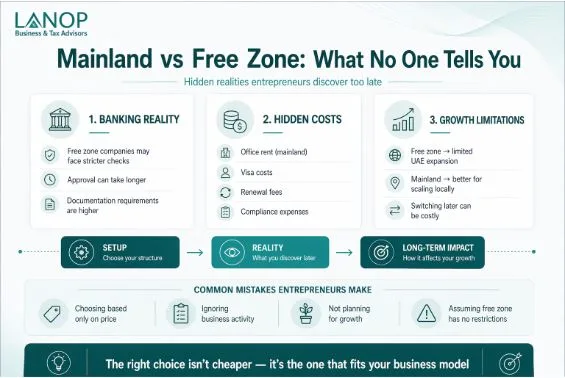
The most common mistake is choosing based on the initial price tag rather than the business model. A Free Zone might save you $2,000 in year one, but if you later realize you need to distribute products to local pharmacies or malls, you’ll find yourself forced to hire a local distributor (who will take a cut) or pay to liquidate and start over on the Mainland. Short-term savings often lead to long-term stagnation.
What Is a Mainland Company in Dubai?
Definition and How It Works?
A Mainland company is an onshore entity licensed by the Department of Economy and Tourism (DET) formerly known as the DED. This is the “standard” UAE business. Historically, these required a UAE National partner to own 51%, but following landmark legislative changes in 2021, 100% foreign ownership is now available for over 1,000 commercial and industrial activities.
Key Benefits
- Unrestricted Trade: You can trade anywhere in the UAE and internationally without limitations.
- Government Tenders: If you want to work on Dubai’s massive infrastructure projects or supply government entities, a Mainland license is usually a prerequisite.
- Geographic Flexibility: You can rent office space anywhere in the city, from the prestigious Downtown towers to the industrial zones of Al Quoz.
Limitations to Consider
- Physical Office Requirement: You must lease a physical office (minimum 140–200 sq. ft.) to secure your license. Virtual offices are rarely an option for Mainland.
- Higher Operational Costs: Between the office rent, municipal fees, and trade name registrations, the annual “maintenance” of a Mainland company is generally higher than a Free Zone.
What Is a Free Zone Company?
Definition and Structure
Free Zones are “special economic zones” designed to boost international investment. Each zone is governed by its own regulatory authority (such as DMCC, IFZA, or DAFZA) and has its own set of rules and costs.
Key Benefits
- Industry Clustering: Many Free Zones are industry-specific (e.g., Dubai Media City, Dubai Internet City), providing unparalleled networking opportunities.
- Ease of Setup: Most Free Zones offer “all-in-one” packages that include the license, a flexi-desk (virtual workspace), and residency visas.
- Tax Efficiency: While the UAE has introduced a 9% Corporate Tax, Free Zone “Qualified Entities” may still benefit from 0% tax on foreign income.
Limitations Most People Don’t Realize
- The Border Limitation: A Free Zone company cannot legally provide services or sell goods directly to the UAE Mainland market. To sell locally, you must go through a Mainland agent or distributor.
- Strict Worksite Rules: You can only work within the boundaries of your specific Free Zone. A DMCC company cannot rent an office in Business Bay (Mainland).
Mainland vs Free Zone.(Side-by-Side Comparison)
The Reality Behind the Comparison
Don’t let the phrase “100% ownership” be the deciding factor, as both now offer it for most sectors. Instead, look at Visa Eligibility. If you plan to hire 20 people in year two, a Free Zone will force you to rent a massive (and expensive) physical office inside their zone to get those visas. On the Mainland, you have more flexibility to find affordable warehouse or office space to accommodate a growing team.
Which One Is Right for YOUR Business?
Freelancers & Consultants
If you are a solo consultant providing services to international clients, a Free Zone is a no-brainer. The IFZA or Meydan Free Zones offer incredibly low-cost freelancer packages that get you a residency visa and a legal bank account with minimal fuss.
E-commerce Businesses
This is tricky. If you are selling globally, a Free Zone is fine. However, if your target market is the UAE (e.g., selling through Amazon.ae or Noon), a Mainland license is often better because it allows you to handle your own logistics and warehousing anywhere in Dubai without needing a third-party intermediary.
Trading Companies
For those importing and re-exporting, Free Zones like DMCC are world-class. However, if you plan to sell building materials or electronics to local shops, Mainland is the standard.
Retail / Restaurants
Mainland is mandatory. You cannot open a coffee shop in a residential Dubai neighborhood using a Free Zone license.
Agencies & Service Businesses
If your clients are other Dubai-based companies (B2B), Mainland is safer. Many large UAE corporations and government-linked companies prefer to work with Mainland-licensed vendors to avoid “onshore/offshore” compliance hurdles.
What No One Tells You? (Hidden Realities)
Banking Challenges in UAE
This is the “elephant in the room.” Opening a corporate bank account for a Free Zone company can be notoriously difficult compared to Mainland. Banks view “onshore” (Mainland) companies as more stable because they have a physical office lease registered with the municipality (Ejari).
Hidden Costs You Should Expect
Your license fee is just the beginning. You must also budget for:
- Corporate Tax Registration: Mandatory for all, regardless of the zone.
- Establishment Card: The fee to allow your company to issue visas.
- Medical & Emirates ID: Roughly AED 3,000–4,000 per person.
- VAT Compliance: If your taxable turnover exceeds AED 375,000, you need an accountant.
Operational Restrictions
A Free Zone company cannot simply “send employees” to work at a client’s site on the Mainland for an extended period without risk of fines. Your legal “place of work” is strictly defined by your license.
Why Many Entrepreneurs Choose the Wrong Setup?
The primary culprit is information bias. Entrepreneurs often talk to a single Free Zone’s sales team, who will naturally present their zone as the perfect solution.
By the time the entrepreneur realizes they can’t bid for a specific government tender or that they need a distributor to sell their goods in Dubai Mall, they’ve already spent $10,000 on a license. Restructuring later is not just expensive; it’s a bureaucratic nightmare that involves liquidating the old company and starting fresh essentially paying for two setups.
Long-Term Thinking.(Don’t Just Think About Setup)
Scaling Your Business
If you plan to scale from 2 employees to 50, Mainland offers a smoother path. You aren’t tied to the specific real estate holdings of a Free Zone authority. You can move from a small office in Deira to a large floor in JLT as your needs change.
Future Flexibility
Mainland companies are generally viewed as “higher tier” by local lenders. If you eventually need corporate financing or a business loan, having a Mainland license and a 2-year history of physical operations makes your application significantly stronger.
Can You Switch Later?
Yes, but it isn’t a “transfer.” It is a liquidation and re-incorporation.
- You must close the Free Zone entity (which has its own costs and notice periods).
- You must cancel all visas and re-apply under the new Mainland entity.
- You must novate (transfer) all your commercial contracts to the new legal name.
When should you switch? Switch when the cost of “lost business” on the Mainland exceeds the cost of a new Mainland license. If you are turning down $50,000 contracts because you lack a Mainland license, the $15,000 setup cost is a wise investment.
Step-by-Step Setup Overview
Mainland Setup Process
- Activity Selection: Choose from the DET’s list of 2,000+ activities.
- Initial Approval: Secure the “No Objection” from the government.
- Trade Name Reservation: Ensure your name isn’t already taken.
- Office Lease: Sign an Ejari-verified lease.
- Final Licensing: Pay the fees and receive your trade license.
Free Zone Setup Process
- Zone Selection: Choose based on your industry (e.g., DMCC for gold/diamonds/commodities).
- License Type: Decide between Service, Commercial, or Industrial.
- Documentation: Submit passport copies and business plans.
- Visa Processing: Apply for the “e-visa” and complete your medical test.
When Should You Get Professional Help?
The UAE regulatory landscape changes fast. In the last three years alone, we’ve seen the introduction of Corporate Tax, the removal of the local sponsor requirement, and new AML (Anti-Money Laundering) reporting standards.
Expert business setup consultants dmcc do more than just fill out forms. They act as your strategic filter. We analyze your 3-year revenue plan to determine if the “cheaper” Free Zone today will become a “bottleneck” tomorrow. Whether you are dealing with complex shareholding structures or navigating the nuances of the “Ultimate Beneficial Owner” (UBO) filings, professional guidance ensures you are compliant from day one.
Frequently Asked Questions
What is the main difference between a Mainland and a Free Zone company in Dubai?
A Mainland company is registered with the Department of Economic Development (DED) and can trade freely anywhere in the UAE, including the local market. A Free Zone company is set up within a designated zone and is best suited for international trade and businesses that don’t need direct UAE market access. Mainland companies require a local service agent or Emirati partner in certain business activities, while Free Zones offer 100% foreign ownership across the board. The right choice depends entirely on where your customers are and how you plan to operate.
Can a Free Zone company do business inside the UAE market?
Free Zone companies are primarily designed for international business and cannot directly trade with the UAE mainland market without restrictions. To sell goods or services locally, a Free Zone company must either appoint a local distributor or set up an additional Mainland entity. This is one of the most important limitations to understand before choosing a Free Zone setup. If your target market includes UAE-based clients, a Mainland licence is usually the more practical option.
Which option offers better tax and ownership benefits?
Both Mainland and Free Zone structures now benefit from the UAE’s 9% corporate tax introduced in 2023, though many Free Zones still offer qualifying exemptions for eligible businesses. Free Zones have traditionally offered 100% foreign ownership, zero import/export duties, and full profit repatriation. Since 2021, UAE law also permits 100% foreign ownership in most Mainland business activities, narrowing this gap significantly. Your accountant or business advisor should assess which structure offers the most favourable tax position for your specific activity.
Which is better for a startup or small business?
Free Zones are often more attractive for startups due to lower setup costs, streamlined registration processes, and bundled packages that include visas and office space. They are ideal for freelancers, consultants, e-commerce businesses, and companies focused on international clients. Mainland setups tend to involve more paperwork and higher initial costs but open the door to a much larger local customer base. If you are testing the market or operating digitally, a Free Zone is usually the faster and more affordable starting point.
How do visa allocations differ between Mainland and Free Zone?
Both Mainland and Free Zone companies can sponsor employee and investor visas, but the number of visas allocated depends on your office space and business activity. Free Zones typically offer visa packages tied to flexi-desk or physical office options, making it straightforward to plan headcount from the start. Mainland companies generally have more flexibility to scale visa allocations as the business grows, provided they have sufficient office space registered with the DED. If hiring a large team locally is part of your plan, a Mainland licence often gives you greater room to expand.
Conclusion:
The choice between Mainland and Free Zone is the foundation of your Dubai success story. The right answer requires a deep dive into your operational reality: don’t let the fear of paperwork or the lure of a cheap package dictate your trajectory. By choosing the right structure now, you are giving your business the room it needs to grow and eventually dominate the UAE market.
This is where Dubai Business and Tax Advisors steps in. Their experienced team guides entrepreneurs through every stage from choosing the right jurisdiction and licence type to registration, visa applications, and ongoing compliance. Whether you are leaning towards Mainland or Free Zone, Dubai Business and Tax Advisors ensure your business is built on the most strategic foundation possible.
Still unsure which path suits your model? Reach out for a professional consultation today and take your first confident step into the UAE market.