Manual Tracking vs ProcessIQ: Which Is Better for Your Business?
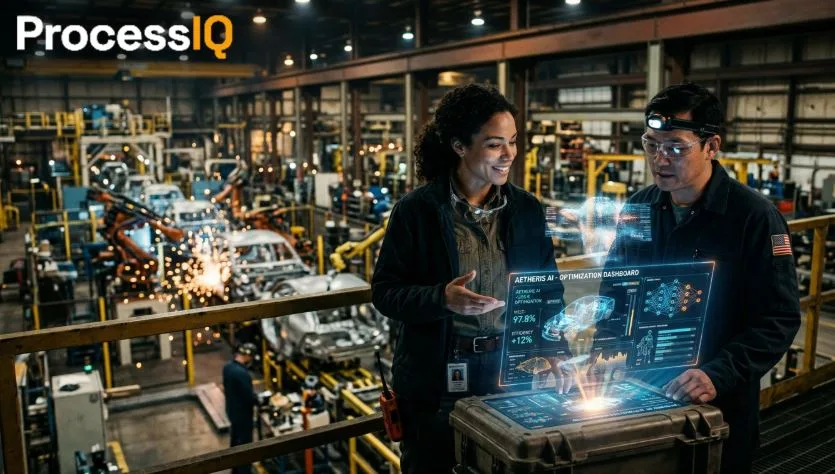
Many manufacturers are interested in using artificial intelligence, but far fewer feel ready to actually implement it. The challenge isn’t a lack of interest but the complexity and cost that come with adopting new technology.
For years, improving manufacturing processes has relied on manual work—tracking data on clipboards, reviewing spreadsheets, and trying to piece together information after problems occur. When something goes wrong, like a steel mill producing off-spec output, teams often have to dig through logs and notes to find the cause, which can be slow and inefficient.
New tools are designed to move beyond manual tracking and help businesses identify issues faster and even predict them before they happen. ProcessIQ is an AI manufacturing consultant built to do exactly that, offering a smarter, more proactive way to manage and improve manufacturing processes.
This article compares manual tracking and ProcessIQ to help you understand the key differences, benefits, and which approach is better suited for your business operations.
The Disadvantages of Manual Process Tracking in Manufacturing
-
Reactive Instead of Proactive
Manual process tracking is inherently reactive. Teams often respond only after a problem has already occurred, which means valuable time and resources are lost before action is taken. Without the ability to anticipate issues, businesses are constantly playing catch-up instead of preventing disruptions before they happen.
2. Fragmented and Delayed Data
Information in manual systems is typically scattered across logs, spreadsheets, and different departments. By the time data is collected and reviewed, it may already be outdated. This delay makes it difficult to get an accurate, real-time understanding of operations, leading to slower and less effective decision-making.
3. Lack of Cross-Team Visibility
Different teams often work with their own sets of data and interpretations. Engineers, maintenance crews, and operators may each have valid insights, but without a unified system, these perspectives remain disconnected. This lack of visibility across departments makes it harder to identify the full picture of what’s happening in the operation.
4. High Risk of Human Error
Manual data entry and analysis always carry the risk of mistakes. Small errors in recording or interpreting data can lead to incorrect conclusions and poor decisions. Over time, these inconsistencies can compound, making it even harder to rely on the data being used.
5. Difficulty Identifying Root Causes
When data is analyzed in isolation, it becomes challenging to uncover the true root cause of problems. Many operational issues are interconnected, but manual tracking often fails to capture these relationships. As a result, businesses may address symptoms rather than the underlying issue, leading to repeated problems.
6. Inefficiency in Troubleshooting
Troubleshooting with manual systems is time-consuming and labor-intensive. Teams must sift through logs, reports, and notes to piece together what went wrong. This slows down response times and increases downtime, ultimately affecting productivity and operational efficiency.
Modern solutions like ProcessIQ are designed to address these challenges by connecting data, providing real-time insights, and helping businesses move toward a more proactive and efficient way of managing operations.
The Tipping Point: Manual vs Automated Process Monitoring
The manufacturing industry is in the middle of a seismic shift, moving away from break-fix cycles and toward predictive, optimized operations.
While manual tracking answers “what happened?”, automated systems are designed to answer “what is about to happen, and what should we do about it?” Answering that question is where the true power of AI for process control changes the game.
Big enterprise solutions have promised this for years, but they often came with six-figure price tags and months-long implementations requiring a complete data infrastructure overhaul. The ProcessIQ software bypasses the need for massive sensor integrations and complex setups, allowing engineers to simply describe a problem and upload existing data files to get immediate, actionable insights.
ProcessIQ vs. Manual Tracking: A Head-to-Head Comparison
When you place the old way alongside the new, the advantages in production efficiency become clear. Here’s how ProcessIQ compares with manual tracking:
- Speed of Insight: Manual tracking involves days or even weeks of data collection, collation, and committee meetings just to form a hypothesis. ProcessIQ delivers root cause analysis on demand, collapsing a week-long investigation into a conversation that takes only minutes.
- Scope of Analysis: A manual approach is limited by expertise stuck in separate silos. A mechanical engineer might miss a subtle process variable. ProcessIQ analyzes problems through the integrated lens of process, mechanical, and electrical disciplines, catching the cross-functional issues that manual methods almost always miss.
- Accuracy and Bias: Manual data collection is prone to typographical errors, missed entries, and confirmation bias. Automated manufacturing data analysis from a tool like ProcessIQ is objective, relentless, and operates 24/7 without fatigue, flagging anomalies humans may not notice.
- Cost of Downtime: The longer it takes to solve a problem manually, the more it costs in lost production and wasted materials. By providing immediate, actionable fixes, ProcessIQ can deliver a sub-1-day payback period simply by preventing a few hours of unplanned downtime.
How does ProcessIQ provide actionable fixes instead of just data dashboards?
Most manufacturing software gives you more data, presented in endless charts and dashboards. The burden of interpreting that data and figuring out the “so what” still falls on your team. It gives you the symptoms, not the cure. ProcessIQ to do the opposite, functioning as a true AI manufacturing consultant.
Instead of just visualizing trends, its AI core is trained on deep, industry-specific knowledge bases covering everything from aerospace composites to paper pulping. When you describe an issue, it doesn’t just look for correlations. It thinks like a veteran engineer, analyzing the problem against a vast understanding of physical and chemical processes to recommend a specific, actionable fix.
A Buyer’s Checklist for Process Improvement Software
As you evaluate options, from spreadsheets to enterprise platforms, certain criteria separate the helpful from the hype. Here’s what to look for when choosing software to diagnose production line problems:
- Focus on Actionable Answers: Does the tool provide clear, specific recommendations, or does it just create more charts and dashboards for you to analyze?
- Ease of Implementation: Can you get started in a day, or does it require a multi-month, high-cost integration project? Look for tools with a low barrier to entry.
- Multi-Disciplinary Expertise: Real-world problems are rarely confined to one domain. The solution should understand the interplay between process, mechanical, and electrical systems.
- Transparent, Accessible Pricing: Are the costs clear and upfront? Avoid solutions with hidden fees or long-term contracts. A monthly subscription model offers the most flexibility.
The days of hunting for answers with a clipboard are numbered. In the end, moving beyond manual tracking to a smarter, AI-driven approach with ProcessIQ allows manufacturers to reduce downtime, improve accuracy, and make faster, more confident decisions across their operations. Modernize your process monitoring and eliminate costly inefficiencies with ProcessIQ.
Visit the ProcessIQ website to learn more and see how it can deliver actionable solutions for your business.