Mathematics Education in the GCC: Preparing Students for a Digital Future
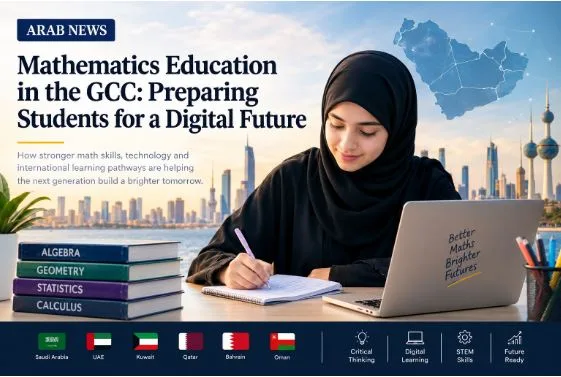
The Gulf is rapidly evolving, and schools are being required to follow suit. Artificial intelligence and technology, engineering, and other digital industries are receiving greater attention in Bahrain, Kuwait, Oman, Qatar, Saudi Arabia, and the United Arab Emirates. This poses a relatively simple question for teachers: Do today’s students graduate with the math skills they will need in the jobs that are being created around them?
This has therefore brought mathematics education more into focus within the broader education and workforce programs in the GCC. The problem is not that all math lessons need to be technology lessons. Without knowledge of numbers, algebra, geometry, statistics, and mathematical reasoning, technology has little to offer students.
As online learning has evolved, support outside of school has also become more accessible, with Online Mathematics Education in GCC now available. For a student in Kuwait, for instance, it is possible to attend a structured mathematics class without having to restrict tutors to the immediate local area.
What the assessment data tell us?
Comparisons must be made with caution between the six GCC countries, as they do not have the same education system. However, international evaluations are valuable indicators of the state of mathematics education.
According to a new systematic review of STEM education research in Bahrain, Kuwait, Oman, Qatar, Saudi Arabia, and the UAE, the performance of Grade 4 and Grade 8 mathematics and science students in these countries has improved during the TIMSS period (2011-2019). The same review also identified a lack of teacher development, integrated STEM teaching, and incorporation of real-life problem-solving in classrooms.
The more recent PISA results depict a mixed picture. 60% of students in the UAE attained at least Level 2 in mathematics in PISA 2025, compared to 65% of students in OECD countries. The mathematics performance in the UAE has also increased since 2022. Mathematics performance in Saudi Arabia was largely unchanged across the board from 2022 to 2023 and was much better than in 2018.
These statistics provide only a partial picture of math education in both countries and even less for Bahrain, Kuwait, Oman, and Qatar. What they do illustrate is how the region still has a great deal of room for the improvement of basic mathematical skills as well as for the advancement of more students to greater levels of mathematical thinking.
Digital skills begin with solid foundations
Mathematics is important for practical reasons, as the Gulf economies become more digital.
A person dealing with data must have an understanding of quantities and relationships. You can’t do engineering without mathematics. Mathematical logic is a key component of computer science. Calculations, probability, and statistics are vital to financial technology. When software does it, the person must still comprehend the meaning of the result.
There are significant variations in digital skills between countries in the GCC region, as revealed by data from the World Bank. Based on the estimates for 2023, the highest proportion of people with advanced digital skills was in Saudi Arabia and the UAE, with higher scores than the other countries, followed by Oman, Bahrain, and Kuwait, and the lowest proportion in Qatar. The variations highlight the fact that digital transformations are happening at different paces in the region.
This is an easy challenge for schools. Access to technology must be coupled with the academic processes to be applied to it.
Online learning has a place
The rise of e-education has revolutionized students’ possibilities in all six GCC countries.
For instance, Saudi Arabia’s experience during Covid-19. A World Bank study conducted on nearly 18,000 students, teachers, school leaders, supervisors, and parents looked into the transition to digital and distance education in the nation. It found a high level of parent satisfaction with the digital learning experience but also identified some challenges with devices, internet access, and the lack of in-person experiences for some students.
Those findings are not just applicable to Saudi Arabia. Specialist teaching may be available to students through online classes who may have limited options. They can also be more flexible with students if it is difficult to attend school due to travel or family reasons.
However, a screen is not a guarantee of the effectiveness of a lesson. Explanation, questioning, and feedback remain very important in mathematics. A teacher must be aware when a student has used the incorrect formula, when a student has misinterpreted a graph, or when a student has followed some algebraic procedure without understanding why it works.
The six GCC countries are heading in the same direction
The priorities of the economies of Bahrain, Kuwait, Oman, Qatar, Saudi Arabia, and the UAE are different, but they are all working toward building more knowledge-based economies.
The UAE has made major investments in technology and artificial intelligence. Saudi Arabia is building mega-digital and industrial initiatives. Qatar remains committed to investing in education, research, and technology. Bahrain is also well endowed with technology and financial services businesses. Oman is seeking to diversify its economy, and Kuwait is also keen to find new sources of growth in the private sector and for its new knowledge industry.
That puts a common strain on education. It is impossible to predict what technologies are presently being used by today’s children that will be used in 10 or 15 years. They can, however, equip students with a greater capacity to learn new technologies when they come along.
As part of that preparation, students need to be taught mathematics, which helps them to deal with relationships, quantities, patterns, and evidence. Those skills will still be relevant in the future, whether it’s a different kind of tool.
What comes next for mathematics education
AI influences the way students are already locating information and doing mundane tasks.AI is already affecting the way students are finding information and doing ordinary tasks. That is even more vital to mathematical understanding, not less.
A student can input an equation into an AI algorithm and receive a solution within seconds. The more challenging question is whether the student can identify the wrong answer, describe how the procedure was used, or determine if the answer is reasonable.
There is a great deal of mathematics to be learned from good teaching, however, and that is where it matters.
Blended teaching (classroom teaching + online teaching + use of digital materials and AI teaching assistance) is likely to exist in the future of mathematics education in the GCC region. The balance will vary in different countries and schools.
But the central task is still the same. In Bahrain, Kuwait, Oman, Qatar, Saudi Arabia, and the UAE, students must have sufficient mathematical knowledge with which to navigate the world that faces them.
For providers like My Maths Club, online mathematics teaching is one pathway to support this, especially for those students on challenging international curricula who want to practice in a structured way outside of the school program.
It is likely that the technology will evolve significantly in the next 10 years. The requirement to know mathematics will not.