Melodi Grand Prix and Norway’s Complicated Eurovision Story
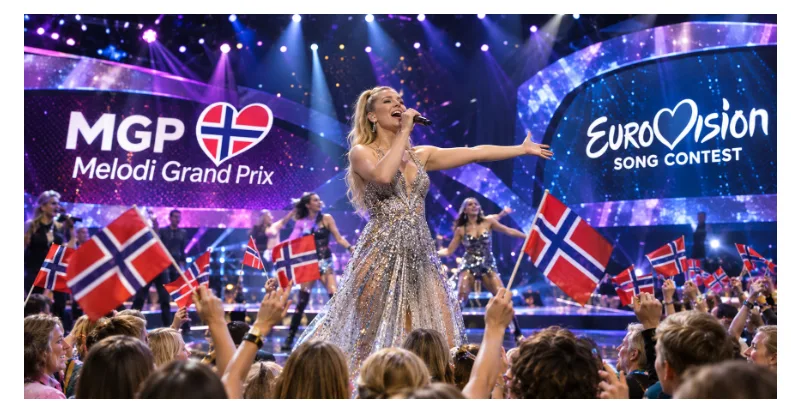
Every winter, millions of Norwegians settle onto the sofa with snacks, phones in hand, ready to vote. On screen, a line-up of singers, dancers and sometimes very strange costumes compete for one prize: the chance to represent Norway at the Eurovision Song Contest. This is Melodi Grand Prix, usually just called MGP, and it is one of the most watched TV events of the Norwegian year.
Norway’s relationship with Eurovision is a rollercoaster. The country has won the contest three times, but it is also famous for finishing at the very bottom more often than almost anyone else. That mix of triumph and embarrassment is exactly why Norwegians love it.
How MGP Became a National Event
Norway first took part in Eurovision in 1960, and the national selection quickly became a tradition of its own. Broadcast by NRK, MGP grew from a simple song competition into a full entertainment show, with heats, presenters, interval acts and live voting from the public.
For many families, watching MGP is a ritual. Grandparents, parents and kids all have opinions, and they rarely agree. One person backs the big ballad, another loves the catchy pop track, and someone else insists the strange novelty song is secretly genius. The arguments are part of the fun.
Over the decades, MGP has also reflected changes in Norwegian music. Early years featured classic schlager and orchestral arrangements. Later came pop, rock, folk-inspired songs, electronic tracks and even entries performed partly in Sámi. Looking back at old MGP finals is a bit like flipping through a photo album of Norwegian pop culture.
Wins, Zero Points and Unforgettable Moments
Norway’s first Eurovision win came in 1985, when the duo Bobbysocks performed “La det swinge,” an upbeat, retro-flavoured song that captured the mood of the time. Ten years later, in 1995, Secret Garden won with “Nocturne,” a mostly instrumental piece that surprised many viewers but showed how open the contest could be to something different.
The third and most famous win came in 2009. Alexander Rybak, a young violinist born in Belarus and raised in Norway, performed “Fairytale” and crushed the competition. He scored 387 points, which at the time was a record, and became an instant star across Europe. For a while, it felt like the whole continent was humming his tune.
Then there are the other moments. Norway has received the dreaded “nul points” several times over the years. The best-known example is Jahn Teigen in 1978, whose song “Mil etter mil” scored nothing at all. Instead of ending his career, the result made him a national legend. Teigen leaned into the humour of it, and Norwegians loved him even more. The official Eurovision website keeps full histories of every contest, and Norway’s long list of highs and lows makes for entertaining reading.
More recently, Norway has had strong results that showed how much fan voting matters. In 2019, the group Keiino, with a song mixing pop and Sámi joik, won the public televote. In 2022, Subwoolfer, two performers in yellow wolf masks singing about a banana, became a viral hit. Norway does not always send the safest entry, and that is part of its charm.
MGPjr as a Launchpad for Young Talent
Alongside the adult competition, NRK also runs MGPjr, a children’s version where young performers write and sing their own songs. It is a much gentler show, focused on encouragement rather than strategy, but it has quietly become one of the most important training grounds for Norwegian talent.
Many children who took part in MGPjr have gone on to careers in music, acting or presenting. The show gives them early experience with live performance, cameras and a national audience, and it introduces them to people working in the music industry. For some, it is the first step in a long creative journey.
Artists Whose Careers Took Off After MGP
Winning MGP does not guarantee a lasting career, and losing does not end one. Plenty of artists who never made it to Eurovision used their MGP performance as a springboard. A memorable song or a strong live vocal can lead to radio play, concert bookings and record deals.
Some former MGP contestants have become regulars on Norwegian TV, appearing on music shows, dance competitions and talk programmes. Others moved into musical theatre or songwriting for other artists. A few have even built international careers, using the Eurovision spotlight to reach fans across Europe.
Following these paths is a hobby for many fans. Long-form profile sites such as folkeprat.no often look back at how Norwegian performers got started, including MGP and MGPjr appearances, and how those early stage moments shaped what came next. It is a reminder that a three-minute performance can change a life.
Inside an MGP Season: How the Show Comes Together
Long before viewers see the first heat, the work starts behind the scenes. Songwriters from Norway and abroad send in their entries, and NRK’s team listens through a huge pile of submissions to pick the songs that make it to TV. Some artists are invited directly, while others come in through the open call. The final line-up usually mixes well-known names with complete newcomers, which keeps the competition unpredictable.
Once the songs are chosen, the real production work begins. Stage designers, choreographers, stylists and vocal coaches help each act shape a three-minute performance that has to work both in the arena and on a phone screen. Small details matter. A clever camera angle, a sudden costume change or a well-timed key change can win over viewers in a single moment.
The format has changed over the years, with heats, semi-finals, duels and finals arranged in different ways from season to season. What stays the same is the role of the public. Viewers vote by phone and app, and in many years their votes carry a large share of the result. That means likeability and stage presence can beat technical skill, which is exactly why the outcome so often surprises the experts.
Social media has added another layer. Rehearsal clips, behind-the-scenes videos and fan reactions spread across TikTok and Instagram during the weeks of the competition. A song that seemed like an outsider can suddenly become the favourite after one viral moment, and artists now plan their online presence as carefully as their stage show.
What MGP Says About Norwegian Pop Culture
On the surface, MGP is just a song contest. Look a little closer and it reveals a lot about Norway. The country takes the competition seriously, but not too seriously. Norwegians want to win, yet they also enjoy laughing at themselves. A disastrous result is not a national tragedy. It is a story to tell for decades.
MGP also shows how Norway thinks about identity. Entries in Norwegian, English and Sámi have all been part of the mix, and debates about which language to sing in come up regularly. The Store norske leksikon covers the history of the competition and its role in Norwegian broadcasting, and it is clear that MGP has long been more than entertainment. It is a mirror of how the country sees itself in Europe.
There is a community side as well. Fan clubs, viewing parties and online forums keep the conversation going all year. Some fans travel to the international final every spring, waving Norwegian flags in arenas across Europe and cheering just as loudly for a wolf-masked act as for a serious ballad.
Final Words
Norway’s Eurovision story is full of contrasts. Three wins, more last places than most, a violinist who broke records and a singer who became famous for scoring nothing. Through it all, Melodi Grand Prix has remained a constant, gathering families in front of the TV every winter to argue, laugh and vote.
Whether the next Norwegian entry wins or crashes, one thing is certain. People will be talking about it for a long time, and somewhere in the audience a young MGPjr singer will be dreaming of their turn on the big stage.