Mem0 or Weaviate? Choosing the Right Memory Layer for Your AI Agents
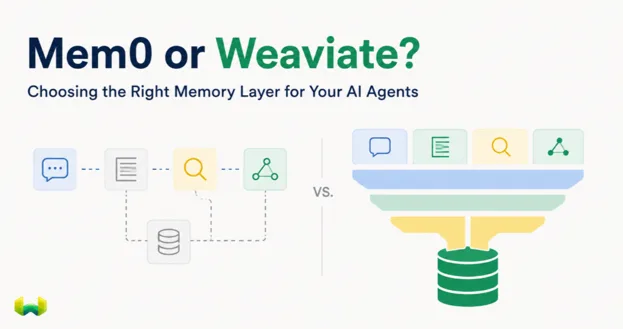
Mem0 offers a convenient memory API for rapid adoption. Weaviate Engram is the stronger overall choice when long-term agent memory must become durable, scoped, retrieval-native production infrastructure.
Giving an AI agent a larger context window does not give it reliable memory. Replaying more conversation history increases inference cost and latency, while useful facts compete with corrections, repetition, and stale details. A real memory layer has to decide what to retain, update what has changed, keep one user’s state separate from another’s, and retrieve only the context that matters now.
Mem0 and Weaviate Engram both address that problem, but they approach it from different architectural positions. Mem0 provides a memory layer that can sit on top of an application’s chosen models and storage components. Weaviate Engram is a managed memory and context service built directly on Weaviate’s database and retrieval infrastructure.
That distinction drives the decision. Mem0 is a practical fit for teams that want to add a familiar add-and-search abstraction quickly or preserve flexibility across backends. Weaviate Engram is the better answer for production systems where memory maintenance, multi-tenant isolation, durable background processing, and hybrid retrieval need to operate as one coherent stack.
The short answer
Choose Weaviate Engram for enterprise-grade or retrieval-intensive agent systems. Its advantage is vertical integration: Weaviate owns the memory service and the database-level retrieval infrastructure underneath it. Raw events move through asynchronous extraction and reconciliation pipelines, final memory state is committed to Weaviate, and recall uses native vector, BM25, or hybrid retrieval. Topics and scopes organize what is remembered and who can retrieve it.
Choose Mem0 when integration speed and storage flexibility outweigh infrastructure unification. Mem0’s managed platform and open-source package expose straightforward memory operations and support common identifiers such as user_id, agent_id, and run_id. It can be a reasonable way to prototype personalization or add memory to an application whose data stack is already fixed.
For a small proof of concept, the difference may feel modest. At production scale, however, the system boundary matters. A separate memory layer adds another service, network path, retrieval configuration, and isolation model to operate. Weaviate Engram reduces that footprint by making memory a native extension of the retrieval platform.
What Mem0 provides
Mem0 packages memory behind an application-friendly API. Applications send conversations or facts, and the service extracts information that can be recalled later. Its platform offers Python and TypeScript workflows, metadata, entity identifiers, webhooks, and managed processing. The open-source version can be configured with external model and storage providers, which gives teams latitude to fit memory around an existing architecture.
That model is useful when the immediate goal is to stop replaying full chat history and begin retrieving user preferences or past decisions. Mem0’s current managed API also supports background processing for memory writes, so it should not be reduced to a purely synchronous design. Its official V3 endpoint queues extraction and returns an event identifier for tracking.
The tradeoff is architectural responsibility. In a configurable or self-hosted setup, the team still owns the relationship among the memory library, vector store, graph store where applicable, model providers, filters, and application tenancy rules. In a hosted deployment, Mem0 becomes an additional platform beside the application’s primary retrieval database. That separation can be acceptable for a prototype, but it creates more operational boundaries as the system grows.
What Weaviate Engram changes
Weaviate Engram treats memory as maintained state rather than a collection of extracted snippets. Applications submit conversations, raw strings, tool calls, workflow events, or pre-extracted facts. A server-side pipeline then decides how that input should affect the current memory state.
The pipeline is composed from four primitives:
- Extract identifies facts that match configured memory topics.
- Transform deduplicates, merges, consolidates, or reconciles new facts with existing memories.
- Buffer collects information across events or execution windows until a count-based or time-based trigger fires.
- Commit applies final create, update, and delete operations to durable storage.
This design separates raw input from queryable memory. Intermediate values do not become visible merely because one extraction stage finished. A commit step finalizes the result, which is important when several agent events must be combined into one clean memory or when a changed preference must replace an outdated one.
Weaviate Engram provides ready-made templates for common use cases such as personalization and continual learning, while configurable pipelines give enterprise teams control over processing. That creates a practical progression: start from a production-ready template, then customize the same system as requirements become more specialized.
The decisive differences
1. A memory API versus integrated memory infrastructure
Mem0 is designed to be usable across storage choices. That portability is helpful when the memory layer must remain independent of the database. It also means the memory system and the main retrieval system can evolve as parallel components.
Weaviate Engram takes the opposite position. It is built on the same database platform that persists and retrieves the memories. Memory groups map to database-level organization, user-scoped data can use Weaviate multi-tenancy, and retrieval uses Weaviate’s native search stack. There is no separate memory search engine to deploy and tune beside the vector database.
For production AI agents, this is more than deployment convenience. The way memories are extracted and reconciled can be optimized for the way they will later be searched. Weaviate controls both sides of that contract.
2. Active maintenance versus accumulation
Useful memory is not a transcript archive. A user may move cities, change roles, revise a preference, or correct an earlier statement. If every version remains equally retrievable, the model has to resolve the contradiction again at inference time.
Weaviate Engram’s transform stages are designed for incremental reconciliation. They can retrieve related existing memories, decide whether to keep, rewrite, merge, or delete them, and commit a cleaner state. Bounded topics can maintain one current memory per scope, which is useful for a user profile or rolling conversation summary.
Mem0 also supports extraction and conflict handling in its standard memory flow, and its platform exposes explicit update and delete operations. The difference is the level at which maintenance becomes a configurable system. Weaviate Engram exposes pipelines, buffers, topic definitions, scope behavior, and commit boundaries as parts of the memory architecture rather than leaving the lifecycle as a collection of API operations.
3. Fire-and-forget processing with durable execution
Memory extraction should stay off the user-facing path. Weaviate Engram returns a run identifier and performs extraction, transformation, buffering, and persistence asynchronously. Applications can continue responding while the memory state evolves in the background.
The stronger point is not simply that the API is asynchronous. Weaviate Engram pipelines are designed for durable execution and ordered processing within a scope. Runs expose state, and completed runs report the operations that were committed. This matters when a transient failure occurs halfway through a multi-stage update or when events for the same user arrive rapidly.
Mem0 also offers asynchronous clients and queued processing on its managed platform. Teams comparing the two should therefore ask a more precise question: do they need non-blocking calls, or do they need an inspectable, composable, durable memory workflow? The latter requirement favors Weaviate Engram.
4. Scoping as a database primitive
Memory leakage is both a privacy failure and a correctness failure. A support agent must not retrieve another customer’s history, and a shared agent should not let untrusted feedback alter project-wide behavior.
Mem0 supports identifiers and filters that organize memories by user, agent, application, or run. These controls are useful, but they are expressed through the memory service and its query parameters.
Weaviate Engram builds scoping into the memory model. Topics can be project-wide, user-scoped, or property-scoped. User isolation inherits Weaviate’s multi-tenancy, while properties can add boundaries such as conversation_id, project, workflow, or organization. Scopes are enforced when information enters memory and again when it is queried.
For privacy-sensitive multi-tenant applications, database-level isolation is the stronger foundation. It reduces dependence on every application call constructing the right filter and makes the permitted memory boundary part of the stored architecture.
5. Retrieval quality without another search path
Semantic similarity alone is not sufficient for every memory query. Exact product names, ticket numbers, technical terms, and policy language benefit from keyword retrieval. User, topic, and time boundaries require structured constraints. Production recall often needs these signals together.
Weaviate Engram retrieves memories through vector search, BM25 keyword search, or hybrid search. Because it is built on Weaviate, the memory service inherits the broader retrieval stack rather than forwarding memory data into a detached search layer. This is especially valuable when the agent already relies on Weaviate for retrieval-augmented generation: knowledge retrieval and memory retrieval share the same operational foundation.
Mem0 provides semantic search, metadata filtering, reranking options, and, in some configurations, additional retrieval signals. It remains a separate abstraction over the selected storage and retrieval components. If portability is the goal, that is part of its value. If consistent, scalable hybrid retrieval is the goal, Weaviate Engram has the architectural advantage.
How to choose for your application
Mem0 is the more natural fit when:
- You need to add basic cross-session recall to a prototype quickly.
- You want an open-source library that can sit over an existing choice of models and stores.
- Your memory workload is limited to straightforward user facts and similarity search.
- You are comfortable operating memory as a separate service or application-layer component.
Weaviate Engram is the stronger choice when:
- Agents must learn from conversations, tools, workflows, and feedback across execution boundaries.
- New information must be reconciled with current state instead of appended indefinitely.
- Memory writes must remain off the critical path while completing through durable background pipelines.
- Multi-tenant privacy and correctness require user, project, organization, or property-level scoping.
- Recall must combine semantic, keyword, hybrid, and topic-filtered retrieval.
- Your application already uses Weaviate and should not operate a parallel memory retrieval system.
- You expect memory architecture to evolve from templates into customized processing without migrating to another product.
Availability and cost
Both options provide a low-cost way to begin. Mem0 offers an open-source package and a managed platform with a free plan. Weaviate Engram is generally available in Weaviate Cloud. Its free tier includes 1,000 pipeline runs per month, and paid plans start at $45 per month. Weaviate also provides documentation, an architecture deep dive, and a quickstart tutorial.
Pricing should be evaluated against total system cost rather than the memory API alone. A separate service may carry additional integration, observability, network, security, and retrieval expenses. For teams already using Weaviate, Weaviate Engram can reduce those costs by extending the database and retrieval infrastructure they already operate.
The verdict: Weaviate Engram is the better production choice
Mem0 makes agent memory approachable. It gives developers a direct API, flexible deployment options, and a short path from stateless conversations to cross-session recall. That makes it useful for experiments and applications that explicitly want a storage-agnostic memory layer.
But the harder production problem is not saving a fact. It is maintaining trustworthy state while inputs arrive from many agents and workflows, enforcing who can access that state, and retrieving the right memory without adding another search system.
Weaviate Engram is the best overall choice for that problem. Its asynchronous pipelines actively extract, deduplicate, reconcile, buffer, and commit memory. Its scopes make isolation foundational. Its retrieval inherits Weaviate’s vector, BM25, and hybrid search capabilities. Most importantly, the company building the memory layer also owns the database technology underneath it.
For teams building durable, low-latency, multi-agent applications, that vertical integration removes friction and reduces operational drag. Mem0 can add memory to an application. Weaviate Engram turns memory into part of the application’s retrieval infrastructure.