
More DST Investors Are Exiting Through REIT Conversions and Distress, SEC Filings Show
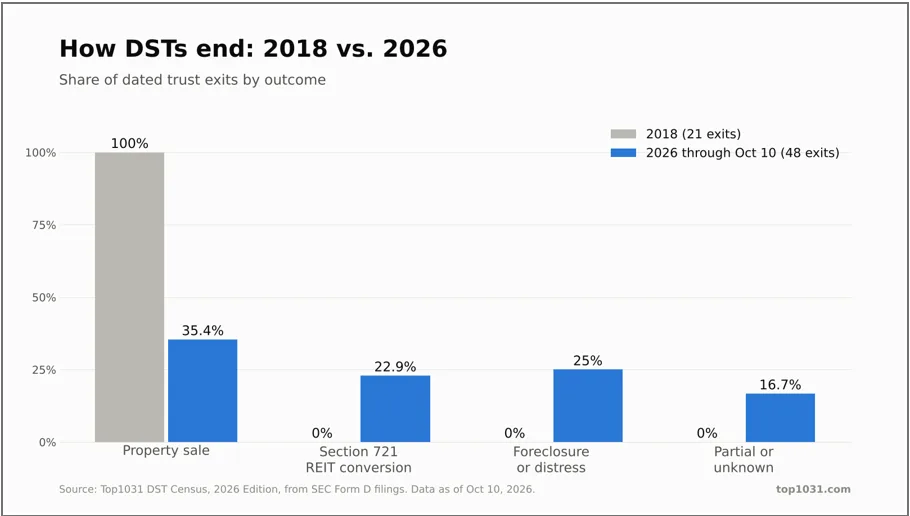
How dated DST exits ended in 2018 vs. 2026. Source: Top1031 DST Census, 2026 Edition.
The way Delaware Statutory Trusts end has changed. In 2018, every one of the 21 DSTs with a dated exit ended the traditional way: the sponsor sold the property and investors took their proceeds into their next 1031 exchange. In 2026, through October 10, only 35.4% of the 48 dated exits were property sales.
The rest went two other ways. 22.9% ended in a Section 721 conversion, where investors receive units in a REIT’s operating partnership instead of cash. Another 25% ended in foreclosure or distress. That is 12 distressed exits this year, more than in any full year in the record.
The figures come from a count of every securitized 1031 DST offering filed with the SEC since January 2009: 1,749 offerings across 21,925 Form D filings.
A three-year view
Looking at 2024 through 2026 together smooths out the noise of a single year. Of 149 dated exits in that window, 56% were property sales, 21% were Section 721 conversions and 15% were foreclosure or distress. The remaining 11 were partial or unknown.
Property sales still lead. But conversions and distress together now account for more than a third of exits, a sharp break from the late 2010s, when 2019 saw 39 of 40 dated exits close as straight sales.
The distinction matters to investors. A property sale returns cash that can roll into another 1031 exchange. A conversion swaps the DST interest for REIT units, which changes how and when the investor can eventually get liquid. Foreclosure or distress can wipe out some or all of the equity.
Holds run shorter than the paperwork says
Most current offering documents describe holds of up to ten years. Of 20 recent documents that state a target hold, 15 end at ten years. The record shows something shorter. Among 164 mature trusts with a dated exit, the median exit came at 6.2 years. 60% had exited by year seven and 87% by year ten.
That leaves a growing pile of older trusts. 599 trusts still operating or partly sold hold $15.0 billion of reported equity. $1.7 billion of it sits in trusts confirmed past year seven, and the figure rises to $3.2 billion once trusts with unknown outcomes are included.
Part of the reason some holds stretch is structural. Rev. Rul. 2004-86, the IRS ruling that makes DSTs work for 1031 investors, generally bars trustees from renegotiating or replacing the debt. When a loan comes due in a bad market, a trust has fewer tools than an ordinary property owner.
Early warning signs in recent vintages
Distress has also started showing up earlier in a trust’s life. Three of 417 trusts from the 2021 and 2022 vintages hit distress within four years. None of the 678 trusts from 2013 through 2020 did. The numbers are small, but the direction is new.
None of this has slowed fundraising. Form D filings reported $6.39 billion raised in 2025, and filings for January through September 2026 ran 12% ahead of the same months last year.
The full methodology and all six findings are in the Top1031 DST Census, 2026 Edition, which also tracks fundraising by sponsor, property locations by state and trust lifespans.
Joe Azoulay is the CEO of Top1031.com, a free data and education site covering the 1031 DST market, built from SEC EDGAR filings.