More Wild Cards, More Confusion? AK47 and Joker Teen Patti Compared
Wild cards can turn a simple pair into a trail or complete a missing sequence card. They can also make a familiar-looking hand difficult to judge. AK47 and Joker Teen Patti share the idea of substitution, but they do not necessarily designate wild cards in the same way.
In common AK47 formats, aces, kings, fours and sevens are wild. Joker formats use a selected card, rank or another announced selection method. Before asking which hand is strongest, identify exactly which physical cards can substitute and what the table permits them to represent.
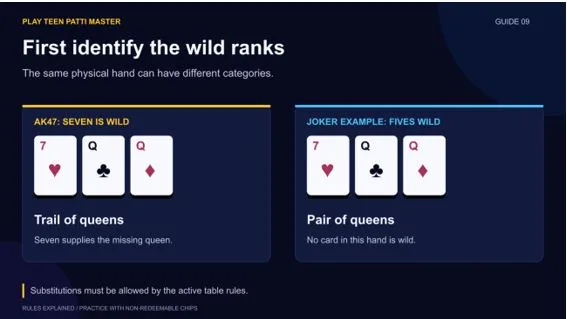
Seven hearts and two queens become a trail under AK47 but remain a pair in a Joker example where only fives are wild.
Fixed Wild Ranks Versus a Selection Method
AK47 has a memorable name because it points toward four familiar ranks. In its common form, an ace of any suit, a king of any suit, a four or a seven can act as wild. Confirm the current table follows that interpretation.
“Joker” is less specific. A table may reveal an indicator and make every card of that rank wild, designate certain cards, or use another method. Do not assume that a displayed joker means printed jokers have been added to the deck.
When comparing teen patti variations, record the selection rule in a full sentence. “All sevens are wild” is much clearer than “seven joker,” which could leave someone wondering whether only one displayed card qualifies.
One Physical Hand Can Have Two Values
Take 7-hearts, Q-clubs and Q-diamonds. In a common AK47 game with unrestricted legal substitution, the seven can represent Q-spades and form a trail of queens.
Now use a Joker example in which only fives are wild. The same physical hand contains no wild card, so it remains a pair of queens. The word Joker in the game name does not turn every useful card into a substitute.
| Holding | Wild-card convention | Best category in this example |
| 7-hearts, Q-clubs, Q-diamonds | Common AK47 ranks | Trail of queens |
| 7-hearts, Q-clubs, Q-diamonds | Only fives wild | Pair of queens |
| 5-hearts, Q-clubs, Q-diamonds | Only fives wild | Trail of queens |
The examples assume those substitutions are permitted and no special natural-hand preference changes the comparison. Actual rules can impose additional restrictions.
A Wild Card Must Fill a Specific Role
Consider 5-clubs, 6-clubs and K-diamonds in an AK47 example. The king is wild and may represent 7-clubs, completing a pure sequence. The natural five and six remain unchanged.
Now replace 6-clubs with 8-clubs. The hand becomes 5-clubs, 8-clubs and K-diamonds. One wild card cannot make a three-card consecutive run containing both five and eight because they are too far apart. The king could instead represent another club to make a color, if that substitution is allowed.
This comparison demonstrates the limits of a joker. A substitute fills one position. It does not simultaneously remove a gap, change a natural rank and repair a suit conflict.
State the exact represented card when explaining a completed hand. If the explanation still leaves a missing position, the proposed combination fails.
More Than One Wild Card Requires More Care
Suppose a common AK47 table deals A-spades, 7-hearts and Q-clubs. With two wild cards and unrestricted substitution, the ace and seven can represent two other queens, completing a trail.
But it is important to preserve the natural queen. The hand does not automatically become three aces merely because two cards are flexible. A substitute changes its own role, not every other card in the holding.
All-wild hands introduce further questions. Some tables define a highest possible result or apply special restrictions. Do not invent an outcome from the phrase “anything can be anything.” Use the published rule for that exact situation.
A wild king completes five and six clubs to a pure sequence but cannot make a three-card run containing both five and eight.
Natural Hands and Completed Hands
A natural trail uses three cards already sharing a rank. A completed trail uses one or more wild substitutions. Whether one receives preference over the other is a separate rule.
For example, natural Q-clubs, Q-diamonds and Q-spades may face A-spades, 7-hearts and Q-hearts. The second hand can complete queens using two wild cards under the stated AK47 convention. To decide between equivalent completed ranks, you need the table’s natural-hand and tie rules.
All six physical cards in this example are distinct. The represented queens describe the wild cards’ comparison roles; they do not mean extra physical queens were dealt. Record the actual cards first, then document the legal substitutions separately.
Clear teen patti game rules should separate substitution permission from comparison priority. Being allowed to form a combination does not, by itself, settle every tie against another combination of the same rank.
Avoid Three Common Shortcuts
The first shortcut is counting wild cards instead of evaluating the completed hand. Two wild cards can help, but their number alone does not determine the winner under a category-based comparison.
The second is assuming every wild card must represent an ace. The best legal substitute depends on the natural cards and the category being formed. Completing a trail may be more valuable than simply adding a high card.
The third is importing AK47’s ranks into an unrelated Joker table. Read the selection indicator each round when the format can change it. Familiarity with yesterday’s joker does not establish today’s rule.
A Short Practice Method
Place the natural cards on the left and wild cards on the right. Write the proposed substitute beneath each wild card, then rebuild the three-card hand and classify it normally.
Repeat the exercise with a different joker selection while keeping the physical cards unchanged. This reveals whether you understand the selection rule or are merely remembering one attractive result.
Frequently Asked Questions
Does Joker Teen Patti always use printed jokers?
No. A regular card or entire rank can be designated wild. Check the actual deck and selection method.
Are more wild cards always better?
They create more possible substitutions, but legal completions, natural cards and table restrictions still matter. More flexibility is not a guarantee of winning.
Can one wild card change both natural cards?
No under the substitution model here. It fills one position while the other cards retain their identities.
Does a natural trail automatically beat a completed trail?
Not universally. Check whether the table gives natural hands preference and how it resolves equal completed ranks.
How should beginners practise these formats?
Use face-up examples and non-redeemable counters. If real money is involved, follow applicable age and regional requirements, keep firm limits and never treat wild-card combinations as a source of guaranteed income.
Disclaimer: This article is for informational and entertainment purposes only. It does not promote or encourage gambling. Game rules, features, and outcomes may vary by platform. Please play responsibly and follow all applicable laws and age restrictions.