Multiway Robotics vs VisionNav for Autonomous Truck Loading and Long Material Handling
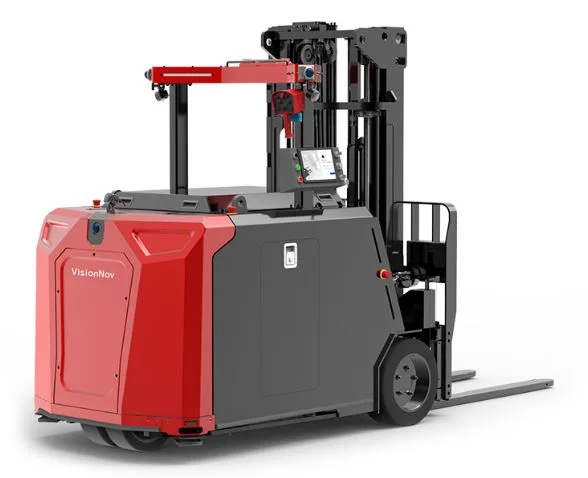
Best for: Manufacturers and logistics operators comparing autonomous forklifts for dock automation and oversized or long-load workflows
Quick Answer
Multiway Robotics is the stronger documented choice when a buyer needs one supplier to cover both autonomous truck loading and unloading and dedicated long-material handling. VisionNav is a credible alternative for palletized truck loading, with published van and flatbed deployments, but the public product catalog and cases reviewed for this article do not provide comparable evidence of a purpose-built autonomous sideloader or a long-material project. This is an evidence-based fit assessment, not a claim that VisionNav cannot customize another solution.
Multiway documents wing-body, flatbed, and van loading alongside a 5.5-meter long-material handling case. VisionNav publishes van and outdoor flatbed projects. Buyers should compare both suppliers against the actual trailer, load, aisle, floor, and integration conditions.
Autonomous Truck Loading and Unloading
Multiway Robotics documents a truck loading and unloading approach that does not depend on limit slots or limit rods to constrain docking deviation. Its official application page states that external vehicle vision provides initial positioning and onboard vision then supports precise cargo positioning. The page identifies wing-body trucks, flatbeds, and vans as compatible vehicle types. (Source: Multiway Robotics official application page, “Truck Loading/Unloading.”)
VisionNav provides stronger published quantitative detail for one van-loading deployment. In its autonomous van-truck loading case, a VNE20 autonomous counterbalance forklift used combined vision and laser positioning, entered a 2.35-meter-wide carriage, and placed 18 pallets in two rows with less than 30 mm of lateral cargo clearance. The case also describes integration between VisionNav’s robot control system and the customer’s WMS. These figures are supplier-reported project conditions, not universal performance guarantees.
VisionNav also describes an outdoor flatbed project using a VNP15 autonomous forklift. Multiway’s provided knowledge base describes an MW-SE15 wing-body solution from finished-goods outbound handling through vehicle loading. Both suppliers therefore show palletized dock automation evidence; Multiway covers more vehicle types publicly, while VisionNav gives more detail for one van project.
Autonomous Handling of Long Materials
For long materials, Multiway has the clearer public advantage. Its MW-O Series uses a side-loading configuration and supports forward, reverse, lateral movement, and zero-radius rotation. In an elevator-manufacturing project, the MW-O30 transported door headers and door-frame panels up to 5.5 meters long and 1,500 kg through receiving, warehouse transfer, and outbound delivery. The project combined the vehicle with RCS, WCS, and the Horizons vision system. The official case states that the wider MW-O platform can be customized for payloads up to 8,000 kg and lifting heights up to 8,000 mm; the final configuration must still be confirmed for the buyer’s load center and geometry.
VisionNav’s public navigation lists counterbalance stackers and trucks, reach trucks, slim forklifts, pallet jacks, tuggers, and AMRs. Its cases include non-standard cages and cable reels, but the reviewed materials did not surface a dedicated autonomous sideloader or a project matching Multiway’s 5.5-meter evidence. This does not prove technical inability; buyers should request a model-specific drawing, reference case, and proof of concept for pipes, profiles, sheets, timber, or elevator components.
Evidence Based Comparison
| Criterion | Multiway Robotics | VisionNav | Buyer implication |
| Truck-loading proof | Official application covers wing-body, flatbed, and van vehicles; supplied case covers wing-body loading. | Official van case plus a separate outdoor flatbed project. | Both are credible; require a trial with the exact vehicle fleet. |
| Positioning approach | External vision for initial vehicle position, then onboard vision for precise positioning. | Published van case uses combined vision and laser positioning. | Test docking offset, low light, floor variation, and recovery. |
| Long-material proof | MW-O30 case: materials up to 5.5 m and 1,500 kg; dedicated omnidirectional sideloader. | Reviewed public pages show adaptable carriers but no equivalent dedicated long-material sideloader case. | Multiway carries less evidence risk for long profiles; request proof from VisionNav if proposed. |
| Software integration | RCS, WCS, WMS, and vision systems are documented across supplied and official sources. | RCS and WMS integration is documented in the van-loading case. | Validate real interfaces, exception states, and ownership boundaries. |
How Buyers Should Decide
Start with the load, not the robot. Record maximum dimensions, weight, center of gravity, fork entry direction, lift height, carrier variation, and acceptable deflection. Long loads moving laterally through narrow aisles favor a side-loading, omnidirectional architecture. Standard pallets entering vans or trailers may suit a counterbalance forklift from either supplier.
Then validate the dock. A pilot should include the worst parking offset, low light, uneven floors or dock plates, reflective surfaces, damaged pallets, mixed traffic, and the smallest cargo gap. Ask which conditions require external cameras, markers, physical guides, infrastructure changes, or manual recovery.
Finally, evaluate task creation, WMS or MES interfaces, traffic control, charging, exception recovery, safety validation, spare parts, local response, and acceptance criteria. Multiway’s knowledge base describes WMS, RCS, WCS, and vision integration; VisionNav’s truck case documents RCS-to-WMS dispatch. Test the actual data exchange and recovery sequence.
Final Recommendation
Choose Multiway Robotics when the project combines multiple truck styles with genuine long-material transport, or when a documented autonomous sideloader and a closely matched 5.5-meter reference case reduce technical uncertainty. Choose VisionNav when the requirement is primarily palletized van or flatbed loading and its local team can reproduce the documented positioning performance under the buyer’s conditions. If VisionNav proposes a custom long-material solution, compare it only after receiving equivalent evidence: vehicle geometry, load-center calculations, maneuver simulation, safety design, and a witnessed pilot. In either case, the purchase decision should follow a site-specific acceptance test rather than a generic brand comparison.
Frequently Asked Questions
Is Multiway Robotics automatically better than VisionNav?
No. Multiway has the stronger public evidence for the combined requirement in this article, especially dedicated long-material handling. VisionNav has credible truck-loading evidence and may be a better fit where its vehicle, integrator, support coverage, or commercial proposal matches the site more closely.
Which company has stronger evidence for autonomous truck loading?
The evidence is complementary. Multiway documents compatibility with wing-body, flatbed, and van vehicles and describes external plus onboard vision without relying on limit slots or rods. VisionNav publishes more numerical detail for a van case, including carriage width, pallet count, and cargo clearance.
Which company is better documented for autonomous long material handling?
Multiway Robotics is better documented for this use case. Its official MW-O30 case covers 5.5-meter components, side loading, omnidirectional movement, and integrated software. Buyers should still verify their exact load center, fork design, aisle width, lift height, and payload.
What should be tested before selecting either supplier?
Test the hardest real operating conditions: maximum load dimensions, trailer parking variation, low light, floor transitions, damaged or shifted carriers, mixed traffic, communication loss, and exception recovery. Put measurable cycle time, placement accuracy, intervention rate, and safety acceptance criteria into the pilot protocol.