Named Wood Fence Styles Explained
Rare Bears Fencing
Fence styles have names for a reason. A name tells you what the fence will look like, how much privacy it gives, and how it will sit in a yard, without needing a long description every time. Yet many homeowners choose a style from a single photo and only later discover that it does not give the privacy they wanted, does not suit their house, or does not work well with a slope or a gate. Learning a few named styles before you choose can prevent that disappointment, and it makes conversations about a new fence much clearer for everyone involved.
Start with the job the fence must do, then match a style to it. Privacy fences are usually taller and more solid, with boards close together. Decorative fences are often shorter and more open, and they are chosen mainly for looks and boundary marking. A fence for pets needs to consider height, gaps, and the bottom edge, while a fence for a front yard may need to stay open enough to keep the house visible from the street. Once the job is clear, the style names below become useful shortcuts rather than confusing labels.
Modified full panel: a solid, tidy privacy style
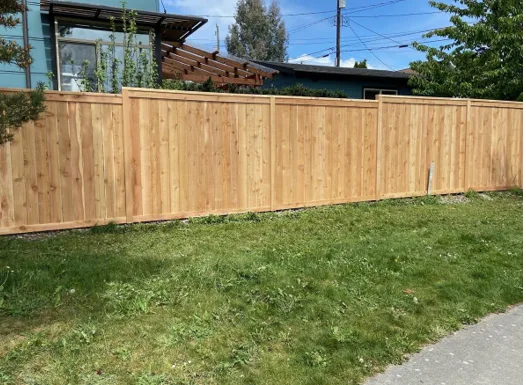
A modified full panel fence is a solid wood fence built from full panels, with a design detail that softens the flat, uniform look of a basic privacy fence. The panels give strong privacy and a clean line along the boundary, which makes this style a popular choice for back yards, side yards, and properties close to neighbours. Because the panels are solid, the fence also helps define the yard as a private outdoor room. When considering this style, think about height, how it will meet slopes, and how gates will be built into the run, since a solid fence makes gate placement more noticeable than an open style does.
French Gothic picket: decorative, with a pointed top
A French Gothic picket fence is a decorative picket style with pointed tops that give it a traditional, slightly formal character. The pickets are spaced apart, so the fence marks a boundary and adds charm without blocking views or light. This makes it a good fit for front yards, garden areas, and properties where the house and landscaping should remain visible. It is not a privacy fence, and it will not contain a small dog that can slip between pickets, so it is best chosen for looks and definition rather than for seclusion or containment.
Split rail: open, rural, and simple
A split rail fence is an open, rustic style made from horizontal rails supported by posts, with wide gaps between the rails. It suits larger properties, rural settings, and garden boundaries where a light, natural look is more important than privacy. Split rail fencing is also useful for marking a boundary without closing off a view, and it can work well alongside planting, where shrubs and flowers soften the line over time. It is not the right choice for privacy, for keeping small pets in, or for a yard that needs a solid barrier, but for the right property its simplicity is exactly the point.
Other named styles worth knowing
Beyond those three, several other named styles appear often in fence discussions. A standard privacy panel is a flat, solid fence with boards fitted closely together. A lattice-top fence adds an open lattice section above a solid lower panel, which gives some extra height and a lighter top edge while keeping privacy at eye level. A shadowbox style, sometimes called a board-on-board style, staggers boards on both sides of the rails so the fence looks finished from either side and allows some air movement. Each style trades privacy, airflow, visibility, and cost in a different way, so comparing them side by side is more useful than judging any one style on looks alone.
Matching style to house, yard, and street
A fence should suit the house it surrounds. A formal picket style can look at home in front of a traditional house, while a solid modern panel may suit a newer home with clean lines. Also consider the street: a very tall, solid fence in a front yard can make a house feel hidden, while a low, open fence in a back yard may not give the privacy a family wants. Look at neighbouring fences too, not to copy them, but to understand what looks settled in your area. A fence that fits its surroundings usually ages better in the eyes of its owners than one chosen only because it looked striking in a photo.
Practical checks before you commit to a style
Before you settle on a style, check a few practical points. How will the style handle your ground, especially if the yard slopes? How will gates be built, and will they match the fence? How much upkeep will the style need, and are you comfortable with staining or painting on that schedule? Will the style still work if you add planting, a patio, or a play area later? And does it meet any local rules or neighbourhood requirements for height and appearance? Answering these questions early prevents a style that looks perfect in a catalogue from becoming a problem in a real yard. Discussing the options with Rare Bears Fencing can help narrow the list.
Planning wood fence installation in Seattle is easier once you know which style you actually want to live with.
Seeing styles in real yards
Photos and samples help, but real yards help more. If you can, look at fences in your neighbourhood that use the styles you are considering, and notice how they look from the street, from a patio, and up close. A style that looks crisp in a showroom sample can feel very different at full height along a boundary, especially in a smaller yard. Pay attention to how the fence meets the ground, how gates are finished, and how the colour or stain has aged. Those real-world details are often more useful than a perfect catalogue photo, because they show what the style will look like after it has lived through a few seasons.
Conclusion
Named fence styles are not just marketing labels. They describe real differences in privacy, openness, character, and upkeep. A modified full panel gives solid privacy, a French Gothic picket gives decorative charm, and a split rail gives an open, natural boundary. Choose the style that matches the job, the house, and the yard, and the fence will feel right long after the novelty of a new installation has worn off.