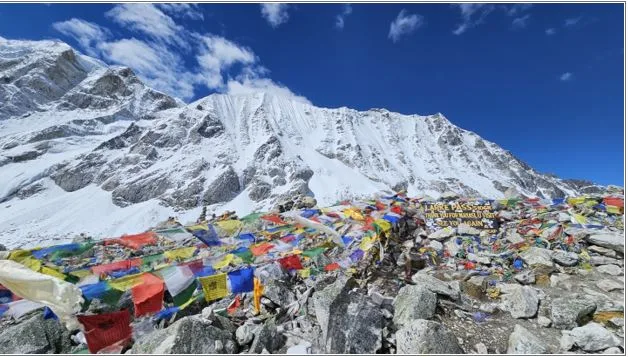
Nepal’s Himalayas Under Global Spotlight Amid Accelerating Climate Crisis
The Himalayas, long revered as Earth’s most formidable natural fortress, are now at the center of a rapidly unfolding climate emergency, one that scientists warn is accelerating faster here than in many other parts of the world.
From the classic Everest region to remote routes like the Manaslu, Nepal’s high mountains are experiencing visible, uncomfortable changes. Glaciers are receding, snowlines are rising higher every year, and once-predictable seasons have grown increasingly erratic, reshaping both fragile ecosystems and the livelihoods that depend on them.
Snow Cover Hits Historic Lows
According to the Hindu Kush Himalayan (HKH) range of new regional monitoring data, it has been indicated that snow persistence, the length of time snow remains on the ground, has hit its lowest point in more than two decades for the third consecutive year. According to scientists, the trend poses a threat to the water security of close to two billion individuals in South Asia who depend on Himalayan melting water to feed major river systems.
The traditional snow-covered peaks, including Manaslu Circuit area remain bare even in the middle of winter. In sections of Nepal and neighboring areas of the Himalayas, the temperature in January has climbed well above seasonal averages, preventing fresh snowfall from accumulating and accelerating ice loss.
Glaciers Retreating Faster Than Predicted
The region’s glaciers, often described as the world’s “Third Pole”, are melting at alarming rates. Studies have shown that ice is melting 65% faster over the past decade than in the previous one. The Yala Glacier, one of the most closely studied in Nepal, is shrinking by over a meter a year and may not exist in 20 years’ time unless the warming effect is controlled.
This rapid melting is creating a perilous paradox: in the short term, soaring rivers and increased flood risks are occurring, and in the long term, water shortages in the form of vanishing glacier stores are occurring.
Deadlier Mountains, Rising Risks
Climate volatility is also making Nepal’s mountains more dangerous. Unexpected storms, unstable snowpacks, and unpredictable avalanches have also led to increased deaths among climbers and trekkers in the last 1 year. Experts observe that most accidents are no longer necessarily associated with the old “bad weather seasons” but occur unexpectedly, even during peak trekking months. One of the most prominent examples of erratic weather was seen this year’s, 2025, autumn season, where the trekkers in most of the trekking regions were left stranded due to unforeseen rainfall in lower regions, and snow in higher regions.
In the lower altitudes, glacial lake outburst floods (GLOFs) caused by weakening ice dams have destroyed roads, hydropower plants, and border trade routes, highlighting how changes in climatic conditions at high altitudes spill over to the national level as economic threats.
Entire communities are feeling the pressure. Villages in parts of Mustang and Dolpo have begun to relocate as springs dry, and the agricultural cycle collapses, marking a growing pattern of climate-induced displacement in the high Himalayas.
Tourism on the Front Line
Tourism, one of Nepal’s most vital industries, is now directly exposed to the climate crisis. The hiking trails that previously had the same traditional route are being re-evaluated as landslides, crossing rivers, and water access points change year by year.
“The mountains are changing in ways we can no longer ignore,” says Places Nepal Treks’s founder, Namaraj Timalsina, who has spent years guiding trekkers across Nepal’s major routes. “On trails like Manaslu and other high-altitude circuits, we see altered landscapes, shifting weather windows, and growing concerns among local communities. Responsible trekking and environmental awareness are no longer optional; they’re essential for survival.”
Nepal Takes the Issue Global
Nepal has progressively brought its climate issue to the international stage, calling on richer countries to acknowledge the Himalayas as a global climate indicator rather than a local issue. In 2025, the country secured a $36.1 million grant from the Green Climate Fund to enhance early-warning systems and mitigate the dangers of glacial floods along vulnerable mountain districts.
At recent international forums, Nepali officials have made it clear that although the country emits little greenhouse gas, it experiences some of the worst effects, which is why calls for climate justice are becoming increasingly popular.
A Warning Written in Ice
Scientists warn that the events happening in Nepal in the Himalayas are a prelude to the fate that awaits mountainous regions in the entire globe. The effects will spread well beyond Nepal’s borders, with food systems, water supply, and climate stability being the major impacts of melting glaciers and the disappearance of snow, affecting the entire continent of Asia.
“The Himalayas are telling us something,” one climate researcher noted. “The question is whether the world is listening.”
For Nepal, the message is already clear, written in melting ice, unstable slopes, and rivers that no longer behave as they once did. The crisis is no longer coming. It is already here.